Chicken Katsu Curry
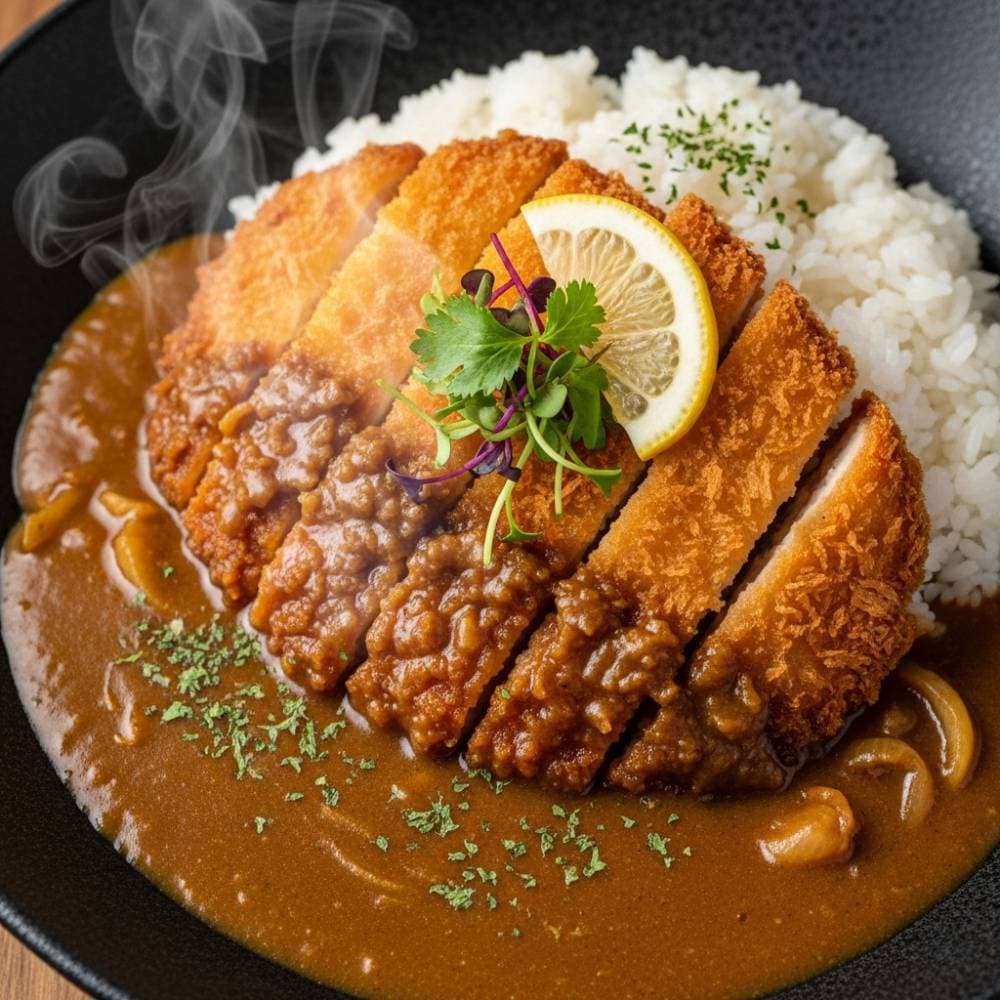
Crispy, golden-brown fried chicken cutlets (katsu) served over fluffy rice and smothered in a rich, savory Japanese curry sauce. A beloved and comforting meal for two.
About This Recipe
What is this dish?
Chicken katsu curry is Japan's most beloved comfort food — a dish that combines the crispy, breaded cutlet of katsu (Japanese for 'cutlet') with the mild, sweet Japanese-style curry sauce. Japanese curry is remarkably different from Indian or Thai curry — it is thick, mild, slightly sweet, and savory, with a gravy-like consistency that is deeply comforting. The combination of crispy katsu and smooth curry sauce over rice is often described as the 'perfect meal' in Japanese culture.
Why you'll love it
Chicken katsu curry hits every satisfying note simultaneously: the crunch of the panko-breaded cutlet, the warmth and sweetness of the Japanese curry sauce, and the comfort of steamed rice. It is universally approachable — even people who claim not to like curry typically love Japanese curry for its mild, almost ketchup-like sweetness. This is Japanese comfort food at its finest.
When to serve
Serve for a satisfying weeknight dinner, a family meal, or anytime you want maximum comfort food satisfaction. This dish is extremely popular with children due to the mild curry flavor. Also excellent as a lunch packed in a bento box.
Quick tips
Pound the chicken to even thickness for consistent cooking. Use panko breadcrumbs only — regular breadcrumbs produce a dramatically different, less crispy result. Maintain oil at 350°F for the crispiest katsu. Make the curry sauce first so it's warm when the katsu is ready.
Ingredient Highlights
Panko Breadcrumbs
Larger, flakier Japanese breadcrumbs that create a dramatically lighter, crispier, more shatteringly crunchy coating than regular breadcrumbs. Panko is made from bread baked without crusts and ground into irregular flakes rather than fine crumbs. Always use panko for katsu — the texture difference is profound.
Japanese Curry Roux
S&B Golden Curry or Vermont Curry blocks are the most convenient and authentic way to make Japanese curry sauce. These flavored fat-and-flour roux blocks dissolve in broth to create the characteristic thick, mild, slightly sweet curry sauce. Buy mild for beginners, medium for most adults, or hot for spice lovers.
Chicken Breast or Thigh
Breasts pounded thin are traditional for katsu — the thinness ensures the chicken cooks through before the panko burns. Chicken thighs require slightly longer cooking but stay juicier. Both work; thighs are more forgiving for home cooks. Always pound to even 1/2-inch thickness for the crispiest, most evenly cooked result.
Short-Grain Japanese Rice
The starchy, slightly sticky texture of Japanese short-grain rice (or medium-grain Calrose) is essential for katsu curry — the rice absorbs and holds the curry sauce better than long-grain varieties. The dish doesn't work as well with basmati or jasmine rice, which are too dry and separate.
Substitution Options
Replace chicken with pork cutlet for the original Japanese tonkatsu curry — pork loin pounded thin is the most traditional version. Use store-bought curry roux blocks (S&B or House brand) instead of making curry from scratch. Bake the breaded cutlet instead of frying (spray with oil, 425°F, 20-25 minutes) for a lower-fat version. Gluten-free panko breadcrumbs are available for celiac-friendly preparation.
Step-by-Step Instructions
Prepare chicken katsu
Pat the chicken breasts dry with paper towels. Slice each chicken breast horizontally to create two thinner cutlets, about 1/2-inch thick. Season both sides of each cutlet with 1/4 teaspoon salt and 1/8 teaspoon black pepper. Set up a breading station: Place 1/4 cup all-purpose flour on a shallow plate. In a second shallow plate, whisk 1 large egg. In a third shallow plate, place 1 cup panko breadcrumbs (flaky Japanese breadcrumbs). Dredge (coat thoroughly) each chicken cutlet in flour, shaking off extra. Then dip in whisked egg, letting excess drip. Finally, press into panko until fully coated. Place breaded cutlets on a wire rack.
Pro Tips:
- •Pounding chicken to an even thickness helps it cook uniformly.
- •Dredge means to coat thoroughly.
- •Panko breadcrumbs provide a crispier coating than standard breadcrumbs.
Make the Japanese curry sauce
Heat 1 tablespoon vegetable oil in a medium saucepan over medium heat. Add 1/2 thinly sliced yellow onion and 1 small thinly sliced carrot. Cook for 5-7 minutes until the onion is soft and translucent (you can see through it). Add 1 clove minced garlic and 1 inch grated fresh ginger. Cook for 1 minute until fragrant (smells pleasant and aromatic). Stir in 2 Japanese curry roux blocks (solid blocks of curry sauce concentrate). Pour in 1 1/2 cups hot water or chicken broth. Bring to a gentle simmer (cook gently just below boiling, with small bubbles), stirring occasionally, until the roux blocks are fully dissolved and the sauce has thickened. Simmer means to cook gently just below boiling, with small bubbles.
Pro Tips:
- •Translucent means you can see through it, indicating it is soft.
- •Fragrant means it smells good and aromatic.
- •Stirring helps the roux dissolve smoothly.
Fry chicken katsu
While the curry simmers, heat 2-3 cups vegetable oil in a large, heavy-bottomed pot or deep skillet over medium-high heat until it reaches 350°F (175°C). Carefully lower 1-2 breaded chicken cutlets into the hot oil (do not overcrowd). Fry for 4-6 minutes per side, or until golden brown and cooked through (internal temperature 165°F / 74°C). Remove from oil and place on a wire rack set over paper towels to drain any extra oil. Repeat with remaining cutlets. Katsu refers to the fried cutlet.
Pro Tips:
- •Maintain oil temperature for even browning and cooking.
- •A wire rack helps keep katsu crispy.
Serve
Slice the cooked chicken katsu into strips. Divide 2 cups cooked white rice between two plates. Place the sliced katsu next to the rice. Spoon a generous amount of the hot Japanese curry sauce over the katsu and rice. Garnish with 2 tablespoons thinly sliced green onions and 1 tablespoon pickled ginger. Serve immediately.
Pro Tips:
- •Serve immediately for best crispness of katsu.
- •Pickled ginger adds a tangy contrast.
Chef's Tips
Techniques that separate good from great
Use the standard breading technique — flour, egg, panko — and never skip the flour step
Flour is the adhesive that makes the egg stick to the chicken. Egg is the adhesive that makes the panko stick to the flour. Panko is the crust. Skip any step and the coating slides off during frying. Shake off excess flour before the egg, shake off excess egg before the panko, and press the panko firmly into the surface.
Maintain oil temperature between 340-360°F for the perfect katsu
Too hot (above 375°F) and the panko burns before the chicken cooks through — producing dark exterior, raw interior. Too cool (below 325°F) and the panko absorbs excessive oil and becomes soggy. Use a cooking thermometer or test with a piece of panko — it should sizzle immediately and float to the surface.
Pound the chicken to exactly 1/2-inch thickness between plastic wrap — don't over-pound
Even thickness ensures the chicken cooks at the same rate across its entire surface. Over-pounding creates tears and ragged edges that make the coating slide off and the chicken overcook in thin spots. Use the flat side of a meat mallet or the bottom of a heavy pan in smooth, even strokes.
Rest the katsu on a wire rack immediately after frying — never on paper towels
Paper towels trap steam underneath the katsu, softening the crust from below within minutes. A wire rack allows air to circulate around the entire cutlet, keeping the panko crispy on all sides. Rest for 2-3 minutes before slicing to allow the juices to redistribute.
Nutrition Facts
Per serving
* Percent Daily Values are based on a 2,000 calorie diet.
Equipment Needed
- Medium bowl (for egg)
- Shallow plates (for flour, panko)
- Large, heavy-bottomed pot or deep skillet (for frying)
- Wire rack
- Paper towels
- Medium saucepan (for curry sauce)
- Measuring cups
- Measuring spoons
- Knife and cutting board
- Tongs or slotted spoon
Quick Tips
- For a gluten-free version, use gluten-free all-purpose flour for dredging and gluten-free panko breadcrumbs. Ensure your Japanese curry roux blocks are also gluten-free, or make the curry sauce from scratch using gluten-free ingredients.
- You can add other vegetables like potatoes or apples to the curry sauce base for a more complex flavor, simmering them until tender before adding the roux blocks.
- Chicken katsu can also be baked or air-fried for a lighter option, but deep frying provides the most traditional crispness.
Recipe Variations
Different ways to make this dish your own
Tonkatsu Curry (Pork Cutlet)
Replace chicken with pork loin cutlets (the original version of katsu curry) for a slightly richer, more traditional Japanese curry experience. Pork loin cutlets pound thin easily and fry in the same time as chicken.
Katsu Sando (Katsu Sandwich)
Slice the fried katsu cutlet and layer on thick-cut Japanese milk bread (shokupan) spread with tonkatsu sauce and Japanese mayo, with shredded cabbage — one of Japan's most iconic sandwiches.
Vegetable Katsu Curry
Use eggplant, sweet potato, or tofu katsu instead of chicken. Slice eggplant 1/2-inch thick, bread and fry identically, serve with the same curry sauce. The eggplant version is particularly popular.
Katsu Don (Rice Bowl)
Simmer sliced fried katsu in a dashi-soy-mirin sauce, top with beaten egg, and serve over rice for a different Japanese classic. The egg sets into soft curds around the katsu for a completely different but equally satisfying preparation.
What to Serve With
Perfect pairings to complete the meal
Katsu Curry Plate (Classic)
Mound steamed Japanese rice on one side of the plate, ladle warm curry sauce over the rice and slightly onto the plate, then place sliced katsu on the plate's edge where curry meets plain rice. This arrangement lets diners control how much sauce they want on each piece.
With Shredded Cabbage and Japanese Mustard
Place a mound of finely shredded raw cabbage drizzled with ponzu or sesame dressing alongside the katsu curry. Raw cabbage is the traditional katsu accompaniment, providing freshness and crunch.
In a Bento Box
Pack sliced katsu, steamed rice, shredded cabbage, a small container of curry sauce (for dipping or pouring), and pickled vegetables for a complete Japanese bento.
With Japanese Pickles (Tsukemono)
Serve with a small side of pickled daikon (takuan) or pickled cucumber to add acidic brightness and crunch that contrasts with the rich curry sauce.
Storage & Make-Ahead
Keep it fresh and plan ahead
Refrigerator
Store the katsu and curry sauce separately in the refrigerator for up to 3 days. The katsu loses its crispiness quickly when stored with sauce — always keep them separate.
Freezer
Freeze fried but unsauced katsu cutlets between layers of parchment paper for up to 1 month. Reheat in the oven at 400°F for 12-15 minutes. The curry sauce freezes well for up to 2 months.
Make-Ahead
Make the curry sauce up to 3 days ahead. Fry the katsu fresh just before serving for the crispiest result. The breaded (unfried) cutlets can be refrigerated on a rack for up to 4 hours before frying.
Reheating
Reheat katsu in a 400°F oven for 8-10 minutes to restore crispiness. Avoid the microwave which makes the panko soft and steamy. Reheat curry sauce gently on the stovetop with a splash of water.
Got Leftovers?
Turn what you already have in your fridge into delicious meals. Our AI-powered generator creates personalized recipes from your ingredients.
Browse more like this: