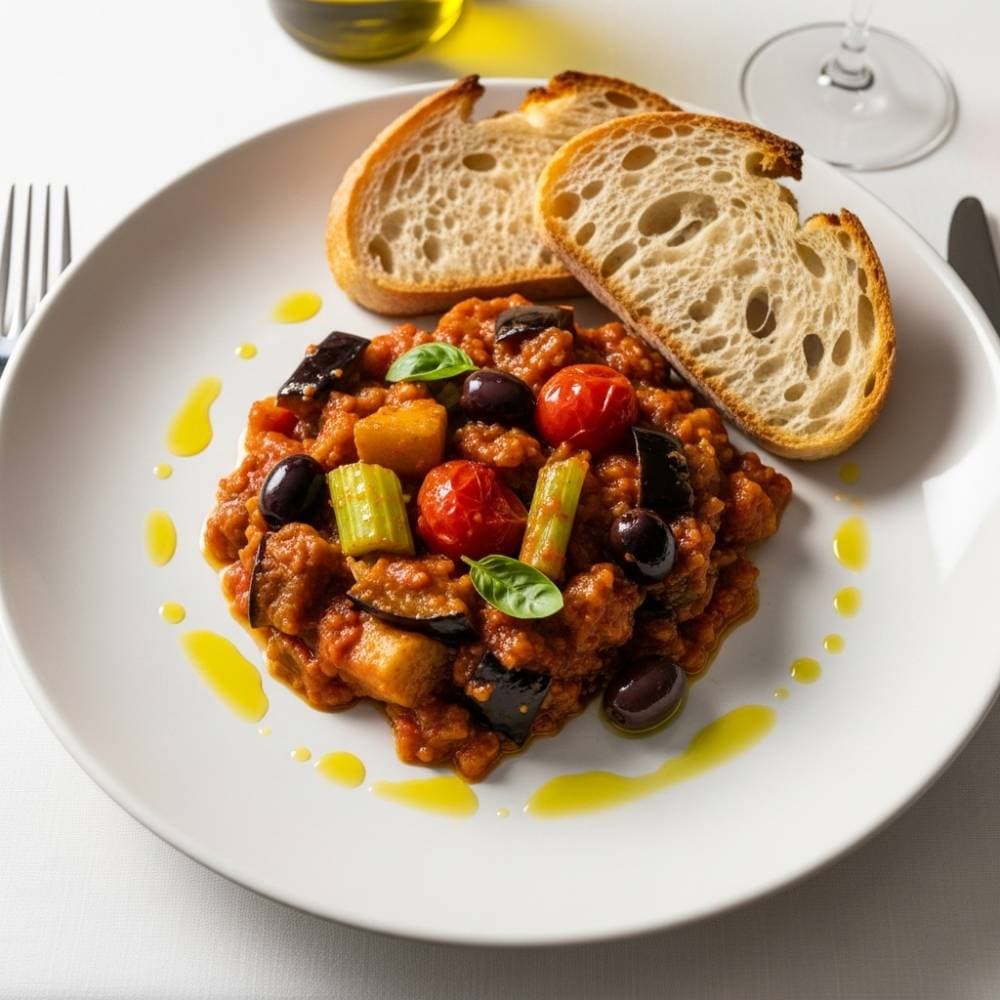
Sicilian Caponata with Crusty Bread
A sweet and sour Sicilian vegetable relish, featuring tender eggplant, bell peppers, celery, olives, and capers simmered in a rich tomato sauce. Served with crusty bread for a flavorful appetizer or light meal for two.
About This Recipe
What is this dish?
Sicilian caponata is a sweet-and-sour (agrodolce) vegetable relish from Sicily featuring eggplant as the star, cooked with celery, onion, tomatoes, olives, capers, and raisins in a vinegar-and-sugar sauce. The dish reflects Sicily's Arab culinary heritage in its use of agrodolce seasoning — a hallmark of Sicilian cooking that creates an extraordinary balance of sweet, sour, savory, and briny in a single dish.
Why you'll love it
Caponata is one of the most complex-tasting dishes achievable from entirely pantry-friendly ingredients. The agrodolce sauce creates a flavor that's simultaneously sweet, sour, savory, briny, and rich — impossible to describe fully but impossible to stop eating. It improves dramatically over 2-3 days as the flavors meld, making it an ideal make-ahead dish.
When to serve
Caponata shines as a starter or antipasto before a Sicilian or Italian meal, served at room temperature with crusty bread for spreading. It's also excellent as a condiment alongside grilled fish, chicken, or lamb, or as part of a vegetarian mezze spread. Make it a day ahead for best flavor.
Quick tips
Cook the eggplant separately first before adding to the sauce — don't skip this step. Balance the agrodolce carefully by tasting and adjusting vinegar and sugar before finishing. Let it rest at room temperature for at least 30 minutes before serving. Make it a day ahead for dramatically better flavor.
Ingredient Highlights
Eggplant
The centerpiece of caponata. Cubed and cooked until golden and tender before being added to the vinegar-tomato sauce. The eggplant absorbs the agrodolce sauce and becomes the main textural element. Frying gives the richest result; roasting is easier and healthier.
Red Wine Vinegar
The acid component of the agrodolce sauce. It provides the essential sharpness that defines caponata and distinguishes it from standard ratatouille. The amount should be adjusted to taste — you want a noticeable tang without overwhelming sourness.
Capers and Green Olives
The briny, salty elements that contrast with the sauce's sweetness. Capers add a peppery, fermented brine note while olives provide richness and savory depth. Both are quintessential Sicilian ingredients that cannot be substituted without fundamentally changing the dish's character.
Raisins and Pine Nuts
The unexpected but essential sweet elements that create the agrodolce effect. Raisins plump during cooking and add little pockets of sweetness throughout. Pine nuts add richness and crunch. These are the distinctly Sicilian elements that show the Arab influence on the island's cuisine.
Substitution Options
Replace raisins with finely chopped dried apricots or dried currants for a different sweet note. Capers packed in salt (rinsed thoroughly) deliver more intense flavor than brine-packed capers. Balsamic vinegar can partially substitute for red wine vinegar for a richer, sweeter acid note. Zucchini, fennel, or bell peppers can supplement or partially replace eggplant. Pine nuts can be replaced with toasted almonds or walnuts. For serving, crostini or bruschetta-style toasted slices work instead of plain crusty bread.
Step-by-Step Instructions
Cook eggplant and bell pepper
Heat 1 tablespoon olive oil in a large pot or Dutch oven over medium-high heat. Add the eggplant cubes and green bell pepper. Cook for 8-10 minutes, stirring often, until the vegetables are tender and lightly browned. Remove the cooked vegetables from the pot and set them aside.
Pro Tips:
- •Cooking the eggplant until tender ensures a good texture in the final dish.
- •Browning adds depth of flavor.
Sauté onion and celery
Add the remaining 1 tablespoon olive oil to the same pot. Add the chopped onion and finely chopped celery. Cook for 7-10 minutes, stirring occasionally, until the onion is soft and translucent (you can see through it). Add the minced garlic and cook for 1 minute until it smells pleasant (fragrant).
Pro Tips:
- •Translucent means you can see through it, indicating it is soft.
- •Fragrant means it smells good and aromatic.
Simmer the sauce
Stir in the 1 can crushed tomatoes, halved green olives, drained capers, pine nuts, and raisins. Add 2 tablespoons red wine vinegar and 1 tablespoon granulated sugar. Stir well. Bring the mixture to a gentle simmer (cook gently just below boiling, with small bubbles). Add 1/2 teaspoon salt and 1/4 teaspoon black pepper. Stir in the cooked eggplant and bell pepper. Cover the pot and simmer for 15-20 minutes, stirring occasionally, allowing the flavors to blend.
Pro Tips:
- •Simmer means to cook gently just below boiling, with small bubbles.
- •Allowing it to simmer slowly helps the flavors meld and the vegetables soften further.
Prepare crusty bread
While the caponata simmers, preheat your oven to 400°F (200°C) or use a toaster. Toast 4 slices of crusty bread or baguette until golden brown and crisp. This bread is for serving the caponata.
Pro Tips:
- •Toasting the bread prevents it from becoming soggy when topped with caponata.
- •A crisp bread provides a good texture contrast.
Finish and serve
Taste the caponata and adjust salt, pepper, sugar, or vinegar if needed to achieve your desired sweet and sour balance. Stir in 2 tablespoons fresh chopped basil. Serve the Sicilian caponata warm or at room temperature, alongside the toasted crusty bread. The bread makes the dish no longer gluten-free.
Pro Tips:
- •Caponata often tastes even better the next day as the flavors deepen.
- •Fresh basil adds a lovely aromatic finish.
Chef's Tips
Techniques that separate good from great
Cook the eggplant separately before adding to the sauce — never simmer it raw in the tomato
Eggplant simmered raw in tomato sauce becomes waterlogged and mushy, losing its texture entirely. Instead, fry or roast it separately until golden and slightly caramelized before adding to the sauce. This gives the eggplant a firmer, more satisfying texture and deeper flavor that holds up through the long cooking.
Balance the agrodolce carefully — taste and adjust before finishing
The sweet-sour balance of caponata is personal and varies by region. After adding the vinegar and sugar, let the sauce simmer for 5 minutes, then taste. It should be noticeably sweet AND noticeably sour without either overpowering. If too sour, add more sugar in small increments. If too sweet, add more vinegar. Getting this balance right is what makes caponata unforgettable.
Make it at least a day ahead — the flavor transforms overnight
Freshly made caponata is good; day-old caponata is extraordinary. Overnight in the refrigerator allows the acidic tomato-vinegar sauce to penetrate every piece of eggplant and olive and raisin, transforming separate components into one cohesive, deeply flavored relish. This is one of the dishes where patience is directly rewarded with dramatically better flavor.
Serve at room temperature — never cold from the refrigerator
Cold caponata is dull and flat-tasting. Cold mutes the volatile flavor compounds in the olive oil, vinegar, and herbs. Remove from the refrigerator at least 30-45 minutes before serving. At room temperature, the flavors bloom and the olive oil loosens to coat everything with its fruitiness. This simple step makes a dramatic difference.
Nutrition Facts
Per serving
* Percent Daily Values are based on a 2,000 calorie diet.
Equipment Needed
- Large pot or Dutch oven
- Spatula or wooden spoon
- Knife and cutting board
- Measuring cups
- Measuring spoons
- Baking sheet or toaster
Quick Tips
- For a spicier caponata, add a pinch of red pepper flakes with the garlic.
- The sweet and sour balance is key in caponata; adjust the sugar and vinegar to your preference.
- Caponata can be made ahead of time and stored in an airtight container in the refrigerator for up to 5 days. Its flavors tend to improve over time.
Recipe Variations
Different ways to make this dish your own
Caponata with Chocolate (Catanese Style)
A variation from Catania that adds a small square of dark chocolate (about 1/2 oz) in the last 5 minutes of cooking. The chocolate deepens the color and adds a barely perceptible bittersweet note that elevates the agrodolce to extraordinary complexity.
Caponata with Tuna
Add drained oil-packed tuna and a tablespoon of anchovy paste to the finished caponata for a more substantial, protein-rich version that works as a complete main course served over toasted bread.
Pasta alla Caponata
Toss warm caponata with al dente penne or rigatoni and a generous grating of ricotta salata for a quick, spectacular Sicilian pasta dish. The agrodolce sauce coats the pasta beautifully.
Caponata Bruschetta
Spoon finished caponata onto grilled ciabatta rubbed with garlic and drizzled with excellent olive oil for one of the best bruschetta variations possible — sweet, sour, savory, and deeply satisfying.
What to Serve With
Perfect pairings to complete the meal
As a Sicilian Antipasto with Crusty Bread
Serve a generous bowl of caponata at room temperature surrounded by thick slices of toasted or grilled ciabatta for spreading. Drizzle with excellent Sicilian olive oil just before serving. This is the most traditional and satisfying way to eat caponata.
Alongside Grilled Fish or Seafood
Caponata is the classic Sicilian accompaniment to grilled swordfish, tuna, or sea bass. The agrodolce sauce complements the richness of oily fish perfectly. Serve a generous spoonful alongside the fish on the same plate.
As Part of an Italian Antipasti Spread
Include caponata among a spread of Italian antipasti: marinated artichoke hearts, burrata, prosciutto, olives, and bruschetta. The caponata's complex flavors and different character make it a standout among simpler accompaniments.
Tossed Warm with Pasta
Gently heat leftover caponata in a pan, add just-drained pasta, and toss vigorously with a drizzle of olive oil and a handful of grated ricotta salata or Parmesan. This quick pasta preparation turns leftovers into a main course in under 15 minutes.
Storage & Make-Ahead
Keep it fresh and plan ahead
Refrigerator
Caponata actually improves significantly over 2-3 days in the refrigerator as the agrodolce sauce penetrates all the vegetables and the flavors fully meld. Store in an airtight container for up to 5-7 days.
Freezer
Caponata does not freeze well — the eggplant loses its texture upon freezing and becomes mushy when thawed. The vinegar-based sauce also changes character when frozen. Always make fresh and refrigerate rather than freeze.
Make-Ahead
This is an ideal make-ahead dish. The caponata is best made 1-2 days before serving. Cool completely before refrigerating. Remove from the refrigerator 30-45 minutes before serving to return it to room temperature.
Reheating
Caponata is traditionally served at room temperature and should not be reheated. If you prefer it warm, gently heat a portion in a small pan over low heat, stirring carefully to avoid breaking up the vegetables. A brief microwave on low power also works.
Got Leftovers?
Turn what you already have in your fridge into delicious meals. Our AI-powered generator creates personalized recipes from your ingredients.
Browse more like this: