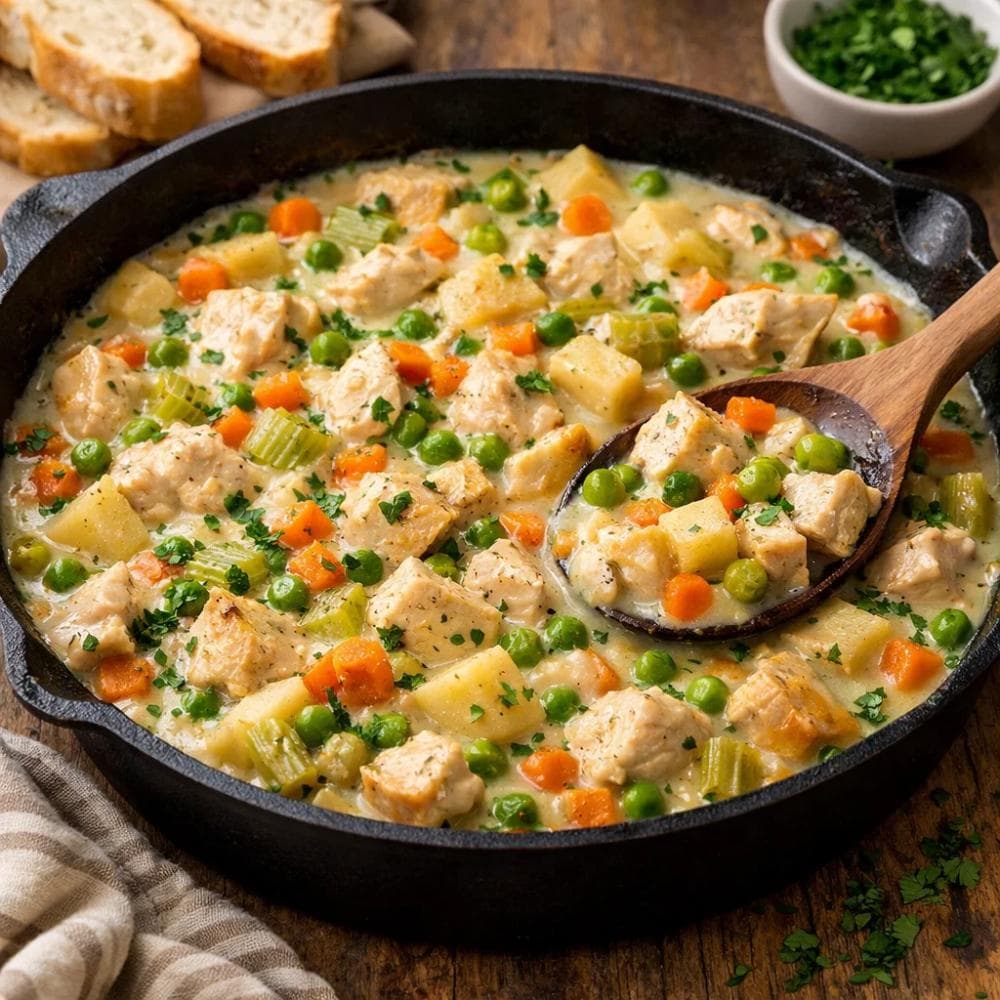
Chicken Pot Pie Skillet (Comfort Food Without the Crust)
All the creamy, vegetable-packed filling of a classic chicken pot pie made in one skillet in 30 minutes — no pastry, no fuss. Serve with crusty bread or biscuits for a complete comfort food dinner.
You'll likely need to buy
Likely in your pantry
Planning the week? Start with a free 7-day dinner plan
Seven tested weeknight dinners from our kitchen, with one combined shopping list. Free, and no sign-up needed to see it.
Step-by-Step Instructions
Sauté the vegetables
Melt the butter in a large, deep skillet or sauté pan over medium heat. Add the diced onion and cook for 3–4 minutes until softened and translucent. Add the garlic, carrots, and celery and cook for another 5 minutes, stirring occasionally, until the vegetables have softened slightly. Season with salt and pepper.
Chef's Tips
- ›Don't rush the onion — it should be soft and slightly translucent before adding the other vegetables.
- ›Cut carrots and celery into similar-sized pieces for even cooking.
Make the roux
Sprinkle the flour over the vegetables and stir to coat everything evenly. Cook for 1–2 minutes, stirring constantly, until the flour smells slightly nutty and no dry white patches remain. This cooks out the raw flour taste and forms the base for the creamy sauce.
Chef's Tips
- ›Cooking the flour for 1–2 minutes is important — raw flour gives the sauce a starchy, paste-like flavour.
- ›Stir constantly during this step to prevent the flour burning on the bottom.
Add stock and cream
Pour in the chicken stock gradually, stirring continuously to prevent lumps. Once all the stock is incorporated and smooth, stir in the double cream and Dijon mustard. Bring to a gentle simmer and cook for 5–7 minutes, stirring occasionally, until the sauce has thickened enough to coat the back of a spoon.
Chef's Tips
- ›Add the stock slowly at first and stir vigorously to incorporate the flour before adding more.
- ›The sauce should be thick enough to hold its shape on a spoon but still pourable.
Add chicken and peas
Stir in the shredded chicken, frozen peas, and thyme. Cook for 3–4 minutes until the chicken is heated through, the peas are tender, and the sauce is bubbling gently. Taste and adjust seasoning — the filling should be well-seasoned and creamy.
Chef's Tips
- ›Frozen peas go in at the end — they only need 2–3 minutes and overcooking makes them mushy.
- ›Taste at this stage and be generous with seasoning — the crust-less version needs assertive flavouring.
Finish and serve
Remove from heat and scatter fresh parsley over the top. Serve directly from the skillet with crusty bread, buttery biscuits, or puff pastry squares baked separately on the side for dipping.
Chef's Tips
- ›Serving from the skillet keeps it hot longer and creates a casual, communal feel.
- ›If the sauce thickens too much on standing, stir in a splash of chicken stock to loosen.
Made it? Rate it
One tap. It helps other cooks pick a dinner.
About This Recipe
What is this dish?
A chicken pot pie skillet is the filling of a classic chicken pot pie — creamy sauce, shredded chicken, carrots, peas, and celery — cooked entirely in one pan on the stovetop in 30 minutes, with no pastry to make or line. It delivers all the comfort of the original without the pastry work.
Why you'll love it
One pan, 30 minutes, and it tastes like a proper chicken pot pie filling. Using rotisserie chicken eliminates the need to cook raw meat. The Dijon mustard and thyme give the cream sauce a depth that most simple cream-based recipes lack. It reheats beautifully and improves overnight.
When to serve
A weeknight comfort food dinner for the whole family. Ideal for using up leftover roast chicken. Feeds 4 generously from one pan. Also a good make-ahead meal — the sauce thickens further in the fridge and tastes better the next day.
Quick tips
Use rotisserie chicken. Cook the flour for 2 minutes. Add stock gradually. Don't overcook the peas. Season assertively.
Ingredient Highlights
Rotisserie Chicken
The biggest shortcut in this recipe. Already cooked, seasoned, and easy to shred, it cuts preparation time substantially and contributes flavour from the roasting juices.
Dijon Mustard
A teaspoon of Dijon adds sharpness and depth to the cream sauce without a noticeable mustard flavour. It's the ingredient that stops the sauce tasting one-dimensional.
Double Cream
Creates the rich, velvety sauce that defines pot pie filling. Whole milk produces a lighter version. Crème fraîche adds a slight tang and is the best alternative.
Substitution Options
Replace chicken with turkey, leftover roast pork, or leave out the meat entirely for a vegetable pot pie filling (use vegetable stock). Swap double cream for crème fraîche or whole milk. Add button mushrooms with the carrots and celery for an earthier, more complex filling. Use cornflour instead of plain flour for gluten-free.
Chef's Tips
Techniques that separate good from great
Add a splash of white wine with the stock
Deglazing the pan with 100ml of dry white wine before adding the chicken stock adds acidity and depth that makes the filling taste more complex. Let the wine reduce by half before adding the stock — the alcohol cooks off and what remains is pure flavour.
Use crème fraîche instead of double cream
Crème fraîche has a slightly sour, tangy edge that cuts through the richness of the chicken and butter better than double cream. It also doesn't split as easily at high temperatures. Substitute 1:1 for the cream.
Top with puff pastry squares for a partial crust
For the pie experience without making a full crust, bake puff pastry squares on a separate tray at 200°C for 12–15 minutes until puffed and golden. Place on top of each portion when serving — they stay crispy and give the pot pie experience without any pastry-lining faff.
Nutrition Facts
Per serving · Estimated values
* Estimated per serving based on a 2,000 calorie diet.
Equipment Needed
- Large deep skillet or sauté pan (28cm+)
- Wooden spoon or silicone spatula
Quick Tips
- Use rotisserie chicken — it's already perfectly cooked and seasoned, and shreds easily. It's the biggest time-saver in this recipe.
- Cook the flour for a full 2 minutes before adding liquid — this removes the raw starch taste that makes cream sauces taste flat.
- The sauce should be thick before adding the chicken — it thins slightly once the chicken and peas are added.
Recipe Variations
Different ways to make this dish your own
Turkey Pot Pie Skillet
Replace chicken with shredded leftover turkey. Use the same quantities and method — an ideal way to use Christmas or Thanksgiving leftovers.
Vegetable Pot Pie Skillet
Omit the chicken and use vegetable stock. Add 200g of button mushrooms, 1 tin of drained butter beans, and a handful of spinach in the last 2 minutes. Just as hearty and completely vegetarian.
Pot Pie Skillet with Biscuits
Drop spoonfuls of simple scone dough on top of the simmering filling and cover the pan. Cook for 12–15 minutes on medium-low heat until the biscuits are cooked through. The dumplings steam on top of the filling.
Spicy Pot Pie Skillet
Add 1 teaspoon of smoked paprika and ½ teaspoon of cayenne to the vegetable sauté step. The heat cuts through the richness of the cream and makes a bolder, more complex filling.
What to Serve With
Perfect pairings to complete the meal
Crusty Bread
Thick slices of crusty bread or a baguette for scooping up the creamy filling — the simplest and most satisfying accompaniment.
Puff Pastry Squares
Bake store-bought puff pastry into rough squares or rounds at 200°C for 12 minutes. Place on top of each bowl of filling for the pot pie experience without the effort.
Mashed Potatoes
Serve the skillet filling over a generous mound of buttery mashed potatoes for an even more substantial, comfort-food plate.
Simple Green Salad
A lightly dressed green salad on the side provides freshness and acidity that cuts through the richness of the cream sauce.
Storage & Reheating
Keep it fresh and plan ahead
Refrigerator
Store in an airtight container for up to 3 days. The sauce thickens considerably in the fridge — add a splash of stock when reheating.
Freezer
Not recommended — cream-based sauces can split and become grainy after freezing and thawing.
Make-Ahead
The filling improves after a day in the fridge as the flavours deepen. Make it the night before and reheat gently for an even better result.
Reheating
Reheat in the skillet over medium-low heat with 3–4 tablespoons of chicken stock, stirring frequently. Do not boil vigorously — the sauce can split at high temperatures.
Cooking tonight?
Get a month of dinners like this — done for you
30 chef-tested dinners mapped to the month, plus 5 ready-to-shop grocery lists. One-time $8.99 — 30 dinners planned for you, zero nightly decisions.
See the 30-Day Plan →The Quick Answer
The classic failure is a sauce that is gluey and pasty rather than silky, caused by a roux cooked with cold stock dumped in all at once or by boiling it hard after the cream goes in. Add the stock gradually to a cooked roux and keep the finished sauce at a gentle simmer, because aggressive heat after the dairy and flour are combined turns smooth into stodgy and can split the cream.
Why is my pot pie skillet sauce gluey or pasty instead of silky?
The sauce thickens because the 3 tablespoons of flour gelatinise their starch in the butter, then swell as they absorb the chicken stock. Two missteps make it gluey. First, adding all 500ml of cold stock at once shocks the hot roux and the starch seizes into lumps that you then over-stir, which can make it pasty. Pour the stock in gradually, whisking, so each addition disperses before the next. Second, the ratio matters: 3 tablespoons of flour to 500ml stock plus 200ml cream is calibrated to coat-the-spoon consistency, and boiling it down too far concentrates the starch into glue. Hold a gentle simmer until it just coats a spoon, then stop - it firms further off the heat.
Why add cornflour as the gluten-free swap rather than just leaving the flour out?
You cannot simply omit the flour - it is the thickener, and without it you get chicken in thin broth, not pot pie filling. The recipe's plain flour relies on wheat starch reinforced by some gluten to build a stable, opaque sauce. Cornflour is pure starch with no gluten, so it thickens with about half the quantity and behaves differently: whisk it into a little cold stock to make a slurry and stir it in near the end rather than cooking it as a roux, because prolonged hard boiling actually breaks cornflour's thickening down and thins the sauce again. Done this way it gives a glossier, slightly more translucent finish, still rich once the 200ml of cream is folded through.
Not sure what to cook next? Let the generator pick your next dish in one click.
Random Recipe GeneratorGot Leftovers?
Turn what you already have in your fridge into delicious meals. Our AI-powered generator creates personalized recipes from your ingredients.
Go Deeper
Master the Culinary Science
Every recipe is a doorway. Our 7 Mastery Guides give you the science, technique, and framework to understand why food works — not just how to follow steps.
AI-Powered
Have Ingredients? Generate a Recipe.
Tell our AI what's in your fridge and get a custom recipe with image in seconds. No waste, no boredom.
Try the AI Recipe Generator →You Might Also Like
Discover more delicious recipes similar to what you're cooking