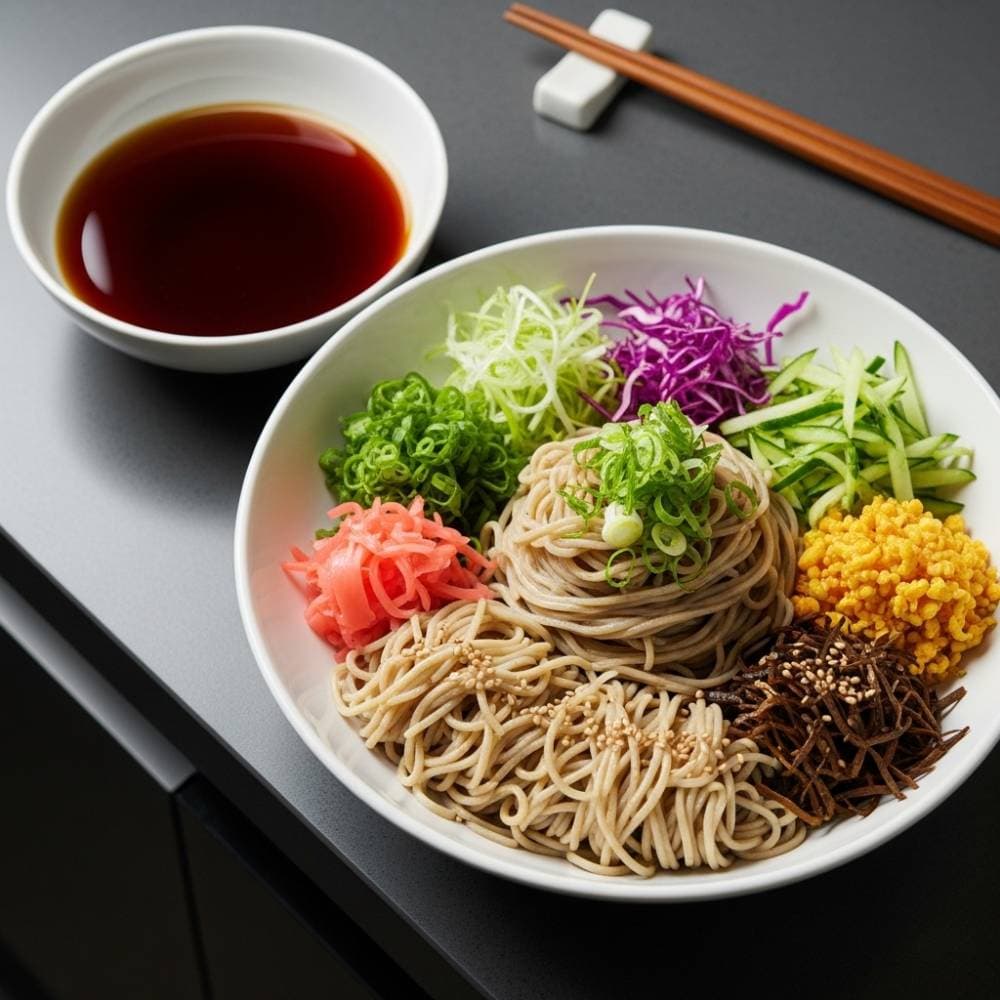
Cold Soba Noodle Bowl with Dipping Sauce
A refreshing and light Japanese-inspired noodle bowl featuring chilled buckwheat noodles (soba), crisp vegetables, and a savory dipping sauce. Perfect for a quick and healthy meal for two.
The Quick Answer
Cold soba lives or dies on two starch-and-temperature effects: buckwheat's gluten-free structure that leaches sticky starch, and the chilled tsuyu whose balance shifts with serving temperature. Both explain why the noodles must be shocked cold and the sauce served chilled rather than warm.
Why do my cold soba noodles turn brittle and fall apart?
Soba is made from buckwheat, which has no gluten, so unlike wheat noodles it has no stretchy protein network holding the strands together. The structure relies instead on gelatinized starch, which is fragile. Overcook the noodles even slightly past the three-to-five-minute window and the strands turn mushy and snap; under-rinse and they clump. The cold-water shock after draining does double duty: it halts cooking the instant they leave the boil and firms the buckwheat starch back up so each strand holds its shape. Handle the rinsed noodles gently and keep them cold, because warming softens that fragile starch structure and the strands break apart in the bowl.
Why does my soba dipping sauce taste flat or harsh when chilled?
Temperature changes how the tsuyu reads on the palate. Saltiness and the soy's sharp edge come across more aggressively when a liquid is warm and mellow when it is cold, so a sauce that tasted balanced hot can turn either flat or harsh once chilled for the bowl. Briefly simmering the mix first dissolves the sugar fully and cooks off the raw alcohol bite of the mirin, but the recipe then insists the tsuyu cool completely, because chilling rounds the soy and lets the dashi's glutamate umami come forward against the cold noodles. Skip the cool-down and the warm, alcohol-tinged sauce overwhelms the delicate buckwheat instead of complementing it.
Not sure what to cook next? Let the generator pick your next dish in one click.
Random Recipe GeneratorAbout This Recipe
What is this dish?
Cold soba noodle bowls (zaru soba) are one of Japan's most refreshing summer dishes — buckwheat noodles cooked, rinsed until ice-cold, and served on a bamboo mat or in a bowl alongside a chilled dipping sauce (mentsuyu) of dashi, soy, and mirin. It is an exercise in Japanese minimalism: a few quality ingredients prepared with precision to create something far more satisfying than the sum of its parts.
Why you'll love it
Cold soba represents the Japanese philosophy of letting good ingredients speak for themselves. The buckwheat noodles have an earthy, nutty, slightly mineral flavor that stands apart from wheat noodles. The mentsuyu dipping sauce is intensely savory, sweet, and umami-rich — just a small amount flavors each mouthful dramatically. The dish is light yet deeply satisfying and takes less than 20 minutes to make.
When to serve
Serve in summer as a refreshing lunch or dinner, or year-round as a light meal. Cold soba is traditionally eaten for Toshikoshi Soba (New Year's Eve) in Japan, symbolizing cutting ties with the difficulties of the past year due to the ease of cutting soba noodles.
Quick tips
Rinse and rub the cooked soba aggressively under cold running water — this removes surface starch and prevents clumping. Serve the dipping sauce in individual small cups. Dip a small amount of noodles at a time — don't drown them in sauce. Slurping is encouraged in Japan.
Ingredient Highlights
Soba Noodles
Dried buckwheat noodles with an earthy, nutty flavor that is completely distinct from wheat noodles. Quality matters here — 100% buckwheat (juwari) soba has the purest flavor and is gluten-free, but is fragile and difficult to cook. Blended soba (20-40% buckwheat) is more forgiving and widely available. Fresh soba from Japanese grocers is exceptional if available.
Dashi (Japanese Stock)
The foundation of Japanese cuisine — a light, deeply umami-flavored stock made from kombu (kelp) and katsuobushi (dried bonito flakes). Instant dashi (dashi powder or dashi packs) is convenient and excellent for home cooking. Without dashi, the mentsuyu sauce lacks the subtle oceanic depth that makes it distinctively Japanese.
Mirin
Japanese sweet rice wine with a golden color and complex sweetness that is completely different from sugar. It adds depth, shine, and a subtle fermented sweetness to the mentsuyu sauce. Always use hon-mirin (real mirin) — 'mirin-style seasoning' is a inferior product with added sugar and chemicals.
Nori (Dried Seaweed)
Thinly sliced nori strips or crumbled nori are the classic garnish for cold soba. The iodine-rich, umami-dense seaweed adds a subtle sea flavor and textural contrast. Toasted nori has the best flavor — pre-toasted sheets are widely available.
Substitution Options
Bottled mentsuyu (tsuyu) sold at Japanese grocery stores is an excellent time-saving substitute for homemade dipping sauce — dilute according to package directions. For vegetarian/vegan, use kombu-only dashi and omit the bonito flakes (kombu dashi is umami-rich on its own). Soba can be replaced with udon, though the flavor profile changes completely. Add cold cooked shrimp, poached chicken, or sliced tofu to make the dish more substantial.
You'll likely need to buy
Likely in your pantry
Step-by-Step Instructions
Make the dipping sauce
In a small saucepan, combine 1/2 cup water or dashi (Japanese broth, use vegetable broth for vegan), 1/4 cup soy sauce (use tamari for gluten-free), 2 tablespoons mirin (sweet Japanese cooking wine), 1 tablespoon rice vinegar, 1 teaspoon granulated sugar, and 1/2 teaspoon grated fresh ginger. Bring the mixture to a gentle simmer (cook gently just below boiling, with small bubbles) over medium heat, stirring until the sugar dissolves. Cook for 2-3 minutes, allowing the flavors to blend. Remove from heat and let the sauce cool completely. You can chill it in the refrigerator for faster cooling. Simmer means to cook gently just below boiling, with small bubbles. Mirin is a sweet Japanese cooking wine.
Chef's Tips
- ›Making the sauce ahead of time allows the flavors to deepen.
- ›Ensure the sauce is cold before serving with cold noodles.
Cook and chill the soba noodles
Bring a large pot of water to a rolling boil. Add 6 ounces 100% buckwheat soba noodles (thin, brown Japanese noodles made from buckwheat flour). Cook according to package directions, usually 3-5 minutes, until they are al dente (tender but still firm to the bite). Drain the noodles immediately and rinse them very thoroughly under cold running water until they are completely cool. This removes excess starch and stops cooking. Drain again very well. Al dente means cooked so that it is still firm when bitten. Soba noodles are thin, brown Japanese noodles made from buckwheat flour.
Chef's Tips
- ›Rinsing thoroughly is crucial for cold soba noodles to prevent stickiness.
- ›Do not overcook soba noodles, as they can become mushy.
Prepare toppings
Thinly slice or julienne 1/2 English cucumber and 1 medium carrot. Thinly slice 3-4 radishes and 2 green onions. Julienne means to cut into long, thin strips.
Chef's Tips
- ›Preparing vegetables uniformly makes for an appealing presentation.
- ›Fresh vegetables add crunch and color.
Assemble and serve
Divide the chilled soba noodles evenly between two serving bowls. Arrange the prepared cucumber, carrot, radishes, and green onions over the noodles. Sprinkle with 1 teaspoon toasted sesame seeds. Pour the chilled dipping sauce into two small individual bowls for dipping. Serve the cold soba noodle bowls immediately with the dipping sauce.
Chef's Tips
- ›You can serve the sauce directly over the noodles if preferred, but traditional Japanese style is to dip.
- ›This dish is best served immediately for optimal freshness.
Chef's Tips
Techniques that separate good from great
Rinse and rub soba noodles aggressively under cold running water until the water runs clear
Soba noodles release significant surface starch during cooking that makes them stick together and creates an unpleasant, gluey texture if not removed. After draining, rinse under cold running water while rubbing the noodles between your hands for 30-60 seconds. The water should run clear. This step is non-negotiable for properly textured cold soba.
Cook soba noodles for exactly the time on the package — they overcook rapidly
Soba noodles have a narrow window between undercooked and overcooked. Follow the package timing precisely and taste-test 30 seconds before the stated time. They should be tender but still have a very slight firmness at the center. Overcooked soba becomes mushy and loses its signature nutty flavor.
Dip only small amounts of noodles at a time — don't pile them all in the sauce
Take a small bundle of noodles with chopsticks, dip the bottom half into the sauce, and eat immediately. If you dump all the noodles into the sauce, they absorb too much (becoming salty) and lose their clean, fresh buckwheat flavor. The contrast between lightly sauced noodles and the intense sauce is the experience.
Finish with soba-yu — the hot soba cooking water poured into the leftover sauce
In Japan, the starchy water left from cooking soba (soba-yu) is served alongside in a small pitcher. At the end of the meal, pour it into your leftover dipping sauce and drink the warm, mild broth. This is considered an important part of the zaru soba experience and wastes nothing.
Nutrition Facts
Per serving · Estimated values
* Estimated per serving based on a 2,000 calorie diet.
Equipment Needed
- Small saucepan (for sauce)
- Large pot (for noodles)
- Small bowls (for dipping sauce)
- Serving bowls
- Whisk
- Knife and cutting board
- Measuring cups
- Measuring spoons
As an Amazon Associate we earn from qualifying purchases — at no extra cost to you.
Quick Tips
- For a spicier dipping sauce, add a tiny bit of red pepper flakes or a touch of wasabi.
- You can add other toppings like shredded nori (seaweed), a hard-boiled egg, or grilled tofu for extra protein.
- Ensure your soba noodles are 100% buckwheat for a gluten-free dish, as many brands mix with wheat flour.
Recipe Variations
Different ways to make this dish your own
Zaru Soba (Bamboo Mat Presentation)
Serve the rinsed cold soba on a traditional zaru (bamboo draining basket) for the classic elegant Japanese presentation. The bamboo allows any excess water to drip away and keeps the noodles from sitting in puddles.
Tenzaru Soba (With Tempura)
Serve cold soba alongside freshly made shrimp or vegetable tempura with the same mentsuyu sauce for dipping both noodles and tempura. One of the most satisfying Japanese combination dishes.
Soba Salad (Fusion Style)
Toss cold soba with shredded cucumber, edamame, shredded nori, sesame seeds, and a sesame-ginger dressing for a Japanese-inspired salad format. Serve cold without a dipping sauce.
Oroshi Soba (With Daikon)
Place a mound of freshly grated daikon radish (oroshi) in the dipping sauce or alongside the noodles. The fresh daikon adds digestive enzymes and a clean, slightly spicy radish note that contrasts the earthy buckwheat.
What to Serve With
Perfect pairings to complete the meal
Traditional Zaru Presentation with Individual Cups
Serve the chilled soba on a bamboo mat or in individual bowls with the mentsuyu dipping sauce in separate small cups. Arrange wasabi, sliced scallions, and nori strips in small dishes for each person to add to their sauce.
As a Light Summer Lunch
Cold soba is perfect as a light, satisfying summer lunch. Pair with a small Japanese salad (wakame seaweed, cucumber, sesame dressing) and chilled green tea or mugicha (barley tea) for a refreshing complete meal.
With Tempura Alongside
Serve fresh shrimp or vegetable tempura alongside the cold soba — the contrast of crispy hot tempura and cold chewy noodles is one of Japanese cuisine's great combinations. Use the same dipping sauce for both.
As Part of a Japanese Multi-Course Meal
Serve cold soba as a noodle course alongside chilled tofu (hiyayakko), edamame, and pickled vegetables for a traditional izakaya-style spread.
Storage & Reheating
Keep it fresh and plan ahead
Refrigerator
Cooked and rinsed soba can be refrigerated for up to 2 days, tossed with a tiny drizzle of sesame oil to prevent sticking. Mentsuyu keeps refrigerated for up to 1 week.
Make-Ahead
Make the mentsuyu dipping sauce up to 5 days ahead and refrigerate. Cook and rinse soba up to 4 hours before serving and refrigerate. Assemble just before serving.
Reheating
Cold soba is meant to be served cold — no reheating is necessary or appropriate. If the noodles have clumped in the refrigerator, briefly dip them in boiling water for 15 seconds and re-rinse with cold water.
Cooking tonight?
Get a month of dinners like this — done for you
30 chef-tested dinners mapped to the month, plus 5 ready-to-shop grocery lists. One-time $8.99 — 30 dinners planned for you, zero nightly decisions.
See the 30-Day Plan →Got Leftovers?
Turn what you already have in your fridge into delicious meals. Our AI-powered generator creates personalized recipes from your ingredients.
Go Deeper
Master the Culinary Science
Every recipe is a doorway. Our 7 Mastery Guides give you the science, technique, and framework to understand why food works — not just how to follow steps.
AI-Powered
Have Ingredients? Generate a Recipe.
Tell our AI what's in your fridge and get a custom recipe with image in seconds. No waste, no boredom.
Try the AI Recipe Generator →You Might Also Like
Discover more delicious recipes similar to what you're cooking