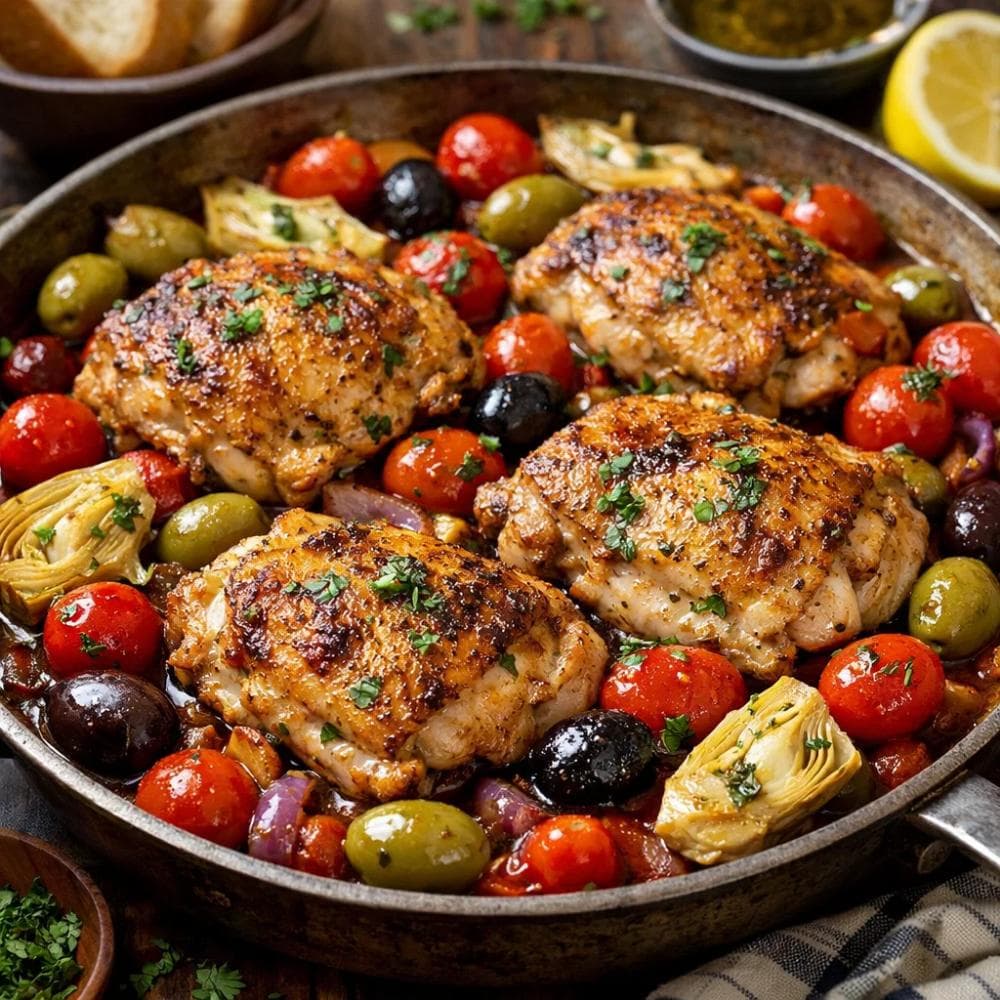
Mediterranean Chicken with Tomatoes and Olives
A fragrant, sun-soaked one-pan chicken dish braised with ripe tomatoes, Kalamata olives, capers, garlic, and white wine — the core flavours of Mediterranean cooking in a single skillet. Bone-in chicken thighs cook slowly in the sauce until tender and infused with the sweet, briny, herby richness of the surrounding ingredients. Deeply flavourful, vibrantly coloured, and requiring very little hands-on effort, this is a dish that improves with time and fills the kitchen with the most wonderful smell.
The Quick Answer
The usual disappointment with this braise is soggy chicken skin that you worked hard to crisp, caused by submerging the thighs in the sauce. Keep the rendered skin proud of the liquid and uncovered for the final stretch so it stays crackly while the meat below braises to tenderness.
Why does my braised chicken skin go soft and rubbery?
Crispness is the absence of water. When you sear the thighs skin-side down for 7-8 minutes you render the subcutaneous fat and dehydrate the skin into a crackly layer. Drop that skin into the tomato sauce and it rehydrates, the crisp structure collapses, and the proteins turn to a flabby gel. That is why the thighs go back skin-side up, nestled so the skin rides above the simmer line, and the lid comes off for the last 10 minutes. The exposed skin sits in the dry oven-like air of the pan and re-crisps while the braising liquid keeps the meat moist underneath.
Why is my olive and caper sauce too salty?
Kalamata olives and capers are both preserved in brine, so they carry a heavy salt load that leaches into the sauce as it simmers. Season the tomatoes conservatively before tasting, because the olives, capers, and reduced wine will concentrate further as the liquid cooks down over 30 minutes. If it does turn out sharp and salty, do not add water, which flattens flavour; instead stretch it with extra cherry tomatoes whose natural sugars and acidity rebalance the dish, or serve it over plain orzo or bread that absorbs and dilutes the saltiness on the plate.
Not sure what to cook next? Let the generator pick your next dish in one click.
Random Recipe GeneratorAbout This Recipe
What is this dish?
Mediterranean braised chicken with tomatoes and olives is one of the great one-pan dishes of European home cooking — a style of dish found across Italy, Greece, Spain, France, and North Africa with only minor regional variations. The technique is the same everywhere: sear the chicken, cook the aromatics, deglaze with wine, add tomatoes and preserved vegetables, and braise slowly until everything is tender and the sauce is deeply flavoured. The olives and capers provide the characteristic briny, savoury backbone of the Mediterranean pantry.
Why you'll love it
It smells extraordinary while it cooks. It requires very little active effort. It is complete in one pan. The combination of tender, falling-off-the-bone chicken, sweet tomatoes, briny olives, and herby aromatics is one of the most universally satisfying flavour profiles in cooking. It is equally good fresh and reheated the next day.
When to serve
A relaxed dinner party main, a weekend family dinner, or a make-ahead weeknight meal. Serves 4.
Quick tips
Deep golden sear on the skin. Deglaze well. Skin above the sauce line. Remove lid for final 10 minutes. Generous herbs at the end.
Ingredient Highlights
Kalamata Olives
The characteristic flavour anchor of this dish — deeply savoury, slightly bitter, and with a rich, fruity quality that is entirely unlike the bland, mild olives used in cooking. Kalamata olives are semi-dried and packed in brine or oil, which concentrates their flavour. They should not be confused with cheaper, watery tinned olives. Their brininess seasons the sauce as they cook, reducing the need for added salt.
Capers
Small, pickled flower buds with an intensely savoury, pungent flavour that acts as a seasoning agent and a flavour accent in the sauce. Capers are one of the defining ingredients of Mediterranean cooking and provide the sharp, fermented edge that prevents the sweet tomato sauce from being cloying. Salt-packed capers (rinsed before use) have a more complex flavour than brine-packed, but either works.
Tinned and Fresh Tomatoes Together
Using both tinned chopped tomatoes and fresh cherry tomatoes produces a sauce with two distinct tomato characters: the concentrated, deeply flavoured base of the tinned tomatoes and the fresh, slightly acidic, jammy pockets of the roasted cherry tomatoes. Together, they produce a sauce with more complexity and textural interest than either alone.
Substitution Options
Use bone-in chicken breasts for a leaner version (reduce braising time by 10 minutes). Replace white wine with chicken or vegetable stock. Swap Kalamata olives for green Castelvetrano olives. Add a preserved lemon for North African character. Replace capers with anchovies for a different savoury depth. Use fresh rosemary instead of oregano.
You'll likely need to buy
Likely in your pantry
Step-by-Step Instructions
Sear the chicken
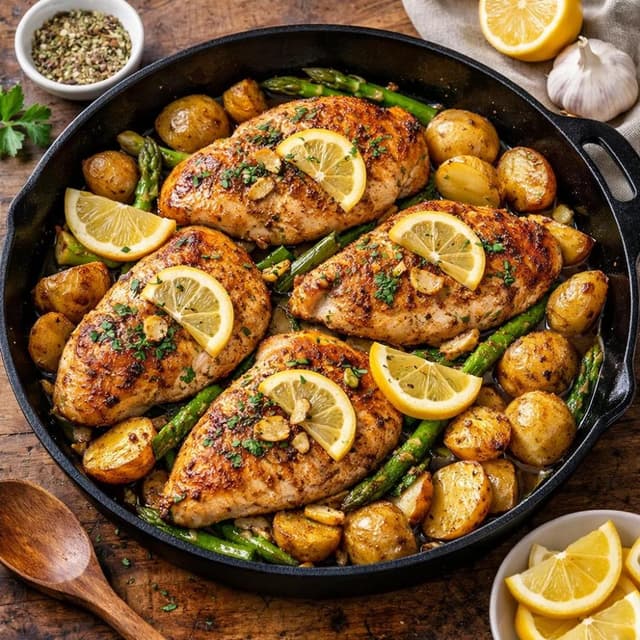
Pat the chicken thighs completely dry with kitchen paper and season generously on both sides with salt and pepper. Heat the olive oil in a large, wide sauté pan or deep frying pan over medium-high heat. Place the thighs skin-side down and cook undisturbed for 7–8 minutes until the skin is deeply golden and crispy. Flip and cook for 3 minutes on the other side. Remove to a plate — the chicken will finish cooking in the sauce.
Chef's Tips
- ›Deeply golden chicken skin is worth every minute of patience — it adds colour, flavour, and textural contrast to the finished dish
- ›The fat rendered from the skin will provide the oil for cooking the vegetables — pour off most of it, leaving about 1 tablespoon in the pan
Build the sauce base
In the same pan with the residual fat, reduce the heat to medium. Add the sliced onion and cook for 5–7 minutes until softened and starting to colour. Add the garlic and cook for 1–2 minutes until fragrant. Pour in the white wine and let it bubble vigorously for 2 minutes, scraping up the browned bits from the base of the pan. The wine will reduce by about half.
Chef's Tips
- ›The deglazing step — scraping up the browned fond from the pan — is where a large part of the flavour of the dish comes from
- ›The onion should be genuinely softened and starting to colour before the garlic goes in — raw onion produces a sharp, unpleasant flavour
Add the tomatoes and braise
Add the tinned tomatoes, cherry tomatoes, olives, capers, dried oregano, and chilli flakes. Stir to combine and bring to a simmer. Taste the sauce and season with salt and pepper — remember the olives and capers are already salty, so season conservatively. Return the chicken thighs to the pan, skin-side up, nestling them into the sauce. The skin should be above the sauce level to stay crispy. Reduce the heat to a gentle simmer, cover with a lid slightly ajar, and cook for 30 minutes.
Chef's Tips
- ›Keeping the skin above the sauce level is important for texture — submerged skin becomes soft and unpleasant
- ›A lid slightly ajar allows some steam to escape and the sauce to reduce and concentrate — a fully covered pan produces a thinner, less flavourful sauce
Finish and serve
Remove the lid for the final 10 minutes of cooking to allow the sauce to thicken further and the skin to crisp up again slightly. Check the chicken is cooked through — the juices should run clear when the thickest part is pierced, or an internal temperature of 74°C (165°F). Scatter generously with torn fresh basil or roughly chopped parsley. Serve directly from the pan with crusty bread to mop up the sauce, or spoon over cooked orzo.
Chef's Tips
- ›The uncovered final 10 minutes are important for concentrating the sauce — do not skip this step
- ›Fresh herbs added at the very end retain their brightness and provide a vivid contrast to the deeply cooked sauce
Chef's Tips
Techniques that separate good from great
Add a preserved lemon
A quarter of a preserved lemon, rinsed, with the pulp removed and the skin finely sliced, added with the olives and capers, adds an intensely salty, citrusy, floral dimension that is distinctly North African and completely addictive. Preserved lemons are the single best optional addition to Mediterranean chicken — they transform the sauce from good to extraordinary.
Use good quality olives
The quality of the olives matters here — they are not just a garnish but a primary flavour component. Good Kalamata olives (not the cheap, pitted, brine-packed ones from a tin) have a richer, more complex flavour with a slight fruity bitterness that works beautifully in the sauce. Green olives such as Castelvetrano are a milder, buttery alternative that is equally good.
Finish in the oven
After returning the chicken to the sauce, transferring the entire pan to a 180°C oven (uncovered) rather than finishing on the stovetop produces more even heat distribution, better caramelisation on the skin, and a more relaxed cooking environment that requires no attention. The oven version is slightly more hands-off and produces a more restaurant-like result.
Nutrition Facts
Per serving · Estimated values
* Estimated per serving based on a 2,000 calorie diet.
Equipment Needed
As an Amazon Associate we earn from qualifying purchases — at no extra cost to you.
Quick Tips
- Sear the chicken until deeply golden before braising — pale seared chicken produces a paler, less flavourful sauce
- Keep the chicken skin above the sauce level throughout braising — submerged skin becomes soft
- Remove the lid for the final 10 minutes to reduce and concentrate the sauce
Recipe Variations
Different ways to make this dish your own
Greek-Style with Feta
Add 150g of crumbled feta over the top of the finished dish and return to a 200°C oven for 5 minutes until the feta is warm and just starting to melt at the edges. Finish with fresh oregano and a drizzle of olive oil. A more substantial, more Greek-inflected variation.
Provençal Chicken
Add a tablespoon of herbes de Provence, a handful of niçoise olives, and replace half the tinned tomatoes with a glass of dry rosé wine. A distinctly French Riviera variation with a more herbaceous, floral character.
Chicken Cacciatore
Add 200g of sliced mushrooms with the onions and replace the olives and capers with a tablespoon of tomato paste. Use red wine instead of white. A classic Italian 'hunter's chicken' — more robust, earthier, and deeply savoury.
Spiced North African Version
Add 1 teaspoon of cumin, ½ teaspoon of coriander, and a pinch of cinnamon to the sauce, along with a quarter of a preserved lemon and a handful of green olives. Serve over couscous with a handful of toasted almonds and fresh coriander.
What to Serve With
Perfect pairings to complete the meal
Crusty White Bread
A thick slice of crusty white bread to mop up the tomato-olive sauce is the most essential accompaniment. The sauce is the best part of this dish and needs something to carry it.
Orzo
The pasta-like rice-shaped orzo tossed in olive oil and stirred through the pan sauce is an excellent, more substantial serving option — it absorbs the sauce beautifully and makes the dish feel more complete.
Roasted Potatoes
Golden roasted potatoes alongside provide a starchy, textural contrast that is very satisfying. The potatoes can be roasted in the oven while the chicken braises on the stovetop, making this an efficient combination.
Green Salad
A simple salad of rocket, cucumber, and red onion dressed with lemon and olive oil provides freshness and a bitter counterpoint to the richness of the braised chicken and sauce.
Storage & Reheating
Keep it fresh and plan ahead
Refrigerator
Keeps well in the fridge for up to 4 days and genuinely improves overnight as the flavours deepen. An excellent make-ahead dinner.
Freezer
Freezes well for up to 3 months. Defrost overnight in the fridge and reheat gently on the stovetop with a splash of stock if needed.
Make-Ahead
Best made a day ahead and refrigerated — the flavours develop significantly overnight. Reheat gently and add fresh herbs just before serving.
Reheating
Reheat gently in a covered pan over medium-low heat with a splash of stock or water. The chicken reheats well and the sauce becomes even more concentrated. Do not overheat or the chicken will dry out.
Cooking tonight?
Get a month of dinners like this — done for you
30 chef-tested dinners mapped to the month, plus 5 ready-to-shop grocery lists. One-time $8.99 — 30 dinners planned for you, zero nightly decisions.
See the 30-Day Plan →Be the first to review this recipe!
Got Leftovers?
Turn what you already have in your fridge into delicious meals. Our AI-powered generator creates personalized recipes from your ingredients.
Go Deeper
Master the Culinary Science
Every recipe is a doorway. Our 7 Mastery Guides give you the science, technique, and framework to understand why food works — not just how to follow steps.
AI-Powered
Have Ingredients? Generate a Recipe.
Tell our AI what's in your fridge and get a custom recipe with image in seconds. No waste, no boredom.
Try the AI Recipe Generator →Browse more like this:
You Might Also Like
Discover more delicious recipes similar to what you're cooking