Nasi Goreng (Indonesian Fried Rice Recipe)
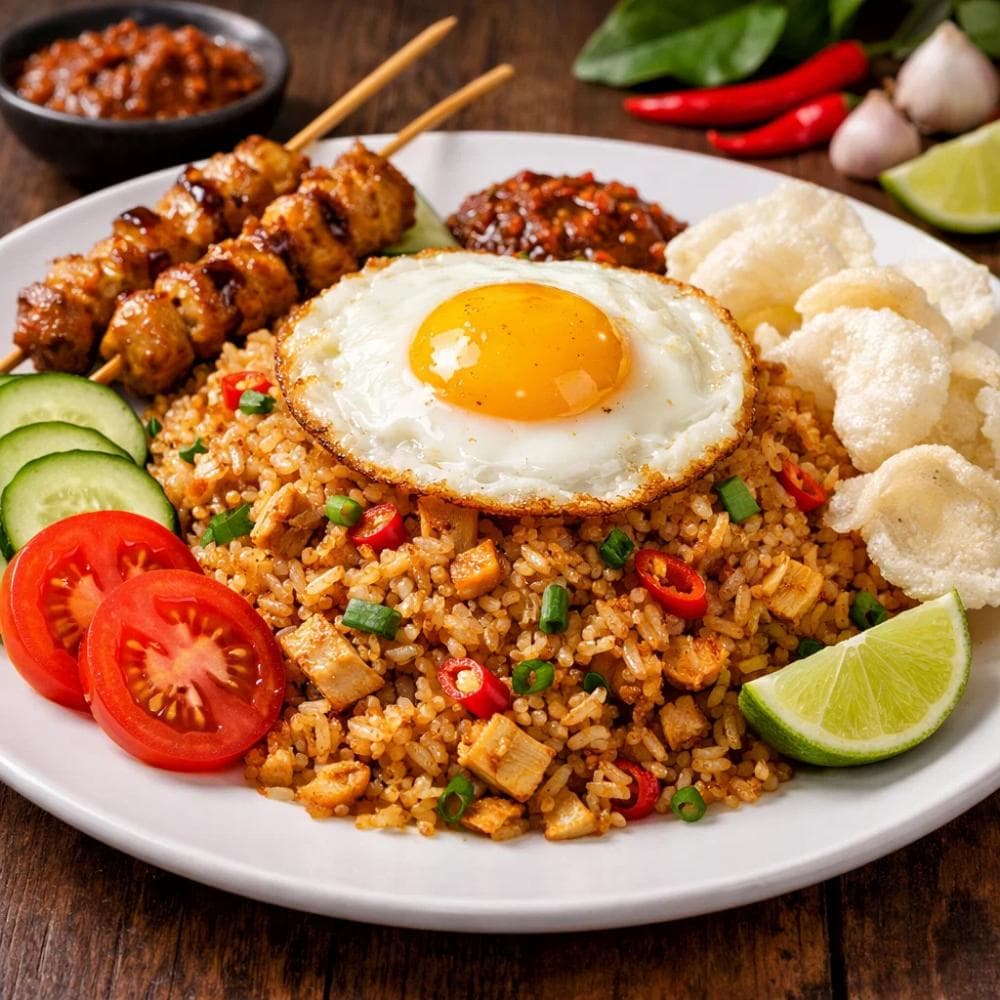
Indonesia's iconic fried rice — smoky, sweet, savoury, and deeply aromatic. Nasi goreng is made with day-old rice tossed in a flavour-packed paste of shallots, garlic, and chilli, then glazed with kecap manis (sweet soy sauce) and finished with egg. Served with cucumber, prawn crackers, and a fried egg on top, it is one of the most satisfying rice dishes in the world. The key is day-old rice and very high heat.
The Quick Answer
Nasi goreng turns out soft, pale, and gluey when the rice steams instead of frying and the kecap manis scorches. Use cold day-old jasmine rice and keep the wok screaming hot, and add the sweet soy only at the end so its sugars glaze rather than burn.
Why is my nasi goreng mushy and clumpy instead of separate grains?
Freshly cooked jasmine rice is saturated with water and its surface starch is sticky and gelatinised, so in the wok it releases steam and glues into clumps rather than frying. Refrigerating cooked rice overnight does two things: the grains lose surface moisture, and the starch retrogrades - the gelatinised molecules recrystallise into a firmer structure that fries into distinct, slightly chewy grains. Spreading it uncovered in the fridge dries it further. The second half of the fix is heat: a screaming-hot wok flashes off the little remaining surface water on contact and lets grains char against the metal for that smoky wok hei. A cool or crowded wok drops the temperature, the rice stews in its own steam, and you are back to mush.
Why does my kecap manis taste burnt and bitter in nasi goreng?
Kecap manis is sweetened with palm sugar and is essentially a syrup, so it behaves like one in a hot wok. Sugars caramelise and then scorch fast at the very high heat needed for fried rice, and once they pass caramelisation into burning they turn acrid and bitter. That is why it goes in near the end, poured over the rice rather than into an empty smoking wok: the rice and egg buffer the heat and provide surface area for the syrup to coat and lightly caramelise into a glossy, dark glaze in a minute or two. Tossing rapidly keeps any one spot from sitting against the metal long enough to burn. The shrimp paste, by contrast, needs early frying to cook off its raw, sharp aroma.
Not sure what to cook next? Let the generator pick your next dish in one click.
Random Recipe GeneratorAbout This Recipe
What is this dish?
Nasi goreng is Indonesia's most famous export and one of the great fried rice dishes of the world. The name simply means 'fried rice' in Indonesian, but this understates the dish considerably. What sets nasi goreng apart from other fried rice traditions is the spice paste — blended shallots, garlic, and chilli — and the use of kecap manis, the thick Indonesian sweet soy sauce that gives the rice its distinctive dark colour, glossy coating, and caramelised sweetness.
Why you'll love it
It uses leftover rice and takes 15 minutes. The flavour — smoky, sweet, savoury, aromatic, with a gentle heat — is completely addictive. It is one of the very best ways to use up rice that would otherwise be thrown away, and the result tastes like a dish from a good restaurant rather than a meal made from leftovers.
When to serve
A quick weeknight dinner for 2 that uses up leftover rice. Scales easily. Also works for a fast lunch or a late-night meal.
Quick tips
Use cold day-old rice. Highest heat possible. Keep everything moving. Add kecap manis at the end. Serve immediately.
Ingredient Highlights
Kecap Manis
The defining ingredient of nasi goreng. A thick, dark Indonesian sweet soy sauce with a molasses-like consistency and a deep, caramelised sweetness. It coats and glazes the rice to give it the characteristic dark colour and glossy sheen of authentic nasi goreng. It is not interchangeable with regular soy sauce — if unavailable, substitute with soy sauce and brown sugar.
Day-Old Rice
The most important technical element. Refrigerated day-old rice is drier, firmer, and less sticky than fresh rice. When it hits the hot wok, the separate grains fry and char at the edges rather than steaming and clumping. The slight crispiness of individual rice grains is the hallmark of good fried rice.
Shrimp Paste (Terasi)
A fermented shrimp paste used widely in Southeast Asian cooking. In small quantities — a pea-sized amount — it adds a profound savouriness and depth that is difficult to replicate. It smells intensely fishy raw but transforms when cooked into a round, complex umami base. Available in Asian supermarkets in small blocks or jars. Miso paste is the best vegetarian substitute.
Substitution Options
Replace kecap manis with soy sauce and brown sugar (2:1 ratio). Swap shrimp paste for fish sauce or miso paste. Use any protein — tofu, tempeh, leftover cooked chicken, beef, or pork. Replace jasmine rice with any long-grain white rice. Use tamari for a gluten-free version (and check the kecap manis label).
You'll likely need to buy
Likely in your pantry
Step-by-Step Instructions
Make the spice paste
Using a pestle and mortar or a small food processor, blend the shallots, garlic, red chillies, and shrimp paste into a rough paste. It doesn't need to be completely smooth — some texture is good. Alternatively, finely mince all the ingredients together with a sharp knife. The paste is the flavour base of the entire dish.
Chef's Tips
- ›A pestle and mortar produces the best texture for this paste — the bruising releases more fragrant oils than cutting
- ›If using shrimp paste, wrap it in foil and toast in a dry pan for 30 seconds per side before using — this reduces its raw, pungent edge
Cook the protein
Heat 1 tablespoon of vegetable oil in a large wok over very high heat until smoking. Add the sliced chicken or prawns and stir-fry for 3–4 minutes until just cooked through. Remove from the wok and set aside. The protein will be returned to the wok later.
Chef's Tips
- ›High heat is essential — a wok over its highest flame is the foundation of good fried rice
- ›Cook the protein in the hottest part of the wok and don't overcrowd — it should sear, not steam
Fry the paste and rice
Add another tablespoon of oil to the wok over very high heat. Add the spice paste and stir-fry for 1–2 minutes until fragrant and slightly darkened — the shallot, garlic, and chilli should be cooked through and the shrimp paste should smell nutty rather than raw. Add the cold day-old rice, breaking up any clumps with a spatula. Stir-fry vigorously for 3 minutes, pressing the rice flat against the wok periodically to allow some grains to char slightly at the edges.
Chef's Tips
- ›Cold, day-old rice is non-negotiable for good fried rice — fresh rice is too wet and steams rather than frying, producing a sticky, clumped result
- ›The slight char on some rice grains is desirable — it adds smoky flavour that is characteristic of good fried rice
Add the sauces and egg
Push the rice to the side of the wok. Crack the eggs into the empty space and scramble them briefly, cooking until just set but still slightly soft. Break into rough pieces and fold through the rice. Pour the kecap manis and soy sauce over the rice. Toss everything together rapidly over high heat for 1–2 minutes until the rice is evenly glazed with the dark, caramelised sauce.
Chef's Tips
- ›Kecap manis burns quickly due to its high sugar content — keep moving the rice and don't let it sit still once the sauce is added
- ›The eggs should be scrambled softly and folded in rather than cooked through — they continue cooking in the residual heat
Serve immediately
Return the cooked chicken or prawns to the wok and toss to combine and warm through. Divide between plates. Traditionally, nasi goreng is served with a fried egg on top (made in a separate pan), sliced cucumber on the side, and prawn crackers. Scatter the spring onions over the rice.
Chef's Tips
- ›The fried egg on top is as much a textural element as a garnish — the runny yolk breaks into the rice and adds richness
- ›Serve immediately — fried rice is best eaten the moment it leaves the wok
Chef's Tips
Techniques that separate good from great
Cook the rice the day before and refrigerate uncovered
Spreading the cooked rice on a tray and refrigerating it uncovered overnight dries it out perfectly for frying. Freshly cooked rice contains too much surface moisture to fry properly, regardless of how long you let it cool at room temperature. The overnight drying step is the most impactful thing you can do to improve home fried rice.
Toast the shrimp paste before using
Raw shrimp paste has an aggressive, pungent smell that softens dramatically when toasted. Wrap a small amount in foil and heat in a dry pan for 1 minute per side, or hold it directly over a gas flame on a skewer for 30 seconds. Toasted shrimp paste smells nutty and complex rather than raw and fishy — this is the version used in professional Indonesian kitchens.
Season at the table with sambal
Sambal oelek (a simple Indonesian chilli paste) served on the side allows everyone to season their own nasi goreng to their preferred heat level. It is also just delicious stirred into the fried rice and is one of the most useful condiments to have in the fridge.
Nutrition Facts
Per serving · Estimated values
* Estimated per serving based on a 2,000 calorie diet.
Equipment Needed
As an Amazon Associate we earn from qualifying purchases — at no extra cost to you.
Quick Tips
- Day-old rice is essential — fresh rice is too moist and steams rather than frying; it clumps and becomes gluey
- Use the highest heat your cooker produces — genuine wok hei (breath of the wok) requires very high temperatures that most domestic hobs approximate but cannot fully replicate
- Keep everything moving in the wok — fried rice waits for nothing
Recipe Variations
Different ways to make this dish your own
Nasi Goreng Kampung (Village Fried Rice)
A simpler, more rustic version made with fewer ingredients — just garlic, shallots, chilli, kecap manis, egg, and rice. No meat, no elaborate paste. It is the version made at home with whatever is available and is arguably the most satisfying and unpretentious version.
Nasi Goreng with Tempeh
Cube a block of tempeh and shallow-fry until golden before adding to the rice. Tempeh has a nutty, fermented flavour that works beautifully in nasi goreng and makes it a more substantial vegetarian meal.
Nasi Goreng Seafood
Use a mixture of prawns, squid rings, and crab meat. Add the squid first (it cooks quickly), then the prawns, then the crab. A seafood nasi goreng is a restaurant staple and makes for a more impressive dinner party version of the dish.
Extra Spicy Nasi Goreng
Increase the bird's eye chillies in the paste to 4–5 and add a teaspoon of sambal oelek to the kecap manis before adding to the rice. A fiercely hot version for those who want genuine Indonesian heat.
What to Serve With
Perfect pairings to complete the meal
Fried Egg (Telur Goreng)
A fried egg with a runny yolk placed on top of the nasi goreng is the classic serving and almost mandatory. Fry in hot oil until the edges are crispy but the yolk remains runny. It adds richness and the yolk breaks into the rice as you eat.
Prawn Crackers (Kerupuk)
Crunchy prawn crackers alongside provide texture contrast and are the traditional accompaniment. Cook from dried in hot oil until they puff up in seconds, or use ready-to-eat versions.
Sliced Cucumber and Tomato
A few slices of cool, refreshing cucumber and tomato alongside provide a cooling contrast to the hot, spiced rice and are a standard part of the classic nasi goreng presentation.
Sambal Oelek
Serve a small bowl of sambal oelek (chilli paste) on the side for those who want extra heat. It is a common table condiment in Indonesia and adds a fresh chilli heat that is different from the cooked paste in the rice.
Storage & Reheating
Keep it fresh and plan ahead
Refrigerator
Store leftover nasi goreng in an airtight container in the fridge for up to 2 days.
Freezer
Not recommended — the texture of fried rice deteriorates significantly when frozen and thawed.
Make-Ahead
Not well-suited to making ahead — fried rice is best eaten immediately. However, the spice paste can be made and refrigerated for up to 3 days ahead.
Reheating
Reheat in a hot wok or skillet over high heat with a tiny splash of water. Toss continuously until heated through. Avoid the microwave which makes the rice soggy.
Cooking tonight?
Get a month of dinners like this — done for you
30 chef-tested dinners mapped to the month, plus 5 ready-to-shop grocery lists. One-time $8.99 — 30 dinners planned for you, zero nightly decisions.
See the 30-Day Plan →Be the first to review this recipe!
Got Leftovers?
Turn what you already have in your fridge into delicious meals. Our AI-powered generator creates personalized recipes from your ingredients.
Go Deeper
Master the Culinary Science
Every recipe is a doorway. Our 7 Mastery Guides give you the science, technique, and framework to understand why food works — not just how to follow steps.
AI-Powered
Have Ingredients? Generate a Recipe.
Tell our AI what's in your fridge and get a custom recipe with image in seconds. No waste, no boredom.
Try the AI Recipe Generator →Browse more like this:
You Might Also Like
Discover more delicious recipes similar to what you're cooking