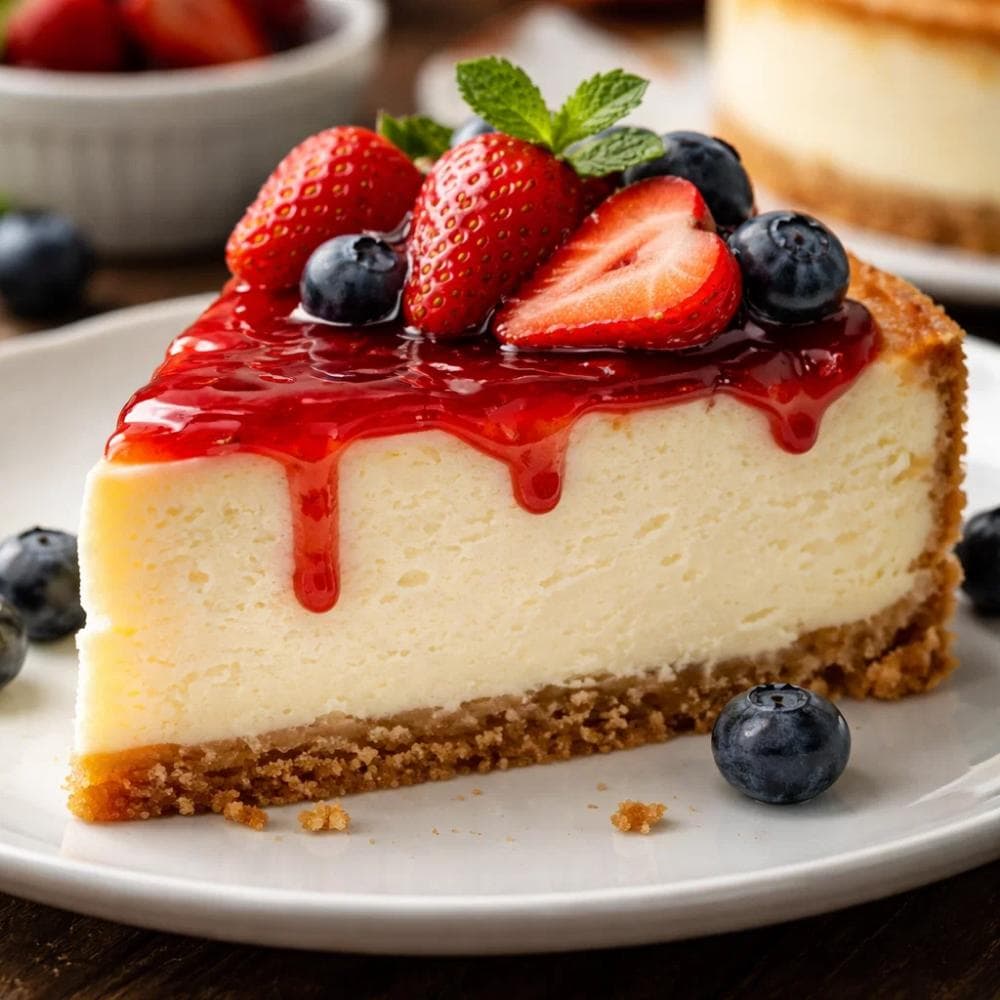
New York Cheesecake (Baked Cheesecake with Buttery Biscuit Base)
Dense, creamy, and rich — a classic baked New York cheesecake with a buttery digestive biscuit base and smooth cream cheese filling. Perfected with a water bath for a crack-free top.
The Quick Answer
A New York cheesecake stumbles two ways before it ever cools: a lumpy, over-aerated batter, and a base that goes soggy in the water bath. Bring the cream cheese and eggs to room temperature and beat on the lowest speed, then double-wrap the springform tin in foil to keep the bath water out.
Why does my cheesecake batter turn out lumpy?
Lumps form when cold cream cheese refuses to soften and break down. Straight from the fridge it is firm and waxy, so the beaters tear it into stubborn nuggets that never fully smooth out, leaving pockets of dense cheese through the bake. Letting the 900g of cream cheese and the eggs come fully to room temperature lets the fat soften so everything emulsifies into one glossy batter. Speed matters just as much: beat on the lowest setting and stop as soon as each addition is combined. High-speed beating whips air into the batter, and that trapped air expands in the oven then collapses as the cake cools, puffing and sinking the top. The flour adds a little starch to stabilise the set.
Why did my cheesecake base turn out soggy?
The buttery digestive base sits directly in a roasting tin of boiling water, and springform tins are not watertight where the base meets the ring. If even a trickle seeps in, the biscuit crumb soaks it up and turns to mush instead of staying crisp. Wrapping the outside in two layers of heavy-duty foil, pressed snug up the sides, blocks that ingress. The water bath is still worth it, because the surrounding steam keeps the oven humid and the heat gentle, which is what lets a dense 900g cream-cheese filling bake slowly without the edges overcooking before the centre sets. Skip the foil and you trade a crack-free top for a wet base.
Not sure what to cook next? Let the generator pick your next dish in one click.
Random Recipe GeneratorAbout This Recipe
What is this dish?
New York cheesecake is a baked cheesecake made with a high proportion of cream cheese, eggs, and sour cream, producing a dense, rich, and creamy texture that is quite different from lighter, gelatine-set cheesecakes. It is one of the most celebrated American desserts.
Why you'll love it
Dense, creamy, and satisfying in a way that no-bake cheesecake cannot match. It keeps for 5 days in the fridge and actually improves overnight. One cheesecake serves 10–12 people.
When to serve
A dinner party centrepiece dessert, a celebration cake alternative, or any occasion where a showstopper is needed.
Quick tips
Room temperature ingredients. Beat on low. Use a water bath. Cool slowly. Refrigerate overnight before serving.
Ingredient Highlights
Full-Fat Cream Cheese
The dominant ingredient. Its fat content provides the dense, creamy texture that defines New York cheesecake. Philadelphia is the most commonly used brand.
Sour Cream
Adds a subtle tanginess and loosens the filling slightly for a smoother, more silky texture. It also contributes to the characteristic slight sourness.
Digestive Biscuits
The classic British base — slightly sweet, slightly salted, and perfectly textured. Graham crackers are the American equivalent.
Substitution Options
Replace digestives with Oreos (remove the filling) for a chocolate base. Use crème fraîche instead of sour cream. Add the zest of 1 orange for an orange cheesecake. Swirl 3 tablespoons of raspberry jam through the top of the batter before baking for a marble effect.
You'll likely need to buy
Likely in your pantry
Step-by-Step Instructions
Make the biscuit base
Preheat the oven to 180°C (fan 160°C). Grease and line a 23cm springform tin. Blitz the biscuits in a food processor to fine crumbs, or crush in a zip-lock bag with a rolling pin. Mix with the melted butter until the crumbs hold together when pressed. Press firmly and evenly into the base of the tin. Bake for 10 minutes. Cool slightly.
Chef's Tips
- ›Press the base firmly with the back of a spoon or a flat-bottomed glass for an even, compact layer.
- ›Baking the base for 10 minutes sets it so it doesn't become soggy under the filling.
Make the filling
Reduce the oven to 160°C (fan 140°C). Beat the cream cheese with an electric mixer on low speed until smooth — about 1 minute. Add the sugar, flour, vanilla, lemon zest, and salt. Beat on low until just combined. Add the eggs and yolk one at a time, beating briefly after each. Finally, mix in the sour cream. Do not overmix.
Chef's Tips
- ›All ingredients must be at room temperature — cold cream cheese produces a lumpy batter.
- ›Beat on low speed throughout — high speed incorporates too much air, which causes cracking.
Bake in a water bath
Wrap the outside of the springform tin tightly in two layers of heavy-duty foil to prevent water seeping in. Pour the filling over the cooled base. Place the tin in a large roasting dish. Pour boiling water into the roasting dish to come halfway up the sides of the springform tin. Bake for 55–60 minutes until the edges are set and the centre has a gentle wobble.
Chef's Tips
- ›The water bath (bain-marie) provides gentle, humid heat that prevents cracking.
- ›The wobble in the centre is correct — it will set completely as it cools.
Cool and chill
Turn off the oven. Open the oven door slightly and leave the cheesecake inside for 1 hour — this slow cooling prevents the top from cracking. Remove from the water bath. Cool completely at room temperature, then refrigerate for at least 6 hours, ideally overnight.
Chef's Tips
- ›Rapid temperature changes are the primary cause of cracking — slow cooling is essential.
- ›The cheesecake must be fully chilled before slicing — it slices cleanly from the fridge, not when warm.
Chef's Tips
Techniques that separate good from great
Run a knife around the edge immediately after baking
As soon as you take the cheesecake from the oven, run a thin knife around the inside edge of the tin. As the cheesecake contracts during cooling, this prevents it from sticking to the side and cracking in the centre.
Bake the day before serving
A New York cheesecake improves overnight in the fridge. The texture becomes denser, the flavour develops, and it slices more cleanly. Always make it the day before.
Nutrition Facts
Per serving · Estimated values
* Estimated per serving based on a 2,000 calorie diet.
Equipment Needed
As an Amazon Associate we earn from qualifying purchases — at no extra cost to you.
Quick Tips
- Room temperature ingredients are not optional — cold cream cheese produces a lumpy, uneven batter.
- Beat on the lowest speed setting throughout. Air in the batter causes the cheesecake to puff and then crack as it deflates.
- The water bath is the key to a crack-free top — the steam keeps the oven humid and the baking gentle.
Recipe Variations
Different ways to make this dish your own
Raspberry Swirl Cheesecake
Drop 3 tablespoons of raspberry jam or coulis over the top of the batter. Use a skewer to swirl it through. Bake as normal.
Biscoff Cheesecake
Replace digestive biscuits with Lotus Biscoff biscuits for the base. Swirl 4 tablespoons of Biscoff spread through the filling before baking.
Lemon Cheesecake
Add the zest of 2 lemons and 2 tablespoons of lemon juice to the filling. Top with lemon curd after baking and chilling.
What to Serve With
Perfect pairings to complete the meal
Fresh Strawberries
The classic topping — halved, fresh strawberries provide sweetness and freshness against the rich, dense cream cheese filling.
Blueberry Compote
Simmer 200g blueberries with 2 tablespoons of sugar and a squeeze of lemon for 5 minutes. Spoon over each slice.
Whipped Cream
A simple dollop of lightly whipped double cream alongside each slice is all the adornment this cheesecake needs.
Storage & Reheating
Keep it fresh and plan ahead
Refrigerator
Store covered in the fridge for up to 5 days. The flavour and texture improve after the first 24 hours.
Freezer
Freeze whole or in slices for up to 2 months. Wrap tightly. Thaw overnight in the fridge.
Make-Ahead
Ideal for making 1–2 days ahead. The flavour develops and the texture firms up. Keep refrigerated until serving.
Reheating
Not applicable — serve cold from the fridge.
Cooking tonight?
Get a month of dinners like this — done for you
30 chef-tested dinners mapped to the month, plus 5 ready-to-shop grocery lists. One-time $8.99 — 30 dinners planned for you, zero nightly decisions.
See the 30-Day Plan →Got Leftovers?
Turn what you already have in your fridge into delicious meals. Our AI-powered generator creates personalized recipes from your ingredients.
Go Deeper
Master the Culinary Science
Every recipe is a doorway. Our 7 Mastery Guides give you the science, technique, and framework to understand why food works — not just how to follow steps.
AI-Powered
Have Ingredients? Generate a Recipe.
Tell our AI what's in your fridge and get a custom recipe with image in seconds. No waste, no boredom.
Try the AI Recipe Generator →Browse more like this:
You Might Also Like
Discover more delicious recipes similar to what you're cooking