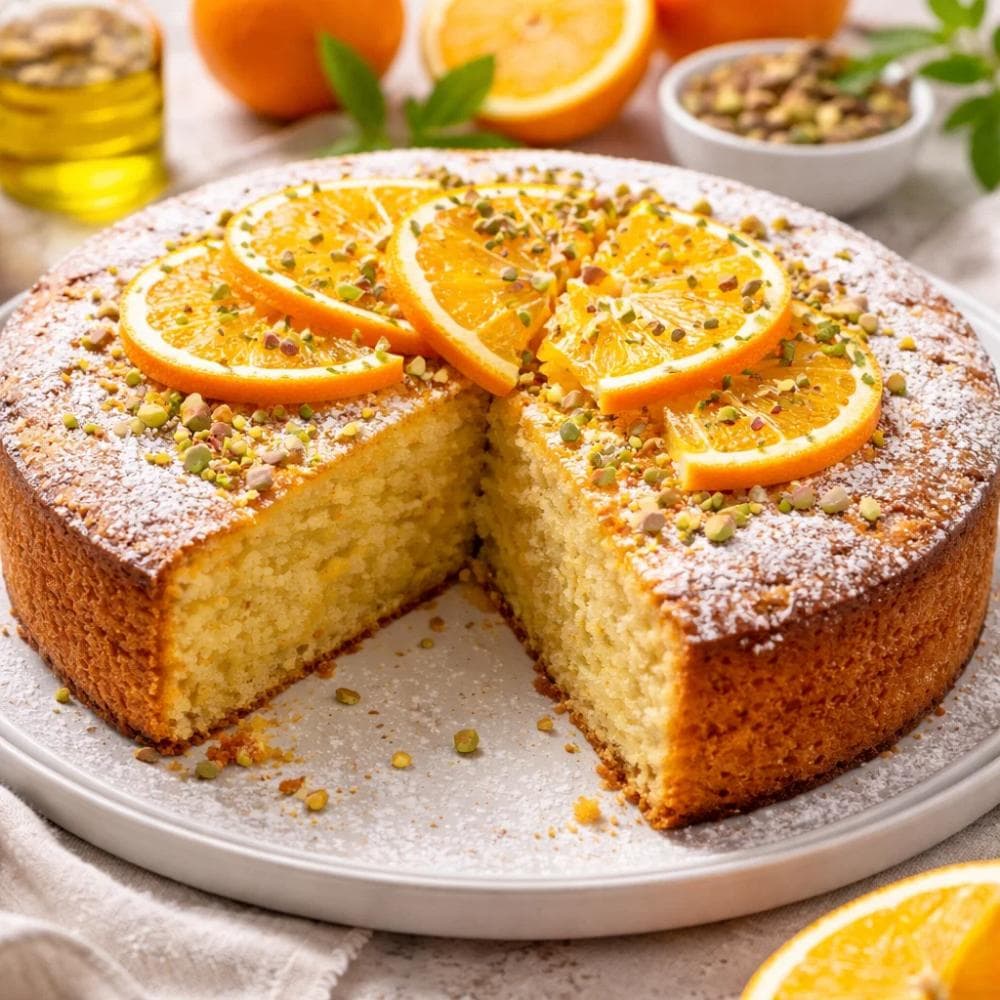
Olive Oil Orange Cake (Moist Mediterranean Cake)
A deeply fragrant, moist Mediterranean cake made with olive oil rather than butter — the result is a lighter crumb with a subtle richness and a distinctly fruity, herbal quality that butter cannot provide. Brightened generously with fresh orange juice and zest, this cake is at once simple and sophisticated. It keeps better than butter cakes, improves over a day or two, and is naturally dairy-free. Dust with icing sugar and serve with a spoonful of Greek yoghurt and honey.
The Quick Answer
An olive oil cake most often comes out greasy or, just as often, sunken and dense in the middle, and each fault traces back to one step you can control. Stream the oil in slowly so it emulsifies rather than pools, and protect the egg-and-sugar foam by folding the flour in gently so it does not deflate or toughen.
Why is my olive oil cake greasy or oily?
With no butter, the 150ml of oil is the only fat, and it has to be locked into the batter rather than left to sit as a free layer. Pouring it in all at once overwhelms the egg-and-sugar foam and the fat separates out, baking into greasy streaks. Adding it slowly in a thin stream, the way you build mayonnaise, lets the egg's lecithin emulsify the oil into tiny suspended droplets that stay evenly dispersed. The orange juice goes in only after the emulsion is set, because its water would otherwise compete and break the mixture. A stable emulsion is what gives this cake its even, moist crumb instead of oily patches.
Why does my olive oil cake sink in the middle?
This cake gets most of its lift not from baking powder but from air, so a sunken centre means that air was lost. Whisking the eggs and sugar for three to four minutes until pale and ribbon-thick traps a foam of tiny bubbles; if you stop short, there is too little structure to hold the rise and the middle collapses. The bigger culprit is the flour stage. Tip the flour in and beat it and the bubbles burst while gluten develops, giving a dense, sunken crumb. Folding the sifted flour in three gentle additions, stopping the moment no dry streaks remain, preserves the foam and keeps gluten minimal, so the cake sets risen and even rather than caving as it cools.
Not sure what to cook next? Let the generator pick your next dish in one click.
Random Recipe GeneratorAbout This Recipe
What is this dish?
Olive oil orange cake is a staple of Mediterranean home baking — made with the ingredients that are always on hand in Italian, Spanish, and Greek kitchens. Using olive oil rather than butter produces a cake that is noticeably more moist, has a lighter, more tender crumb, and stays fresh for longer. The orange — both zest and juice — perfumes the entire cake with a bright, fragrant citrus note that the olive oil complements rather than competes with.
Why you'll love it
It is naturally dairy-free, requires only one bowl, and keeps beautifully for 3–4 days — improving as the orange flavours develop and permeate the crumb. It is the kind of cake that is appropriate at any time of day: with morning coffee, as an afternoon slice, or as a dinner party dessert with a spoonful of Greek yoghurt and honey.
When to serve
A versatile everyday cake that works equally well as a casual bake, a dinner party dessert, or a celebration cake. Serves 8–10 slices.
Quick tips
Use good quality extra virgin olive oil. Whisk eggs and sugar until pale and thick. Add oil in a slow stream. Fold flour gently. Do not overbake.
Ingredient Highlights
Extra Virgin Olive Oil
The defining ingredient. A good quality, flavourful extra virgin olive oil contributes a subtle fruitiness and a slight peppery note that gives this cake its distinctive Mediterranean character. It also keeps the cake moist for longer than butter, because liquid fats do not firm up when cold. Use an oil you would enjoy eating straight.
Fresh Orange Juice and Zest
Both forms of orange are used — the juice for moisture and gentle sweetness, the zest for fragrance. The essential oils in fresh orange zest are far more aromatic than juice alone. Use unwaxed oranges for zesting, or scrub conventional oranges thoroughly under hot water before zesting. The combination of juice and zest produces a cake that smells and tastes intensely of fresh orange.
Eggs Whisked with Sugar
The main source of structure and lift in this cake. Whisking the eggs and sugar until pale, thick, and voluminous incorporates air that, combined with the baking powder, produces a light crumb. The gradual emulsification of the olive oil into this aerated egg mixture is the technique that produces the cake's characteristic tender, even texture.
Substitution Options
Replace plain flour with gluten-free flour blend or ground almonds. Use lemon instead of orange for a different citrus character. Substitute light olive oil for extra virgin for a more neutral flavour. Use caster sugar or granulated sugar interchangeably. Add a tablespoon of poppy seeds for texture.
You'll likely need to buy
Likely in your pantry
Step-by-Step Instructions
Prepare and preheat
Preheat the oven to 180°C (350°F / Gas Mark 4). Grease a 23cm (9in) round cake tin with olive oil and line the base with a circle of baking paper. In a large bowl, sift together the plain flour, baking powder, and salt. Set aside.
Chef's Tips
- ›Greasing with olive oil rather than butter reinforces the olive oil character of the cake
- ›Lining the base prevents the cake sticking even if the sides are only greased — a simple extra step that prevents frustration
Whisk the wet ingredients
In a large bowl or the bowl of a stand mixer, whisk the eggs and caster sugar together vigorously for 3–4 minutes until pale, thick, and increased in volume — the mixture should fall in thick ribbons from the whisk. This step is important: the air beaten in now provides the lift that makes the cake light. Add the orange zest and vanilla extract and whisk briefly to combine.
Chef's Tips
- ›Whisking the eggs and sugar until genuinely pale and thick (not just combined) is the most important step for a light, airy crumb
- ›The mixture should more than double in volume and leave a thick ribbon trail on the surface when the whisk is lifted
Add the olive oil and orange juice
With the mixer running on medium speed (or whisking by hand), pour the olive oil in slowly in a thin, steady stream — as if making mayonnaise. The gradual addition emulsifies the fat into the egg mixture and prevents the batter splitting. Once all the oil is incorporated, add the fresh orange juice and whisk briefly to combine.
Chef's Tips
- ›Pouring the oil in slowly — over about 30 seconds — emulsifies it into the batter and produces a smoother, more uniform crumb
- ›Fresh orange juice is important here — bottled juice has a flatter, slightly fermented flavour that does not perfume the cake in the same way
Fold in the flour
Add the sifted flour mixture to the wet ingredients in three additions, folding gently with a large rubber spatula after each addition until just combined. Do not overmix — stop as soon as you can no longer see dry flour. A few small lumps in the batter are fine. Overmixing develops gluten and produces a tough, dense cake.
Chef's Tips
- ›Fold, don't stir — gentle folding preserves the air beaten into the eggs and produces a lighter crumb
- ›A few lumps in the batter are preferable to a smooth, overmixed one
Bake and cool
Pour the batter into the prepared tin and smooth the top with a spatula. Bake for 35–40 minutes until the cake is golden and a skewer inserted into the centre comes out with just a few moist crumbs attached — not wet batter. The top should spring back when gently pressed. Allow to cool in the tin for 10 minutes, then turn out onto a wire rack to cool completely. Dust generously with icing sugar before serving.
Chef's Tips
- ›Check the cake at 30 minutes — ovens vary significantly and it may be done earlier
- ›The cake should be fully cool before dusting with icing sugar — sugar dissolves on a warm cake
Chef's Tips
Techniques that separate good from great
Use a flavourful extra virgin olive oil
A good extra virgin olive oil with a fruity, slightly peppery character (Arbequina or Picual are excellent varieties for baking) adds a subtle but perceptible flavour dimension that makes this cake taste distinctly Mediterranean. A neutral light olive oil produces a plainer result. The oil should taste good on its own — if it does, it will taste good in the cake.
Soak the warm cake with a citrus syrup
For a more moist, intensely orange-flavoured cake, make a simple syrup by heating equal parts fresh orange juice and caster sugar until dissolved. Remove the warm cake from the oven, prick all over with a skewer, and pour the syrup over. The cake absorbs the syrup as it cools, producing a texture similar to a flourless Seville orange cake.
Add a tablespoon of orange liqueur
A tablespoon of Cointreau, Grand Marnier, or any orange liqueur added with the orange juice intensifies the citrus character of the cake and adds a subtle depth. The alcohol bakes off completely, leaving only flavour. This is the kind of small addition that makes people ask what makes the cake taste so good.
Nutrition Facts
Per serving · Estimated values
* Estimated per serving based on a 2,000 calorie diet.
Equipment Needed
As an Amazon Associate we earn from qualifying purchases — at no extra cost to you.
Quick Tips
- Whisk the eggs and sugar until genuinely pale, thick, and voluminous — this is the main source of lift in the cake
- Pour the olive oil in a slow, steady stream to emulsify it into the batter — do not add it all at once
- Fold in the flour gently with a spatula — overmixing produces a tough crumb
Recipe Variations
Different ways to make this dish your own
Olive Oil and Lemon Cake
Replace the orange juice and zest with lemon juice and zest. The lemon version is sharper, brighter, and more classically Italian. Serve with a lemon curd drizzle or simply dust with icing sugar.
Olive Oil, Orange, and Almond Cake
Replace 50g of the plain flour with 50g of ground almonds. The almond adds a fudgy richness and a slightly denser crumb that is particularly good. This version is closer to a traditional Spanish almond cake.
Blood Orange Olive Oil Cake
Use blood orange juice and zest when in season (January–March). The juice turns the batter a pale pink and the flavour is more complex and slightly berry-like — dramatic and beautiful.
Olive Oil Cake with Orange Syrup
Make a simple orange syrup (equal parts orange juice and caster sugar, simmered for 2 minutes), prick the warm cake with a skewer, and pour the syrup over. The cake absorbs the syrup and becomes more intensely flavoured, moist, and almost pudding-like.
What to Serve With
Perfect pairings to complete the meal
Greek Yoghurt and Honey
The classic Mediterranean accompaniment — thick Greek yoghurt drizzled with good honey alongside a slice of this cake is simple and perfect. The tang of the yoghurt and the sweetness of the honey balance the citrus of the cake beautifully.
Crème Fraîche
A spoonful of cold crème fraîche adds richness and a slight tang. Particularly good served with blood orange olive oil cake.
Candied Orange Slices
Thin rounds of orange slowly simmered in sugar syrup and dried, placed on top of the cake before serving, make for a beautiful, bakery-style presentation and intensify the orange flavour.
Afternoon Tea
This cake is ideal for afternoon tea — it is not too sweet, slices cleanly, holds well, and pairs with both tea and coffee. Dust with icing sugar just before serving for a simple, elegant presentation.
Storage & Reheating
Keep it fresh and plan ahead
Refrigerator
Keeps well at room temperature in an airtight container for up to 4 days — the flavour and texture actually improve over the first 24–48 hours. Refrigeration is not necessary.
Freezer
Freezes well for up to 2 months, whole or pre-sliced, well-wrapped. Defrost at room temperature for 2 hours.
Make-Ahead
Excellent made ahead — bake a day or two before serving for the best flavour. Dust with icing sugar just before serving.
Reheating
Best served at room temperature. If refrigerated, allow to come to room temperature for 30 minutes before serving. A brief 10-minute warm in a low oven (150°C) refreshes the texture if desired.
Cooking tonight?
Get a month of dinners like this — done for you
30 chef-tested dinners mapped to the month, plus 5 ready-to-shop grocery lists. One-time $8.99 — 30 dinners planned for you, zero nightly decisions.
See the 30-Day Plan →Be the first to review this recipe!
Got Leftovers?
Turn what you already have in your fridge into delicious meals. Our AI-powered generator creates personalized recipes from your ingredients.
Go Deeper
Master the Culinary Science
Every recipe is a doorway. Our 7 Mastery Guides give you the science, technique, and framework to understand why food works — not just how to follow steps.
AI-Powered
Have Ingredients? Generate a Recipe.
Tell our AI what's in your fridge and get a custom recipe with image in seconds. No waste, no boredom.
Try the AI Recipe Generator →Browse more like this:
You Might Also Like
Discover more delicious recipes similar to what you're cooking