Pozole Rojo (Hominy Pork Stew)
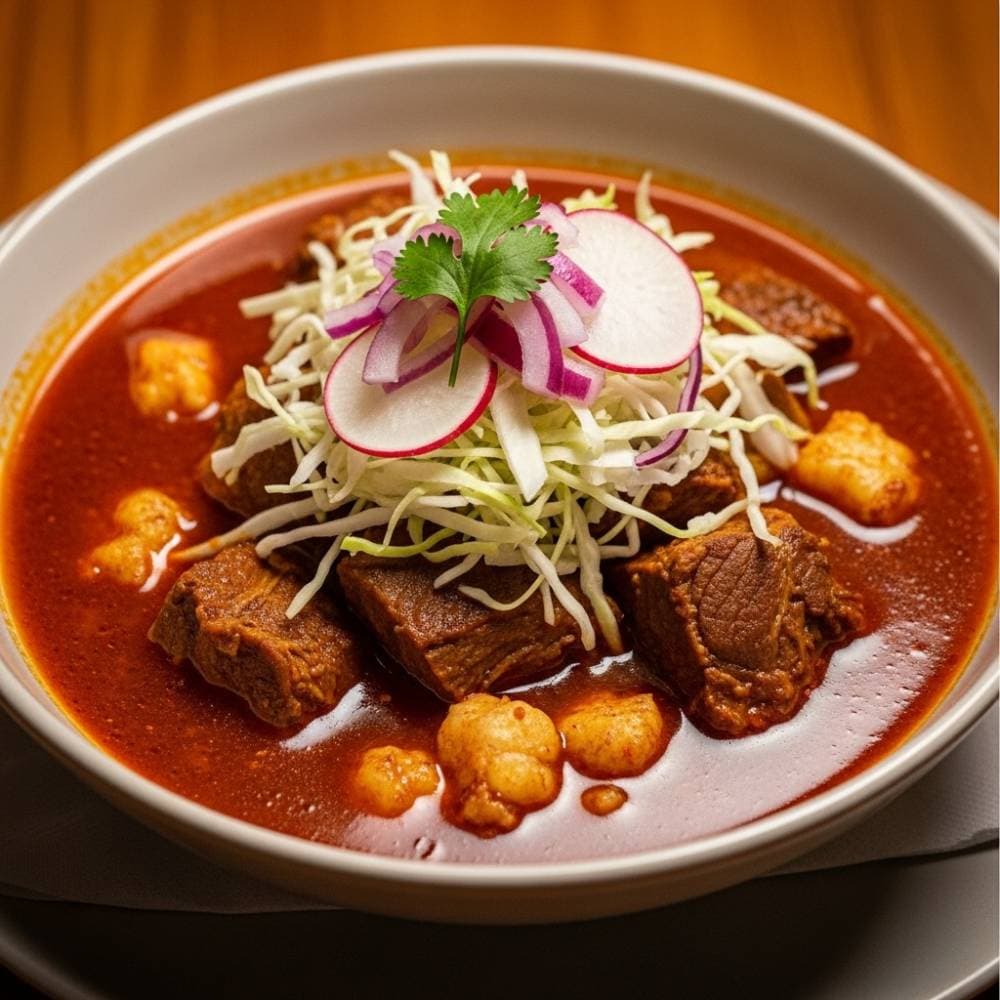
A traditional Mexican pork and hominy stew known for its rich red chili broth. Tender pork and chewy hominy are simmered to perfection, creating a deeply flavorful and comforting meal for two.
The Quick Answer
Pozole is really two slow processes in one pot: rendering tough pork shoulder into tender chunks and building a clean, deep chili broth from guajillo and ancho. The hominy and the final seasoning balance are what tie a long simmer into a finished, layered stew.
Why is my pozole broth thin and greasy instead of rich?
Browning the pork shoulder first is what builds body: the Maillard crust and rendered fat left in the pot become the base the strained chili sauce dissolves into, so skipping or crowding that sear gives a watery broth. But pork shoulder also releases a lot of fat over an hour of simmering, and that fat can sit as an oily slick rather than reading as richness. Skim the surface a few times late in the cook, or chill and lift the fat cap if making it a day ahead. What you want is a broth thickened by gelatin from the collagen and the body of the chili puree, with just enough rendered fat to carry flavor, not a layer of grease over a thin liquid.
Why does my hominy stay hard or taste like nothing?
Canned hominy is nixtamalized corn that is fully cooked but bland and firm straight from the can, holding its chewy bite because its starch is set and its cells are reinforced by the lime treatment. Rinsing it well removes the metallic canning liquid, but it only takes on the dish's character by simmering in the chili-pork broth long enough for the flavor to penetrate the kernels. Add it for the full hour rather than near the end, and taste the broth's salt after the hominy has been in, because the kernels absorb seasoning and can leave an under-salted stew. Properly simmered, the hominy turns tender-chewy and tastes of the broth rather than the can.
Not sure what to cook next? Let the generator pick your next dish in one click.
Random Recipe GeneratorAbout This Recipe
What is this dish?
Pozole rojo is one of Mexico's most ancient and revered dishes — a ceremonial stew with pre-Columbian origins among the Aztec people. The name comes from the Nahuatl word for hominy corn, the dish's defining ingredient. Made from pork and hominy simmered in a deep red broth of rehydrated dried chilies, pozole was historically prepared for major celebrations and festivals. It remains a centerpiece of Mexican celebrations, particularly around Mexican Independence Day in September.
Why you'll love it
Pozole rojo is one of the most deeply satisfying bowls of food in Mexican cuisine. The guajillo and ancho chili broth has a complex, slightly smoky, subtly sweet depth that is completely unlike canned tomato-based soups. The hominy's chewy, corn-fragrant texture is unlike any other ingredient, and the tableside garnishes — crunchy cabbage, sharp radishes, bright lime — transform each bowl into a personalized experience. It tastes like something that cooked for hours, because it did.
When to serve
Serve for a Mexican holiday celebration, a cold-weather comfort dinner, a weekend family meal, or anytime you need a deeply nourishing bowl. Pozole is traditionally served for Mexican Independence Day (September 16), New Year's, and Christmas Eve.
Quick tips
Rehydrate the dried chilies in just-boiled water until fully soft before blending. Strain the chili sauce through a fine-mesh sieve for a smooth, restaurant-quality broth. The pork shoulder must simmer low and slow for full tenderness — at least 60-75 minutes.
Ingredient Highlights
Dried Guajillo Chilies
The backbone of the red pozole broth. Guajillo are long, brick-red dried chilies with moderate heat and a characteristic flavor of dried berries, tea, and mild heat. They provide the broth's deep red-orange color. Always toast and rehydrate dried chilies before blending — never use them dry.
Dried Ancho Chilies
Ancho are dried poblano peppers with a dark, almost black color and a rich flavor of dark chocolate, dried fruit, and mild heat. Combined with guajillo, they create the complex depth that distinguishes authentic pozole broth from simple tomato-based soups.
Hominy
Dried corn kernels treated with an alkaline solution (nixtamalization) that transforms their texture and nutritional profile. The nixtamalization process makes hominy's proteins more bioavailable and gives it a distinctive chewy texture and corn fragrance. Canned hominy is fully cooked and excellent. Dried hominy (pozole corn) requires overnight soaking and hours of simmering.
Pork Shoulder
The ideal cut for pozole because its intramuscular fat (marbling) melts during the long simmer, keeping the meat moist and flavorful. Pork shoulder becomes fork-tender in 60-90 minutes of low simmering. Pork loin is too lean and dries out; pork ribs add even more richness.
Substitution Options
Replace pork with chicken thighs (simmer 30-40 minutes) for a lighter pozole blanco variation. For a vegan version, use hominy and mushrooms (oyster or portobello) with vegetable broth. If guajillo are unavailable, California chilies or New Mexico chilies are close substitutes. Canned hominy is directly equivalent to cooked dried hominy and saves significant time. Add 1-2 árbol chilies to the blender for a spicier pozole.
You'll likely need to buy
Likely in your pantry
Step-by-Step Instructions
Cook the pork
Season the pork shoulder cubes with 1/2 teaspoon salt and 1/4 teaspoon black pepper. Heat 1 tablespoon vegetable oil in a large pot or Dutch oven over medium-high heat. Add the pork cubes and cook for 8-10 minutes, stirring occasionally, until browned on all sides. Remove the pork from the pot and set it aside, leaving any drippings in the pot. Pozole is a traditional Mexican stew.
Chef's Tips
- ›Browning the pork adds depth of flavor to the stew.
- ›Do not overcrowd the pot; cook in batches if needed.
Prepare the chili sauce
While pork cooks, remove the stems and seeds from the 2 large dried guajillo chilies and 1 large dried ancho chili (these are dried Mexican peppers). Place the chilies in a heatproof bowl and pour 1 cup boiling water over them. Let them rehydrate (soak to soften) for 15-20 minutes until soft. Drain the chilies, reserving the soaking liquid. In a blender, combine the rehydrated chilies, 1/2 roughly chopped white onion, 3 peeled cloves garlic, 1/2 teaspoon ground cumin, and 1/4 teaspoon dried oregano. Add 1/2 cup fresh chicken broth. Blend until completely smooth. Strain the chili mixture through a fine-mesh sieve into the pot with the pork drippings, pressing on the solids to extract all liquid. This creates your red chili sauce.
Chef's Tips
- ›Rehydrating chilies makes them soft and easy to blend.
- ›Straining the sauce creates a smooth consistency.
Simmer the pozole
Return the browned pork to the pot with the strained chili sauce. Add 1 can rinsed and drained white hominy (dried corn kernels that have been treated to be soft and fluffy). Pour in the remaining 1 1/2 cups chicken broth (or more if needed to cover the ingredients). Add the remaining 1/2 teaspoon salt. Bring the mixture to a gentle simmer (cook gently just below boiling, with small bubbles). Cover the pot, reduce heat to low, and simmer for 1 hour to 1 hour 15 minutes, or until the pork is very tender and easily pulls apart. Stir occasionally to prevent sticking.
Chef's Tips
- ›Simmer means to cook gently just below boiling, with small bubbles.
- ›Long, slow simmering is key for tender pork and melded flavors.
Serve
Taste the Pozole and adjust salt or seasoning if needed. Ladle the hot Pozole into bowls. Serve with individual bowls of toppings including 1/2 cup shredded green cabbage, 4-6 thinly sliced radishes, 1/4 finely diced red onion, lime wedges for squeezing, and 1/4 cup tortilla chips for crunch.
Chef's Tips
- ›The fresh toppings add essential crunch and brightness to the rich stew.
- ›Serve immediately while hot for best enjoyment.
Chef's Tips
Techniques that separate good from great
Toast the dried chilies briefly in a dry pan before rehydrating
Pass the dried guajillo and ancho chilies over a medium-hot dry pan for 20-30 seconds per side, pressing with a spatula, until they become fragrant and pliable. This toasting step wakes up the dried chili oils and deepens their flavor significantly. Don't over-toast — any black spots means the chili is scorched and will taste bitter.
Strain the chili sauce through a fine-mesh sieve for a smooth, professional-quality broth
After blending the rehydrated chilies with onion, garlic, and broth, strain the mixture through a fine-mesh sieve, pressing hard on the solids. This removes the tough chili skin fragments and any fibrous material, resulting in a perfectly smooth, glossy broth. Skipping straining results in a grainy texture.
Keep the simmer truly low — big bubbles make the pork tough
Once the pork and chili broth are combined, the pot should maintain the gentlest possible simmer: a few bubbles breaking the surface, never a rolling boil. Vigorous boiling makes the pork fibers contract and toughen. Low, patient simmering dissolves the collagen in the shoulder into gelatin, which thickens the broth and keeps the meat tender.
Set up the garnish bar before serving — they are not optional in pozole
The tableside garnishes for pozole are not decoration — they are essential components that complete the dish. Shredded cabbage adds freshness and crunch that the rich broth needs. Lime acidifies and brightens. Radishes add peppery bite. Dried oregano adds herbal complexity. Without the garnishes, pozole is only half the dish it should be.
Nutrition Facts
Per serving · Estimated values
* Estimated per serving based on a 2,000 calorie diet.
Equipment Needed
- Large pot or Dutch oven
- Blender
- Fine-mesh sieve
- Measuring cups
- Measuring spoons
- Knife and cutting board
- Heatproof bowl (for chilies)
As an Amazon Associate we earn from qualifying purchases — at no extra cost to you.
Quick Tips
- For spicier Pozole, you can add 1-2 dried árbol chilies (spicier than guajillo/ancho) to the blender with the other chilies.
- The flavor of Pozole often improves the next day. It can be stored in the refrigerator for up to 3 days.
- You can make the chili sauce ahead of time and store it in the refrigerator for quick assembly later.
Recipe Variations
Different ways to make this dish your own
Pozole Verde (Green Pozole)
Use tomatillos, serrano or jalapeño peppers, pumpkin seeds (pepitas), and fresh cilantro blended into a bright green sauce instead of dried red chilies. Often made with chicken or pork. The green version has a brighter, more herbaceous, tangier character than pozole rojo.
Pozole Blanco (White Pozole)
The simplest version — pork and hominy in a clear broth seasoned only with onion, garlic, and oregano, without any dried chili sauce. The white pozole relies entirely on quality broth and pork for its depth. Traditional from Guerrero state.
Chicken Pozole Rojo
Replace pork shoulder with bone-in chicken thighs for a lighter, faster version of pozole rojo. Chicken thighs become tender in 30-40 minutes and shred easily. The broth depth is slightly less but the dish is significantly quicker to prepare.
Vegan Mushroom Pozole
Use a combination of oyster mushrooms and portobello mushrooms in place of pork. The mushrooms absorb the chili broth beautifully and provide meaty texture. Add chickpeas for additional protein and heartiness.
What to Serve With
Perfect pairings to complete the meal
With Full Traditional Garnish Bar
Serve the broth and pork in deep bowls and surround them with small dishes of shredded cabbage, thinly sliced radishes, diced white onion, dried Mexican oregano, fresh lime wedges, tostada chips, and chili flakes. Let everyone build their bowl to taste.
With Warm Bolillos or Corn Tortillas
Warm bolillo rolls (Mexican soft rolls) or fresh corn tortillas for dipping into the rich chili broth are a traditional accompaniment. The bread soaks up the complex red chili broth in the most satisfying way.
As a Holiday Centerpiece
Pozole is Mexico's celebration soup — ladle it into a large clay pot or Dutch oven placed at the center of the table for a dramatic, communal presentation. The garnishes arranged in a circle around the pot create a festive spread perfect for Mexican Independence Day or New Year's Eve.
With Mexican Hot Chocolate for Dessert
The traditional dessert pairing for a pozole dinner in Mexico is a cup of Mexican hot chocolate — thick, dark, slightly spiced with cinnamon and a pinch of cayenne. The sweetness and warmth perfectly complete a celebration pozole meal.
Storage & Reheating
Keep it fresh and plan ahead
Refrigerator
Pozole keeps exceptionally well — the broth actually deepens in flavor over 2-3 days. Store refrigerated for up to 4 days in airtight containers. Store garnishes separately.
Freezer
Pozole (without garnishes) freezes beautifully for up to 3 months. The chili broth and pork maintain their quality. Thaw overnight in the refrigerator and reheat gently on the stovetop.
Make-Ahead
This is an ideal make-ahead dish. Prepare the entire pozole up to 2 days before serving — the flavor improves substantially overnight. Prepare garnishes fresh on the day of serving.
Reheating
Reheat gently on the stovetop over medium-low heat, stirring occasionally. Add a splash of water or broth if the stew has thickened too much during refrigeration. Heat until fully steaming throughout before serving.
Cooking tonight?
Get a month of dinners like this — done for you
30 chef-tested dinners mapped to the month, plus 5 ready-to-shop grocery lists. One-time $8.99 — 30 dinners planned for you, zero nightly decisions.
See the 30-Day Plan →Got Leftovers?
Turn what you already have in your fridge into delicious meals. Our AI-powered generator creates personalized recipes from your ingredients.
Go Deeper
Master the Culinary Science
Every recipe is a doorway. Our 7 Mastery Guides give you the science, technique, and framework to understand why food works — not just how to follow steps.
AI-Powered
Have Ingredients? Generate a Recipe.
Tell our AI what's in your fridge and get a custom recipe with image in seconds. No waste, no boredom.
Try the AI Recipe Generator →Browse more like this:
You Might Also Like
Discover more delicious recipes similar to what you're cooking