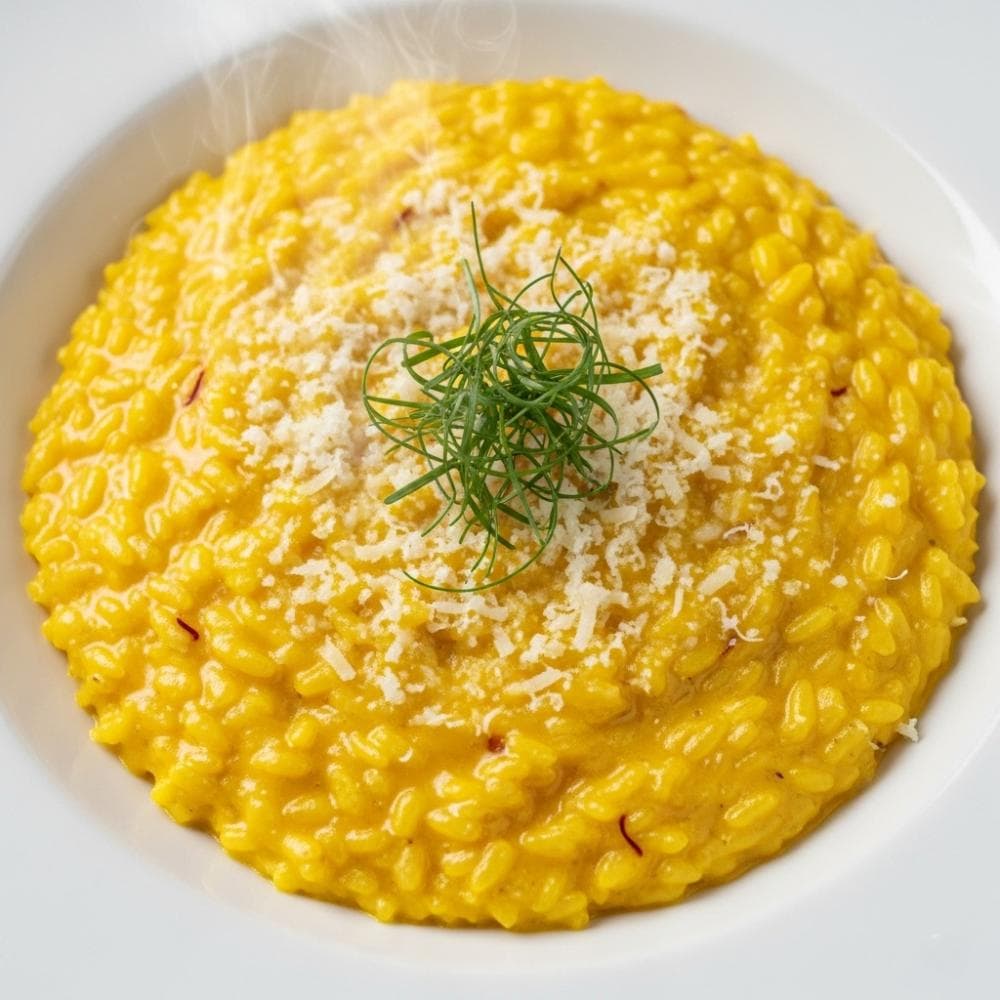
Risotto alla Milanese
A classic Italian risotto known for its rich, creamy texture and golden hue from saffron. It is made with Arborio rice, white wine, and Parmesan cheese, perfect for a comforting meal for two.
The Quick Answer
Risotto turns soupy and loose or stodgy and gluey depending on how the Arborio releases its starch. Toast the grains, add the hot broth one ladle at a time with steady stirring, and finish off the heat with butter and Parmesan so the starch sets into a creamy, flowing texture rather than a paste.
Why is my Milanese risotto loose and soupy instead of flowing creamy?
Proper risotto should spread slowly like a wave, the texture Italians call all'onda, and getting there is about the balance of liquid and released starch at the finish. If you stop adding broth too early or pull it off heat before the starch thickens, the grains swim in thin liquid. If you flood it past the point the Arborio can absorb, the same happens. Judge by the spoon, not the clock: drag a path across the pan and the risotto should close back over it in a couple of seconds. The mantecatura step matters here too, since beating cold butter and grated Parmesan in off the heat emulsifies fat with the starchy liquid, tightening a loose risotto into a glossy, cohesive cream just before serving.
Why is the saffron color and flavor weak in my risotto?
Saffron's gold and aroma sit in compounds, principally water-soluble crocin for color and volatile safranal for scent, that need warm liquid and time to leach out of the dried threads. Stirring whole threads straight into the rice gives them little chance to bloom, so the hue stays patchy and the flavor muted. Steeping the pinch in a few tablespoons of hot broth, as the recipe directs, lets the crocin diffuse fully for an even, deep gold. Folding that infusion in around the halfway point, rather than at the start, keeps the fragile safranal from cooking off across the full 20-25 minutes, preserving the honeyed, hay-like aroma. Crushing the threads lightly before steeping exposes more surface and extracts color faster still.
Not sure what to cook next? Let the generator pick your next dish in one click.
Random Recipe GeneratorAbout This Recipe
What is this dish?
Risotto alla Milanese is the golden risotto of Milan — a luxuriously creamy, saffron-tinted rice dish that is one of the most iconic preparations in all of Italian cuisine. Made with Arborio rice slowly cooked in warm broth with white wine, shallots, butter, Parmesan, and precious saffron, this risotto achieves its signature silky texture through the gradual release of rice starch and the final mantecatura (butter and Parmesan incorporation). The saffron gives it an unmistakably golden color and a subtle, aromatic floral flavor that makes it unlike any other risotto.
Why you'll love it
Risotto alla Milanese rewards patient cooking with extraordinary, restaurant-quality results from humble ingredients. The process — adding warm stock ladle by ladle while stirring — is meditative rather than difficult, and once mastered, becomes a deeply satisfying cooking ritual. The dish is vegetarian, endlessly impressive to serve, and pairs beautifully with virtually any protein. The saffron's golden color makes it visually spectacular, and the silky, flowing texture achieved through the mantecatura technique is genuinely unlike anything else in Italian cooking.
When to serve
Risotto alla Milanese is the classic accompaniment to Osso Buco alla Milanese for an authentic Italian dinner party main course. It also works beautifully as a standalone vegetarian main course, an elegant first course before a meat dish, or a sophisticated side dish for grilled fish or roasted chicken. Serve it to guests who appreciate classic Italian cuisine — it's the kind of dish that demonstrates real cooking skill and creates a memorable dining experience.
Quick tips
Keep the stock at a steady simmer on a back burner throughout — never add cold stock to hot risotto. Toast the dry rice for 1-2 minutes before adding any liquid. Add stock one ladle at a time, waiting for each to be fully absorbed before adding the next. Remove from heat before the mantecatura — vigorously fold in cold butter and Parmesan for maximum silkiness. Serve immediately.
Ingredient Highlights
Arborio Rice
The specific short-grain rice variety that makes risotto possible. Arborio contains a uniquely high proportion of amylopectin starch on the outside of each grain, which releases gradually into the cooking liquid with constant stirring, creating the characteristic creamy, binding sauce that holds risotto together. The inner grain stays slightly firm (al dente), creating the textural contrast of a creamy sauce around a firm rice grain.
Saffron
The defining ingredient of this specific risotto — the spice that transforms Arborio rice into something uniquely Milanese. Saffron's extraordinary flavor (floral, slightly bitter, honeyed) and vibrant golden color come from the stigmas of the Crocus sativus flower, harvested by hand. It is the world's most expensive spice by weight, but only a tiny pinch is needed. Bloom it in a tablespoon of warm wine or broth before adding to fully release its color and aroma.
Dry White Wine
Added early in the cooking process to deglaze the toasted rice and add acidity and complexity. The wine's alcohol cooks off, leaving behind fruity, acidic notes that brighten the risotto and prevent it from tasting flat or one-dimensional. Use a wine you'd enjoy drinking — Pinot Grigio, Vermentino, or Sauvignon Blanc all work well. The wine should be fully absorbed before the stock is added.
Parmigiano-Reggiano
The finishing element that adds saltiness, nuttiness, and richness to the risotto. Added off the heat along with cold butter during the mantecatura, freshly grated Parmesan melts completely into the risotto, contributing to its creamy texture. Always use real Parmigiano-Reggiano, grated fresh — pre-grated cheese contains anti-caking agents that prevent smooth melting.
Substitution Options
Use Carnaroli or Vialone Nano rice instead of Arborio for different textures — Carnaroli holds its shape slightly better and absorbs more liquid, while Vialone Nano produces a more flowing, soupy style favored in Venice. Replace white wine with a splash of white wine vinegar diluted in extra broth for a non-alcoholic version. Use vegetable broth instead of chicken broth for a vegetarian preparation. Replace butter with a high-quality dairy-free alternative for dairy-free needs. Experiment with adding mushrooms, peas, or roasted garlic for variations beyond the classic saffron preparation. Use Grana Padano instead of Parmigiano-Reggiano for a slightly milder, more affordable finish.
You'll likely need to buy
Likely in your pantry
Step-by-Step Instructions
Prepare broth and saffron
Heat 4 cups vegetable broth in a saucepan until it is hot and gently simmering (cooking gently just below boiling, with small bubbles). Keep it warm over low heat. In a small bowl, add 1 pinch saffron threads to about 2 tablespoons of the hot broth and let it soak for a few minutes to release its color and flavor.
Chef's Tips
- ›Simmer means to cook gently just below boiling, with small bubbles.
- ›Keeping the broth hot ensures the risotto cooks evenly without cooling the pot down.
Cook aromatics and toast rice
In a separate large, heavy-bottomed pot or Dutch oven, heat 1 tablespoon olive oil and 1 tablespoon unsalted butter over medium heat. Add the finely chopped 1/2 small onion and cook for 5 minutes, stirring occasionally, until it becomes soft and translucent (you can see through it). Add the 1 clove minced garlic and cook for 1 minute until it smells pleasant (fragrant). Add 1 cup Arborio rice and stir constantly for 2 minutes until the edges of the rice grains become translucent.
Chef's Tips
- ›Translucent means you can see through it, indicating it is soft.
- ›Fragrant means it smells good and aromatic.
- ›Toasting the rice helps it keep its shape and absorb liquid better.
Add wine and cook
Pour 1/4 cup dry white wine into the pot with the rice. Stir constantly until all the wine has been absorbed by the rice. The strong alcohol smell will cook off.
Chef's Tips
- ›Stirring constantly ensures even absorption and prevents sticking.
- ›The alcohol evaporates, leaving behind a subtle flavor.
Add broth and simmer
Begin adding the hot vegetable broth to the rice, 1 ladleful (about 1/2 cup) at a time. Stir constantly, waiting until almost all the liquid is absorbed before adding the next ladleful. After you have added about half of the broth, stir in the saffron-infused broth mixture. Continue adding broth, 1 ladleful at a time, stirring constantly, for 20-25 minutes. The risotto is done when the rice is creamy but still firm to the bite (al dente).
Chef's Tips
- ›Constant stirring creates the creamy texture of risotto.
- ›Al dente means cooked so that it is still firm when bitten.
Finish and serve
Remove the pot from the heat. Stir in 1/4 cup grated Parmesan cheese, 1/2 teaspoon salt, and 1/8 teaspoon black pepper. Stir vigorously for about 1 minute to make the risotto extra creamy (this is called 'mantecare'). Taste and adjust salt or pepper if needed. Serve immediately in warm bowls, garnished with 1 tablespoon chopped fresh parsley.
Chef's Tips
- ›Mantecare means vigorously stirring in butter and cheese at the end for creaminess.
- ›Risotto is best served immediately as it continues to cook and thicken.
Chef's Tips
Techniques that separate good from great
Keep your stock warm throughout cooking — never add cold stock
Adding cold stock to a hot risotto arrests the cooking process, dropping the pan temperature and causing the starch to seize up instead of releasing gradually. Keep stock in a small saucepan over low heat at a steady simmer on a back burner. Warm stock absorbs into the rice continuously, maintaining the rhythmic starch release that creates risotto's signature creamy texture.
Toast the rice before adding liquid
Adding the dry Arborio rice directly to the softened shallots and toasting it in the oil or butter for 1-2 minutes before any liquid is added is essential. You'll see the edges of the grains turn slightly translucent. This toasting step seals the outer starch layer, ensuring the rice releases starch gradually rather than all at once, which gives you control over the final texture.
Add stock one ladle at a time and stir frequently
This is not optional. Adding all the stock at once produces cooked rice in broth, not risotto. Each ladleful of stock should be fully absorbed before the next is added, and the constant stirring agitates the rice grains, causing them to release their starch into the surrounding liquid. This released starch is what creates the thick, creamy sauce that coats every grain.
Finish with the mantecatura — butter and Parmesan off the heat
The final step that separates mediocre risotto from exceptional risotto is the mantecatura: remove the pot from the heat, add cold diced butter and freshly grated Parmesan, then fold vigorously in a swirling figure-eight motion for 60 seconds. The cold butter emulsifies into the hot risotto, creating an impossibly silky, glossy sauce. Serve within 3 minutes — risotto waits for no one.
Nutrition Facts
Per serving · Estimated values
* Estimated per serving based on a 2,000 calorie diet.
Equipment Needed
- Medium saucepan (for broth)
- Small bowl (for saffron)
- Large, heavy-bottomed pot or Dutch oven
- Wooden spoon or sturdy spatula
- Ladle
- Measuring cups
- Measuring spoons
- Knife and cutting board
As an Amazon Associate we earn from qualifying purchases — at no extra cost to you.
Quick Tips
- The key to good risotto is patience and constant stirring. Do not walk away from the pot!
- Use good quality Arborio rice for the best creamy texture; other rice types will not yield the same result.
- For a richer flavor, you can add 1 tablespoon of finely grated Parmesan cheese when serving.
Recipe Variations
Different ways to make this dish your own
Risotto ai Funghi (Mushroom Risotto)
Omit the saffron and add 2 cups of mixed sautéed mushrooms (porcini, cremini, chanterelle) halfway through cooking. Soak 1/4 cup of dried porcini in warm water for 20 minutes and add the soaking liquid (strained) to the stock for intense mushroom depth.
Risotto al Limone (Lemon Risotto)
Skip the saffron and finish the risotto with the zest of 2 lemons, extra lemon juice, and ricotta in place of some butter for a bright, summery Sicilian-inspired variation. Serve with grilled shrimp or seared scallops.
Risotto Nero (Black Squid Ink Risotto)
Add 2 sachets of squid ink to the broth and use seafood stock as the base for a dramatic, jet-black Venetian risotto. Finish with butter, Parmesan, and sautéed squid or clams for a stunning, intensely flavored seafood dish.
Arancini (Fried Rice Balls)
Use day-old leftover risotto alla Milanese to make arancini — shape cold risotto around a cube of mozzarella, roll in breadcrumbs, and deep-fry until golden. The saffron-tinted risotto makes these rice balls particularly beautiful and flavorful.
What to Serve With
Perfect pairings to complete the meal
As the Classic Accompaniment to Osso Buco
Risotto alla Milanese is the traditional accompaniment to Osso Buco alla Milanese — braised veal shanks in white wine and gremolata. The saffron-tinted risotto catches the rich braising juices that run from the veal, and the flavors of the two dishes are historically intertwined. Serve the osso buco directly on top of a generous portion of risotto for the full Milanese experience.
As an Elegant Vegetarian Main Course
On its own, risotto alla Milanese makes a stunning vegetarian main course that feels luxurious despite simple ingredients. Serve in wide, warmed shallow bowls with extra Parmesan shaved over the top, a drizzle of good extra virgin olive oil, a few threads of saffron for visual drama, and fresh chives or microgreens. The golden color makes it visually spectacular.
With Sautéed Wild Mushrooms
A topping of sautéed mixed mushrooms (porcini, cremini, shiitake, and chanterelle) adds earthy depth that complements the delicate saffron flavor without overwhelming it. Sauté mushrooms in butter and garlic until golden, then season with thyme and a splash of white wine. Spoon over the risotto just before serving for a restaurant-quality presentation.
As a Base for Arancini (Fried Rice Balls)
Day-old leftover risotto alla Milanese is the foundation for arancini — the iconic Sicilian fried rice balls. Shape cold risotto around a cube of mozzarella and a spoonful of ragù, roll in breadcrumbs, and deep-fry until golden. The saffron-tinted risotto gives these arancini a distinctive golden color and flavor, making them particularly beautiful and delicious.
Storage & Reheating
Keep it fresh and plan ahead
Refrigerator
Store cooled risotto in an airtight container for up to 3 days. It will thicken considerably as it chills and the starch continues to absorb moisture. This is normal. Risotto is best eaten fresh, but leftovers are excellent repurposed as arancini or as a base for frittata.
Freezer
Risotto does not freeze well in general — the texture becomes mushy and grainy after thawing as the starch structure breaks down. If you must freeze, portion into individual servings, freeze flat in zip-lock bags, and eat within 1 month. Reheat with extra stock and accept a softer texture.
Make-Ahead
You can cook risotto 80% of the way through (cook for about 12 minutes instead of the full 18-20), then spread on a tray to cool quickly and refrigerate for up to 1 day. Finish the final cooking with the remaining stock, butter, and Parmesan just before serving. This 'par-cooked' method is used by restaurants to serve risotto quickly during service.
Reheating
Reheat in a wide saucepan over medium heat with 2-3 tablespoons of warm stock or water per portion, stirring constantly until the risotto loosens, heats through, and regains its creamy consistency. Add more liquid as needed — cold risotto needs more liquid than you expect. Stir in a small knob of fresh butter and a fresh spoonful of Parmesan at the end to restore the creamy finish.
Cooking tonight?
Get a month of dinners like this — done for you
30 chef-tested dinners mapped to the month, plus 5 ready-to-shop grocery lists. One-time $8.99 — 30 dinners planned for you, zero nightly decisions.
See the 30-Day Plan →Got Leftovers?
Turn what you already have in your fridge into delicious meals. Our AI-powered generator creates personalized recipes from your ingredients.
Go Deeper
Master the Culinary Science
Every recipe is a doorway. Our 7 Mastery Guides give you the science, technique, and framework to understand why food works — not just how to follow steps.
AI-Powered
Have Ingredients? Generate a Recipe.
Tell our AI what's in your fridge and get a custom recipe with image in seconds. No waste, no boredom.
Try the AI Recipe Generator →Browse more like this:
You Might Also Like
Discover more delicious recipes similar to what you're cooking