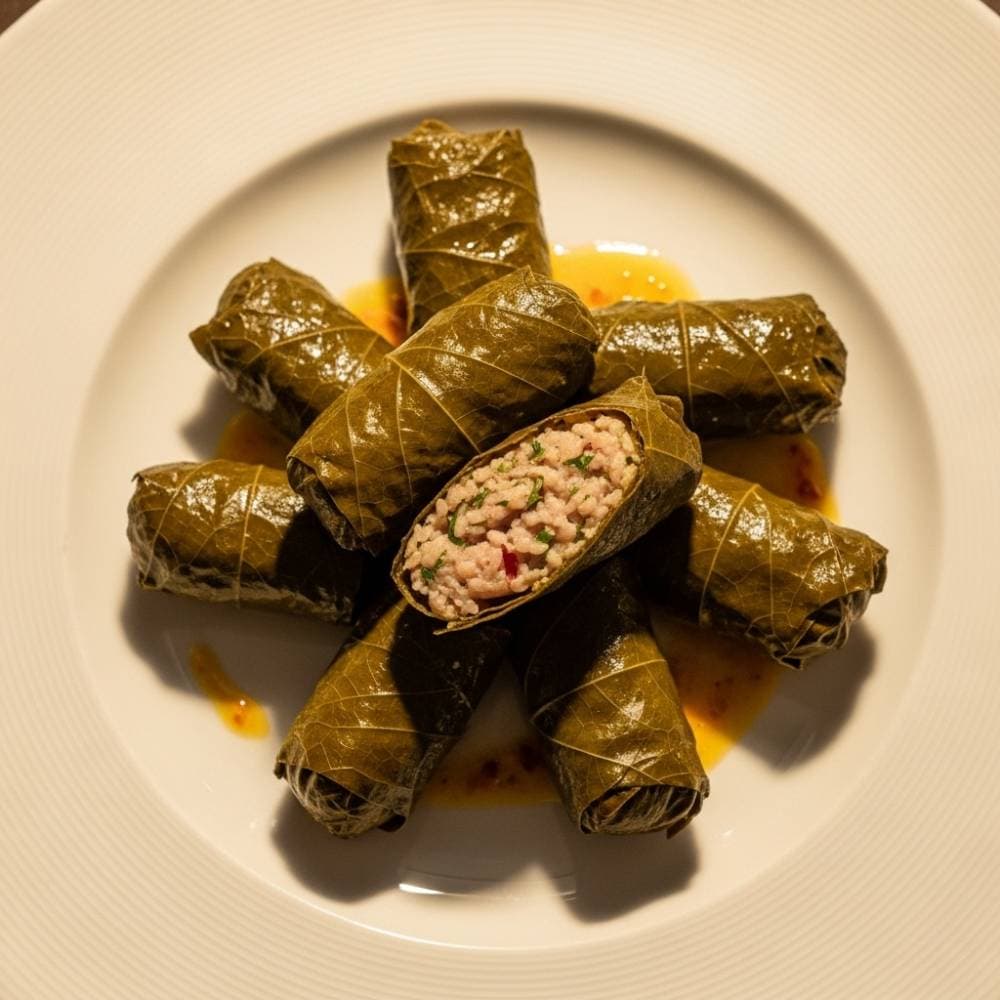
Stuffed Grape Leaves (Warak Enab)
Tender, brined grape leaves filled with a savory mixture of rice, fresh herbs, and tomatoes, slowly simmered until perfectly cooked. A classic Middle Eastern vegetarian dish, wonderful as an appetizer or light meal for two.
The Quick Answer
Warak enab fails when the rolls unravel during cooking or the rice inside stays hard and chalky, both rooted in how tightly you roll and how the rice cooks. Roll firmly but leave a little room for the rice to expand, keep the rolls weighted and submerged in lemony liquid, and simmer low and slow so the raw short-grain rice fully hydrates inside the leaves.
Why is the rice in my grape leaves still hard?
The rice goes into the leaves completely raw, so it must absorb all its water through the leaf during the long simmer rather than being pre-boiled. Short-grain rice is chosen because it is high in amylopectin starch, which swells and turns tender and slightly sticky, helping the filling hold together. If the rolls are not kept submerged in the one cup of liquid and quarter cup of lemon juice, the rice on top dries out and stays chalky, which is why a plate is set directly on the rolls to hold them under the surface. Crowding too much filling in also leaves the grains no room to swell and hydrate evenly, so each roll gets just one to two teaspoons of rice.
Why do my stuffed grape leaves unroll while cooking?
As the rice cooks it swells and pushes outward, and a loosely wrapped leaf simply pops open under that pressure, spilling filling into the pot. Rolling firmly, with the bottom folded over the filling and the sides tucked in before rolling into a tight cylinder, creates a compact parcel that contains the expansion. Packing the rolls snugly together in layers means they brace against each other and cannot wobble loose, and the weighted plate on top stops them floating and shifting. The acid from the lemon juice also helps the leaves stay firm rather than going slack. Together these are why a gentle, steady simmer, not a rolling boil that tumbles the rolls, keeps them sealed.
Not sure what to cook next? Let the generator pick your next dish in one click.
Random Recipe GeneratorAbout This Recipe
What is this dish?
Warak enab (stuffed grape leaves) is one of the most celebrated dishes across the Arab world, Greece (dolmades), Turkey (dolma), and the entire Eastern Mediterranean. Tender grape leaves are wrapped around a filling of rice, herbs, lemon, and olive oil (vegetarian) or mixed with lamb (with meat), then slowly simmered in lemony broth until perfectly tender. This is labor-intensive food in the best sense — a dish made with love and patience, often prepared in families for celebrations.
Why you'll love it
Warak enab achieves a particular kind of pleasure that comes from small, perfect packages of food — the grape leaf's slight bitterness, the lemony rice filling, and the slow-simmered depth create a bite that is complex, satisfying, and addictive. They are served at room temperature or slightly warm, making them ideal for entertaining. Once you eat homemade warak enab, the jarred variety seems very diminished.
When to serve
Serve as a mezze starter, a party appetizer, or a light main course. Warak enab is a centerpiece dish at Levantine holiday tables, Ramadan iftars, and family celebrations across the Middle East and Eastern Mediterranean.
Quick tips
Rinse jarred grape leaves thoroughly to reduce brine. Roll tightly to prevent unrolling during cooking. Pack the rolls seam-side down and snugly in the pot. A heavy plate placed on top during cooking prevents unrolling. Always cook over the lowest possible heat for the gentlest simmer.
Ingredient Highlights
Grape Leaves (Jarred or Fresh)
Jarred grape leaves in brine are widely available at Greek and Middle Eastern grocery stores and provide good results year-round. Rinse under cold water and soak for 10-15 minutes to remove excess salt. Fresh grape leaves (only from grapevines — not all plants are edible) must be blanched briefly before stuffing. They provide a fresher, less briny flavor.
Short-Grain Rice
Short-grain rice (like Calrose or Italian Arborio-style) works better than long-grain for stuffed grape leaves — its starchiness helps bind the filling and creates a cohesive texture when cooked. The rice must be only partially cooked in the filling (it will finish cooking inside the leaves during simmering).
Fresh Herbs (Parsley, Mint, Dill)
The aromatics that distinguish warak enab from a plain rice package. Fresh flat-leaf parsley, mint, and dill (in some regional variations) provide essential freshness and bright green flavor. Always use fresh, not dried — the herb flavors are front and center in this dish.
Lemon Juice
Large quantities of fresh lemon juice are used in both the filling and the braising liquid. The acid brightens the rice and herbs, permeates the grape leaves during cooking, and creates the characteristic bright, tart-savory flavor of Lebanese-style warak enab. Use fresh lemons only.
Substitution Options
Fresh grape leaves can be replaced with jarred (rinse thoroughly). For a meat-stuffed version, add 1/4 pound ground lamb mixed with the rice and herbs. Chard leaves or cabbage leaves can replace grape leaves for a similar preparation with different texture and flavor. For a tomato-based version, add 1 tablespoon tomato paste and diced tomatoes to the filling. Omit the lemon juice for a different regional style (Turkish-style uses less acid).
You'll likely need to buy
Likely in your pantry
Step-by-Step Instructions
Prepare grape leaves and rice filling
Rinse the brined grape leaves thoroughly under cold water to remove excess salt. Carefully separate them and lay them flat. If any are too large, you can cut them in half. Brined means preserved in salt water. In a medium bowl, combine 1/2 cup rinsed short-grain rice, 1 finely diced medium tomato, 1/4 finely diced medium onion, 1/4 cup finely chopped fresh parsley, 2 tablespoons finely chopped fresh mint, 2 tablespoons olive oil, 1/2 teaspoon ground allspice, 1/4 teaspoon ground cinnamon, 1/4 teaspoon salt, and 1/4 teaspoon black pepper. Mix well to combine all ingredients.
Chef's Tips
- ›Rinsing grape leaves well prevents them from being too salty.
- ›Using short-grain rice ensures a tender filling.
Roll the grape leaves (Warak Enab)
On a clean flat surface, lay a grape leaf shiny-side down with the stem end facing you. If the leaf has a tough stem, remove it. Place about 1-2 teaspoons of the rice filling near the stem end (the wider part of the leaf). Fold the bottom part of the leaf over the filling, then fold in the sides towards the center. Roll the leaf tightly from the bottom up to create a compact cylinder. Warak Enab means grape leaves. Repeat with remaining leaves and filling. This step requires patience and practice.
Chef's Tips
- ›Rolling tightly prevents the filling from coming out during cooking.
- ›Practice helps improve rolling speed and neatness.
Layer and simmer
Line the bottom of a heavy-bottomed pot or Dutch oven with any torn or extra grape leaves, or thin slices of potato or tomato. This prevents the rolls from sticking or burning. Arrange the rolled grape leaves snugly in layers in the pot. You can place 1/2 thinly sliced lemon on top of the layers. Pour 1 cup hot water or vegetable broth and 1/4 cup fresh lemon juice over the grape leaves. Place a heatproof plate directly on top of the grape leaves to keep them submerged. Bring the liquid to a gentle simmer (cook gently just below boiling, with small bubbles) over medium heat. Cover the pot tightly with a lid, reduce the heat to low, and simmer for 1 hour to 1 hour 15 minutes, or until the rice is cooked through and the leaves are tender. Simmer means to cook gently just below boiling, with small bubbles.
Chef's Tips
- ›A heavy pot ensures even heat distribution.
- ›The plate keeps the rolls submerged and cooked evenly.
Serve
Once cooked, remove the pot from heat and let it rest for 10-15 minutes, still covered. This allows the liquid to be fully absorbed and flavors to meld. Carefully drain any remaining liquid. Serve the Stuffed Grape Leaves warm or at room temperature, often with extra lemon wedges. They are also delicious chilled.
Chef's Tips
- ›Resting allows the flavors to settle and makes the rolls firmer.
- ›Serving with extra lemon juice brightens the flavors.
Chef's Tips
Techniques that separate good from great
Rinse and soak jarred grape leaves in multiple changes of water to remove excess brine
Jarred grape leaves can be very salty from the preserving brine. After removing from the jar, rinse under cold running water for 1-2 minutes, then soak in a bowl of cold water for 15-20 minutes, changing the water once. Taste a leaf before rolling — it should be mildly flavored, not salty. Proper rinsing prevents the dish from being overwhelmingly briny.
Roll the grape leaves firmly and tightly — loose rolls unravel during cooking
Place the filling in the center of the leaf, fold the bottom up over the filling, fold the sides in, and roll upward firmly toward the pointed tip. The roll should feel firm and compact, not loose or fluffy. Tight rolling is what keeps the leaf closed during the long braising. A loose roll almost always unravels.
Place a heavy plate directly on top of the rolls in the pot before adding liquid
As the rice inside the rolls cooks and expands, the rolls have a tendency to shift and uncurl. A heavy heatproof plate (slightly smaller than the pot) placed directly on top of the rolls keeps them compressed and in place during the entire cooking time. This single technique dramatically reduces unraveling.
Cook at the lowest possible simmer for 45-60 minutes — no vigorous boiling
Vigorous boiling physically agitates and unravels stuffed grape leaves and cooks the exterior leaf before the interior rice is done. The lowest possible simmer — barely a bubble — gently cooks the rice inside without disturbing the delicate rolls. The patient low heat is what produces perfectly cooked rice inside tender, intact leaves.
Nutrition Facts
Per serving · Estimated values
* Estimated per serving based on a 2,000 calorie diet.
Equipment Needed
- Medium bowl (for filling)
- Heavy-bottomed pot or Dutch oven
- Heatproof plate (to weigh down leaves)
- Measuring cups
- Measuring spoons
- Knife and cutting board
As an Amazon Associate we earn from qualifying purchases — at no extra cost to you.
Quick Tips
- Grape leaves vary in saltiness, so taste the rinsed leaves before adding salt to the filling.
- For a meat-filled version, add 1/4 pound (115g) ground beef or lamb to the rice mixture and adjust cooking time slightly.
- This dish can be prepared ahead of time and stored in the refrigerator for up to 3-4 days. Flavors often improve over time.
Recipe Variations
Different ways to make this dish your own
With Ground Lamb (Meat-Stuffed)
Mix 1/4 pound ground lamb with the rice filling for a more substantial, traditional version popular in Lebanon and Syria. The lamb adds richness and the fat keeps the filling moist during the long cooking.
Greek Dolmades with Egg-Lemon Sauce (Avgolemono)
Serve the finished stuffed grape leaves with a warm avgolemono sauce (egg yolks whisked with lemon juice, tempered with the braising broth) for a Greek-style presentation.
Turkish Zeytinyağlı Dolma (Olive Oil Version)
Make the filling with rice, pine nuts, currants, dill, and cinnamon cooked in generous olive oil for the Turkish cold version served with a squeeze of lemon. A different but equally wonderful preparation.
Stuffed Cabbage Leaves (Malfouf)
Use blanched cabbage leaves instead of grape leaves for a heartier version. Stuff with the same filling and simmer in a lemony tomato broth. This variation is common in Lebanon and Syria for winter preparation.
What to Serve With
Perfect pairings to complete the meal
At Room Temperature with Yogurt and Lemon
The traditional serving temperature. Arrange on a platter with lemon wedges and a bowl of thick yogurt alongside. The cool, creamy yogurt and bright lemon juice are the perfect foils for the lemony, herbed rice filling.
As Part of a Lebanese Mezze Spread
Arrange warak enab on a platter alongside hummus, baba ganoush, fattoush salad, olives, and warm pita for a complete mezze spread. The grape leaves are a showstopper centerpiece.
With Toum (Garlic Sauce)
Serve with Lebanese toum — the emulsified garlic sauce — for dipping instead of yogurt for a stronger, more aromatic accompaniment.
Drizzled with Olive Oil and Sprinkled with Sumac
For an elegant presentation, arrange the stuffed grape leaves on a serving platter, drizzle generously with extra-virgin olive oil, and sprinkle with ground sumac (a fruity, tart red spice). This is a beautiful and flavorful finishing touch.
Storage & Reheating
Keep it fresh and plan ahead
Refrigerator
Warak enab keeps refrigerated for up to 5 days in an airtight container. They actually improve in flavor after a day as the lemon and herbs permeate more fully. Excellent served cold or at room temperature.
Freezer
Freeze cooked stuffed grape leaves in a single layer, then transfer to bags. Freeze for up to 2 months. Thaw overnight in the refrigerator and serve at room temperature.
Make-Ahead
One of the best make-ahead dishes. Prepare 1-3 days ahead and refrigerate. The flavor improves over 24-48 hours. Remove from refrigerator 30 minutes before serving.
Reheating
Warak enab are best served at room temperature, not reheated. If you prefer warm, place in a steamer for 5 minutes, or gently warm covered in a pot with a splash of water over low heat.
Cooking tonight?
Get a month of dinners like this — done for you
30 chef-tested dinners mapped to the month, plus 5 ready-to-shop grocery lists. One-time $8.99 — 30 dinners planned for you, zero nightly decisions.
See the 30-Day Plan →Got Leftovers?
Turn what you already have in your fridge into delicious meals. Our AI-powered generator creates personalized recipes from your ingredients.
Go Deeper
Master the Culinary Science
Every recipe is a doorway. Our 7 Mastery Guides give you the science, technique, and framework to understand why food works — not just how to follow steps.
AI-Powered
Have Ingredients? Generate a Recipe.
Tell our AI what's in your fridge and get a custom recipe with image in seconds. No waste, no boredom.
Try the AI Recipe Generator →Browse more like this:
You Might Also Like
Discover more delicious recipes similar to what you're cooking