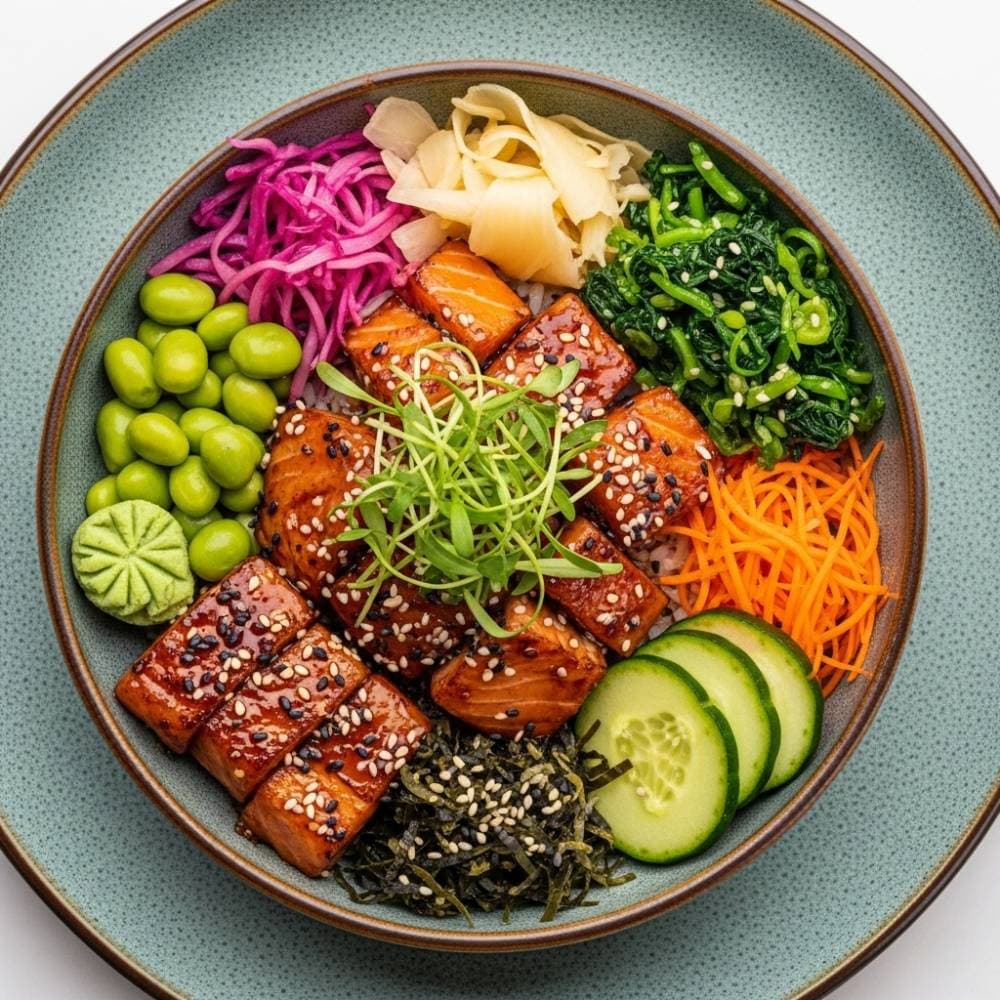
Teriyaki Salmon Poke Bowl
A fresh and vibrant Hawaiian-inspired bowl featuring diced sushi-grade salmon marinated in a sweet and savory teriyaki sauce, served over seasoned rice with crisp vegetables. A delicious and healthy meal for two.
The Quick Answer
A teriyaki salmon poke bowl goes wrong when the raw fish weeps and tastes flat or the rinse-skip leaves the sushi rice gluey. Cutting clean half-inch cubes and rinsing the short-grain rice until the water runs clear are what keep the salmon firm-fresh and the base glossy rather than pasty.
Why does my marinated raw salmon get watery and lose flavor?
How you cut the salmon, not just how long it sits, controls texture here. Ragged, torn cubes expose frayed muscle fibers, and the salt in the soy-mirin marinade pulls water out of those broken surfaces fast, so the fish weeps into the bowl and the marinade ends up diluted and thin. Cutting clean half-inch cubes with a sharp blade in a single stroke leaves smooth faces that release far less liquid, keeping the buttery interior intact. Marinating in the refrigerator, as the recipe directs, also matters beyond safety: cold slows the salt's protein-denaturing action, so the cubes pick up the ginger, garlic and sesame flavor at the surface without curing through to a firm, gravlax-like bite.
Why is my sushi rice gummy even when I season it?
The fix that the recipe leans on is rinsing the short-grain rice before cooking, and skipping it is the usual cause of gumminess. The grains are coated in loose surface starch, mostly amylopectin dust milled off during processing; left on, it gelatinizes into a sticky paste that glues grains into a clumped mass. Rinsing until the water runs nearly clear removes that free starch so the cooked grains stay distinct and glossy while still cohesive enough for poke. The 1-to-1.25 rice-to-water ratio is deliberately tight for the same reason: extra water leaches yet more starch out during the simmer, pushing the finished rice toward porridge no matter how carefully you fold in the vinegar.
Not sure what to cook next? Let the generator pick your next dish in one click.
Random Recipe GeneratorAbout This Recipe
What is this dish?
Teriyaki salmon poke bowl blends the Hawaiian poke (raw fish salad) tradition with Japanese teriyaki flavors. Poke (pronounced poh-KAY) is a Hawaiian word meaning 'to cut crosswise into pieces' and refers to the traditional Hawaiian preparation of cubed raw fish seasoned simply with sea salt, soy sauce, and seaweed. This bowl version adds teriyaki salmon and Japanese-inspired toppings for a contemporary bowl meal that has become a global food trend.
Why you'll love it
Poke bowls deliver extraordinary flavor, nutrition, and visual appeal with minimal cooking. The combination of savory teriyaki salmon, creamy avocado, crunchy cucumber, sweet edamame, and tangy pickled ginger over seasoned sushi rice creates a complete sensory experience. The bowl format is also infinitely customizable — add or remove any component to personal taste.
When to serve
Serve as a healthy weeknight dinner, a satisfying lunch, or a visually impressive meal for guests who will appreciate the fresh, clean flavors. Poke bowls also work well as meal-prep — prepare all components separately and assemble fresh throughout the week.
Quick tips
Use sushi-grade salmon if serving raw. Teriyaki-glazed and seared salmon is the safer and equally delicious option. Season the rice with sushi vinegar while it is still warm. Arrange toppings in neat sections rather than mixing for the best visual presentation.
Ingredient Highlights
Sushi-Grade Salmon
When serving salmon raw in a poke bowl, sushi-grade (also called sashimi-grade) salmon from a trusted fishmonger is essential. The term means it has been handled and frozen at temperatures that kill parasites. When in doubt, sear the salmon briefly in the teriyaki glaze — the flavors are excellent both ways.
Sushi Rice
Short-grain Japanese rice seasoned with a mixture of rice vinegar, sugar, and salt is the foundation of any poke bowl. The seasoning makes the rice slightly tangy and gives it the characteristic sticky texture that holds toppings in place. Medium-grain Calrose rice is an accessible substitute.
Teriyaki Glaze
The signature flavoring of this bowl. Traditional teriyaki is made from soy sauce, mirin, sake, and sugar reduced to a glossy, caramelized glaze. Bottled teriyaki sauce works well as a time-saving substitute. The glaze caramelizes beautifully when the salmon is seared.
Edamame
Frozen edamame (shelled soybeans) provide protein, sweetness, and a pop of green color. They need only 3-5 minutes in boiling water to heat through. They add a substantial, satisfying element to the bowl's lighter ingredients.
Substitution Options
Replace salmon with tuna (most traditional poke fish), yellowtail, or shrimp (seared). For a vegetarian version, use marinated and seared tofu or avocado as the protein element. Cauliflower rice or brown rice can replace sushi rice. Add mango for sweetness, cucumber for crunch, or seaweed salad for umami depth. Sriracha mayo (sriracha mixed with Japanese mayo) is a popular drizzle for additional richness and heat.
You'll likely need to buy
Likely in your pantry
Step-by-Step Instructions
Cook and season the rice
In a medium saucepan, combine 1 cup rinsed sushi rice or short-grain white rice with 1 1/4 cups water. Bring to a rolling boil over medium-high heat. Once boiling, reduce heat to low, cover tightly, and simmer (cook gently just below boiling, with small bubbles) for 15 minutes, or until all water is absorbed. Remove from heat and let rest, covered, for 10 minutes. While rice rests, in a small bowl, whisk together 1 tablespoon rice vinegar, 1 teaspoon granulated sugar, and 1/2 teaspoon salt until dissolved. Fluff the cooked rice with a fork and gently fold in the seasoned vinegar mixture. Simmer means to cook gently just below boiling, with small bubbles.
Chef's Tips
- ›Resting the rice after cooking makes it fluffy.
- ›Seasoning the rice while warm allows it to absorb the flavor well.
Marinate the salmon
While rice cooks, dice 1/2 pound sushi-grade salmon (salmon safe for raw consumption) into 1/2-inch cubes. In a medium bowl, whisk together 2 tablespoons soy sauce (use tamari for gluten-free), 1 tablespoon mirin (sweet Japanese cooking wine), 1 tablespoon sake (Japanese rice wine) or dry white wine, 1 tablespoon granulated sugar, 1/2 teaspoon grated fresh ginger, 1 clove minced garlic, and 1/2 teaspoon sesame oil. Add the diced salmon to the marinade, tossing gently to coat. Let it marinate for at least 15 minutes in the refrigerator. Mirin is a sweet Japanese cooking wine. Sake is Japanese rice wine.
Chef's Tips
- ›Sushi-grade salmon is very important for raw consumption.
- ›Marinating adds a burst of flavor to the salmon.
Prepare toppings
Thinly slice 1/2 English cucumber and 1 ripe avocado. Prepare 1/2 cup cooked edamame (shelled). Shred 1/4 cup carrot. Thinly slice 2 tablespoons green onions. Thinly slice 1/2 sheet nori (dried seaweed).
Chef's Tips
- ›Preparing all toppings in advance makes assembly quick and easy.
- ›Nori is dried seaweed, often used in sushi.
Assemble and serve
Divide the seasoned sushi rice evenly between two serving bowls. Arrange the marinated salmon over the rice. Artfully arrange the prepared toppings (cucumber, avocado, edamame, shredded carrot) around the salmon in each bowl. Garnish with 2 tablespoons thinly sliced green onions and 1 teaspoon toasted sesame seeds. Sprinkle with sliced nori. Serve immediately.
Chef's Tips
- ›Arrange toppings neatly for an appealing presentation.
- ›Poke bowl means Hawaiian raw fish salad bowl.
Chef's Tips
Techniques that separate good from great
Season the sushi rice while still hot — cold rice won't absorb the seasoning
Mix the sushi vinegar (rice vinegar, sugar, salt) into the cooked rice immediately while it is still hot and steaming. The hot rice absorbs the seasoning into its interior. If you add vinegar dressing to cold rice, it coats the surface only, resulting in unevenly seasoned rice with a sharp acidic exterior.
Sear the teriyaki salmon at very high heat for 90 seconds per side for the best glaze
Maximum caramelization of the teriyaki glaze requires intense, brief heat. Pat the salmon completely dry, apply a thin layer of glaze, and sear in a scorching-hot pan (a drop of water should evaporate immediately) for about 90 seconds per side. This caramelizes the sugars in the teriyaki quickly without overcooking the interior.
Arrange toppings in neat sections rather than mixed for the best visual and eating experience
Poke bowls are visually intended to be beautiful — arrange each component in its own section of the bowl rather than mixing everything together. This presentation lets you see and taste each ingredient individually and allows you to combine different elements with each bite as you prefer.
Add avocado last to prevent browning, and squeeze lime juice over it immediately
Avocado oxidizes (browns) rapidly after cutting. Slice or cube avocado just before serving, and immediately squeeze lime or lemon juice over it to slow browning. Adding it as the last topping before serving ensures it looks fresh and bright green rather than brown and unappetizing.
Nutrition Facts
Per serving · Estimated values
* Estimated per serving based on a 2,000 calorie diet.
Equipment Needed
- Medium saucepan (for rice)
- Medium bowl (for salmon marinade)
- Small bowl (for rice seasoning)
- Serving bowls
- Whisk
- Knife and cutting board
- Measuring cups
- Measuring spoons
As an Amazon Associate we earn from qualifying purchases — at no extra cost to you.
Quick Tips
- Always use sushi-grade salmon when consuming raw fish for safety.
- For a spicier kick, add a tiny pinch of red pepper flakes or a drizzle of sriracha to the salmon marinade.
- You can add other vegetables like radishes, pickled ginger, or corn to customize your poke bowl.
Recipe Variations
Different ways to make this dish your own
Ahi Tuna Poke Bowl (Traditional Hawaiian)
Use cubed raw ahi tuna marinated in soy sauce, sesame oil, green onion, and toasted sesame seeds for the most traditional Hawaiian poke. Serve over sushi rice with the same Japanese-inspired toppings.
Spicy Salmon Bowl
Mix diced salmon with sriracha, Japanese mayo, sesame oil, and soy sauce for a creamy, spicy salmon poke mixture. Top with cucumber, avocado, and extra sriracha.
Shrimp Poke Bowl
Use cooked and chilled shrimp (halved lengthwise) instead of salmon. Marinate briefly in ponzu, sesame oil, and ginger for a lighter, fresher bowl that requires no raw seafood concerns.
Cauliflower Rice Poke Bowl (Low-Carb)
Replace sushi rice with seasoned cauliflower rice for a low-carbohydrate version that maintains all the bowl's fresh flavors and toppings.
What to Serve With
Perfect pairings to complete the meal
Build-Your-Own Poke Bowl Bar
Set out the sushi rice, salmon, and all toppings in separate bowls and let guests build their own bowl. This format is ideal for casual gatherings and ensures everyone gets exactly what they want.
With Miso Soup
Serve alongside a bowl of simple miso soup for a complete Japanese-Hawaiian inspired meal. The warm, umami-rich soup complements the cool, fresh poke bowl beautifully.
With Pickled Ginger and Wasabi on the Side
Serve traditional sushi accompaniments — sliced pickled ginger (gari) and wasabi — alongside the poke bowl. These add the classic sushi flavor experience and allow guests to season their bowl as they prefer.
As Weekly Meal Prep Bowls
Prepare sushi rice and all toppings except avocado in advance. Store separately and assemble throughout the week for quick, healthy weekday lunches that require no additional cooking.
Storage & Reheating
Keep it fresh and plan ahead
Refrigerator
Store all components separately for the best quality. Cooked salmon keeps for 2 days. Sushi rice keeps for 2 days (though the texture declines after the first day). All other toppings keep for 3-4 days. Do not store assembled bowls.
Make-Ahead
Ideal for meal prep. Cook rice and all toppings (except avocado) up to 3 days ahead. Slice avocado fresh when assembling. Cook salmon in the teriyaki glaze within 30 minutes of serving for best quality.
Reheating
Serve salmon cold (poke style) or briefly seared in a hot pan. Sushi rice is best at room temperature — remove from the refrigerator 20 minutes before serving and fluff with a fork.
Cooking tonight?
Get a month of dinners like this — done for you
30 chef-tested dinners mapped to the month, plus 5 ready-to-shop grocery lists. One-time $8.99 — 30 dinners planned for you, zero nightly decisions.
See the 30-Day Plan →Got Leftovers?
Turn what you already have in your fridge into delicious meals. Our AI-powered generator creates personalized recipes from your ingredients.
Go Deeper
Master the Culinary Science
Every recipe is a doorway. Our 7 Mastery Guides give you the science, technique, and framework to understand why food works — not just how to follow steps.
AI-Powered
Have Ingredients? Generate a Recipe.
Tell our AI what's in your fridge and get a custom recipe with image in seconds. No waste, no boredom.
Try the AI Recipe Generator →Browse more like this:
You Might Also Like
Discover more delicious recipes similar to what you're cooking