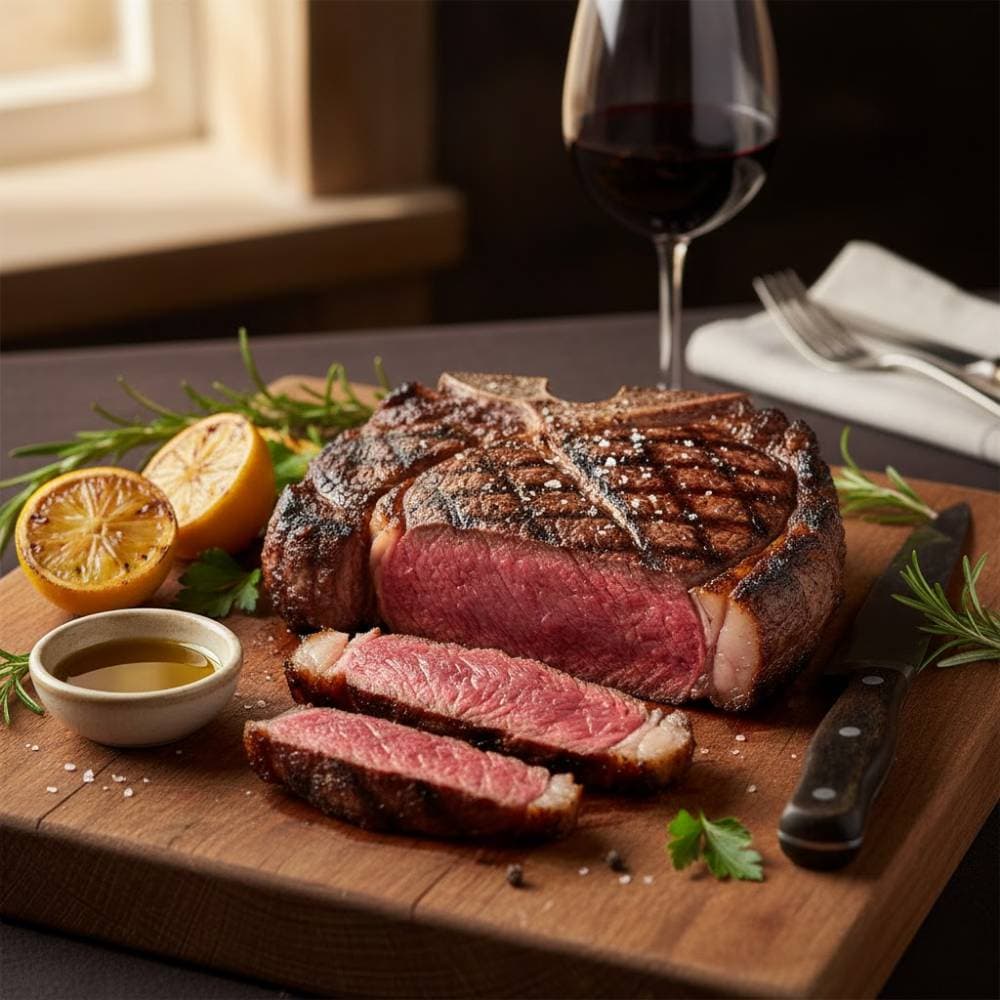
Bistecca alla Fiorentina (Italian Grilled Steak at Home)
A massive, bone-in T-bone or porterhouse steak, simply seasoned and grilled to perfection. This iconic Tuscan dish celebrates the quality of the beef with minimal fuss—just fire, salt, and tradition.
The Quick Answer
A grey, steamed crust or a raw cold center are the two ways this steak goes wrong, and both come from moisture and thickness mismanagement. Dry the surface completely and grill over very high heat for a deep char, then use a two-zone fire and a long rest so a 2-inch steak cooks through to rare without burning.
Why won't my bistecca develop a dark crust on the grill?
The deep, charred crust comes from the Maillard reaction, which only fires once the meat's surface is dry and hot, above roughly 300°F. A steak straight from the fridge carries surface moisture that must boil off first, and while it does, the meat steams grey instead of browning. Pat the steak bone-dry on all sides and let it come toward room temperature so the surface is parched before it hits the grill. Then grill directly over the hottest coals without moving it for five to six minutes a side. Disturbing it interrupts contact with the grate and stops the crust from forming.
Why is the inside still cold and raw while the outside is charred?
A bistecca is 2 to 2.5 inches thick, and that mass takes time for heat to penetrate to the center. Blasting it over direct high heat the whole time chars the exterior long before the interior climbs to 120-130°F for rare. The two-zone fire is the solution: sear hard over the hot side to build the crust, then move the steak to the cooler side so gentle, indirect heat finishes the middle without scorching the surface. Standing it on the bone edge briefly helps heat the thick spine area. The 10-minute rest then lets carryover heat even out the temperature and redistribute juices.
Not sure what to cook next? Let the generator pick your next dish in one click.
Random Recipe GeneratorAbout This Recipe
What is this dish?
Bistecca alla Fiorentina is Tuscany's most iconic dish — a massive, bone-in T-bone or porterhouse steak from Chianina cattle, grilled over a very hot wood or charcoal fire and served rare with only olive oil, salt, black pepper, and lemon. The name means 'Florentine-style steak' and it is eaten only in Florence and its surroundings with near-religious reverence. The preparation is deliberately minimal — the point is to celebrate the extraordinary quality of the beef itself, not to mask it with sauces or seasonings.
Why you'll love it
Bistecca alla Fiorentina is one of the purest expressions of great meat cookery — a deeply charred, slightly smoky crust surrounding beef that is rare and intensely flavored at the bone. When made with high-quality, well-marbled T-bone or porterhouse and cooked correctly, it is among the most satisfying things you can eat. The minimalist preparation — good olive oil, lemon, salt — lets the beef's quality speak without interference.
When to serve
Bistecca is a celebration meal — ideal for a special dinner for two or a summer gathering. It commands center stage and should be the undisputed focus of the meal with very simple accompaniments. Serve it at the table whole, then carve in front of your guests for maximum dramatic effect.
Quick tips
Bring the steak to room temperature for 1 hour before cooking. The steak must be at least 2 inches thick. Season with coarse salt either 40 minutes ahead or right before cooking — never in between. Rest 10-15 minutes before carving. Finish only with the finest extra virgin olive oil and fresh lemon.
Ingredient Highlights
T-Bone or Porterhouse Steak
The defining cut — a T-shaped bone separating the NY strip on one side and the tenderloin on the other. A porterhouse has a larger tenderloin. This cut provides both the most flavor-rich strip and the most tender fillet in a single steak. Must be at least 2 inches thick, ideally 2.5 inches.
Extra Virgin Olive Oil
Drizzled generously over the rested, carved steak before serving — not used in cooking. The olive oil's fruitiness and slight bitterness complement the rich beef beautifully. Use your finest olive oil here, as it is not cooked and its quality is fully apparent.
Coarse Sea Salt
The only seasoning. Used liberally on both sides of the steak. Coarse sea salt creates a textured crust and seasons the meat at the surface without drawing out too much moisture. Flaky finishing salt (fleur de sel) added at the table adds crunchy pops of salinity.
Lemon
A wedge of lemon squeezed over the carved, oil-drizzled steak is the final flavoring element. The acidity cuts through the fat and richness of the beef and brightens every bite. Some purists argue even lemon is unnecessary on a truly excellent steak.
Substitution Options
Any high-quality, well-marbled T-bone or porterhouse from any breed works for this preparation. Dry-aged beef (21-28 days) will give more concentrated, nutty flavor. A thick-cut ribeye with bone can substitute if porterhouse or T-bone is unavailable. Indoor cooking on a cast-iron pan over maximum heat, finished in a 450°F oven, can approximate the charred result when grilling is not possible. Garlic-infused olive oil can replace plain olive oil for a slightly less traditional but delicious finish.
You'll likely need to buy
Likely in your pantry
Step-by-Step Instructions
Bring steak to room temperature
Remove the steak from the refrigerator 30-40 minutes before cooking. Pat it completely dry with paper towels on all sides, including the bone. Let it sit at room temperature to ensure even cooking. The exterior should be bone-dry before grilling.
Chef's Tips
- ›Room temperature steak cooks more evenly throughout.
- ›Dry surface = better crust and char.
Prepare the grill
Preheat a charcoal or gas grill to high heat (500-600°F / 260-315°C). For charcoal, arrange coals in a two-zone setup: pile most coals on one side for direct high heat, leaving the other side with fewer coals for indirect heat. Oil the grill grates lightly to prevent sticking. The grill is ready when you can hold your hand 5 inches above the grates for only 2-3 seconds.
Chef's Tips
- ›Charcoal adds authentic smoky flavor, but gas grills work well too.
- ›Two-zone fire lets you sear over high heat, then finish gently if needed.
Season the steak
Just before grilling, season the steak generously on both sides with 2 tablespoons coarse sea salt or kosher salt and 1 tablespoon coarsely ground black pepper. Press the seasoning into the meat. Traditional Florentine style uses only salt—pepper is optional but delicious. Do not add oil yet.
Chef's Tips
- ›Coarse salt and pepper create a flavorful crust.
- ›Season generously—a thick steak needs more seasoning than you think.
Grill the steak
Place the steak directly over the hottest part of the grill. Grill for 5-6 minutes without moving it, allowing a dark, charred crust to form. Flip the steak using tongs and grill for another 5-6 minutes on the second side. Stand the steak on its side (leaning against the bone) and grill the edges for 1-2 minutes. For a 2-inch thick steak, this method results in rare to medium-rare (120-130°F internal temperature). If you prefer more doneness, move the steak to the cooler side of the grill and cook for an additional 3-5 minutes.
Chef's Tips
- ›Don't move or press the steak—let it develop a crust.
- ›Use an instant-read thermometer: 120-125°F for rare, 130-135°F for medium-rare.
Rest the steak
Remove the steak from the grill and place it on a cutting board. Drizzle 2 tablespoons extra virgin olive oil over the top. Let the steak rest for 10 minutes—this allows the juices to redistribute throughout the meat. Do not skip this step.
Chef's Tips
- ›Resting is crucial for juicy steak—cutting too early releases all the juices.
- ›The steak will continue cooking slightly during the rest (carryover cooking).
Slice and serve
Using a sharp knife, slice the meat off the bone. Cut the tenderloin (smaller side) and strip (larger side) into thick slices, about 1/2 inch thick, cutting against the grain. Arrange the slices on a serving platter. Drizzle with any accumulated juices from the cutting board. Serve immediately with lemon wedges on the side. Optionally, garnish with fresh rosemary sprigs.
Chef's Tips
- ›Slicing against the grain ensures tender bites.
- ›Squeeze fresh lemon over the steak just before eating for brightness.
Chef's Tips
Techniques that separate good from great
Bring the steak to room temperature for 1 hour before cooking
A cold steak from the refrigerator dropped onto a hot grill creates an immediate temperature differential — the outside chars before the center can warm up, resulting in an overcooked exterior and an undercooked center. A steak at room temperature cooks more evenly from edge to edge, giving you uniform doneness.
Season heavily with coarse salt 40 minutes before cooking or right before
Salting 40 minutes before cooking allows the drawn-out moisture to reabsorb into the meat, carrying the salt deeper. Salting right before cooking means the salt stays on the surface for crust formation. Never salt 5-20 minutes before cooking — the drawn-out moisture will not have reabsorbed and results in a wetter, less well-crusted exterior.
The steak must be at least 2 inches thick for this preparation to work
The technique of achieving a deeply charred exterior while maintaining a rare interior is only possible with sufficient thickness. A 1-inch steak will be overcooked before the crust develops properly. Request a minimum 2-inch, ideally 2.5-inch thick steak from your butcher.
Rest for at least 10 minutes before carving
The resting period allows myosin proteins in the meat to relax and reabsorb the juices that were forced toward the center during cooking. Cutting immediately means those juices pour out onto the cutting board rather than staying in the meat. For a steak this thick, 10 minutes minimum, 15 is better.
Nutrition Facts
Per serving · Estimated values
* Estimated per serving based on a 2,000 calorie diet.
Equipment Needed
As an Amazon Associate we earn from qualifying purchases — at no extra cost to you.
Quick Tips
- Authentic bistecca alla Fiorentina uses Chianina beef from Tuscany, but any high-quality, well-marbled T-bone or porterhouse works beautifully.
- The steak must be at least 2 inches thick—thinner steaks won't achieve the proper char-on-the-outside, rare-on-the-inside perfection.
- Traditionalists serve this steak rare to medium-rare only. Well-done is considered sacrilege in Florence.
Recipe Variations
Different ways to make this dish your own
Indoor Cast-Iron Bistecca
Use a large cast-iron skillet over maximum heat (with good ventilation). Sear the steak 4-5 minutes per side without moving, then finish in a 450°F oven for 8-12 minutes to desired doneness. Rest 15 minutes. You lose the wood smoke but maintain the char and crust.
Tagliata di Manzo (Sliced Bistecca)
A restaurant variation where the grilled steak is sliced thinly across the grain and arranged on a bed of arugula dressed with olive oil and lemon, topped with shaved Parmesan. Elegant, lighter, and beautifully presented.
Bistecca with Rosemary and Garlic
While not traditional, brushing the rested, carved steak with garlic-rosemary infused olive oil just before serving adds aromatic depth without interfering with the cooking process itself.
Reverse-Seared Bistecca
Cook the steak low and slow in a 250°F oven until the internal temperature reaches 105-110°F, then sear on a screaming hot grill or cast-iron pan for 2-3 minutes per side. The result is the most evenly cooked, edge-to-edge rare interior with a perfect crust.
What to Serve With
Perfect pairings to complete the meal
Cannellini Beans with Sage and Olive Oil
The quintessential Tuscan accompaniment — creamy white beans cooked with sage, garlic, and good olive oil. Their creamy, mild flavor is the perfect counterpoint to the bold beef.
Sautéed Spinach with Garlic
A simple side of spinach wilted in olive oil with garlic and a pinch of red pepper. The lightly bitter greens and the garlicky oil complement the charred, fatty beef without competing.
Roasted Rosemary Potatoes
Crispy roasted potatoes with rosemary and garlic are a natural partner for the steak. They provide the starch needed to absorb the olive oil and meat juices on the plate.
Chianti Classico
The canonical wine pairing for bistecca alla Fiorentina — a Chianti Classico from the Sangiovese grape has enough tannin to cut through the fat, enough acidity to balance the beef's richness, and enough character to stand up to the bold meat.
Storage & Reheating
Keep it fresh and plan ahead
Refrigerator
Store leftover cooked steak wrapped tightly in foil or in an airtight container for up to 3 days. Cold leftover bistecca is excellent sliced thinly for sandwiches with arugula and Parmesan.
Freezer
Wrap individual portions tightly in plastic wrap then foil and freeze for up to 2 months. Thaw overnight in the refrigerator. Note that the texture of the meat will be somewhat different after freezing — this is best enjoyed fresh.
Make-Ahead
Bistecca cannot be made ahead in the traditional sense as it must be cooked and served immediately. The steak can be removed from the refrigerator up to 2 hours in advance to reach room temperature, and can be seasoned with salt up to 40 minutes before cooking.
Reheating
Reheat leftover steak in a 250°F oven on a wire rack until it reaches 110°F internally, then sear briefly in a very hot cast-iron pan for 1-2 minutes. This best restores the original texture. Alternatively, slice thinly and use cold in salads or sandwiches without reheating.
Cooking tonight?
Get a month of dinners like this — done for you
30 chef-tested dinners mapped to the month, plus 5 ready-to-shop grocery lists. One-time $8.99 — 30 dinners planned for you, zero nightly decisions.
See the 30-Day Plan →Got Leftovers?
Turn what you already have in your fridge into delicious meals. Our AI-powered generator creates personalized recipes from your ingredients.
Go Deeper
Master the Culinary Science
Every recipe is a doorway. Our 7 Mastery Guides give you the science, technique, and framework to understand why food works — not just how to follow steps.
AI-Powered
Have Ingredients? Generate a Recipe.
Tell our AI what's in your fridge and get a custom recipe with image in seconds. No waste, no boredom.
Try the AI Recipe Generator →Browse more like this:
You Might Also Like
Discover more delicious recipes similar to what you're cooking