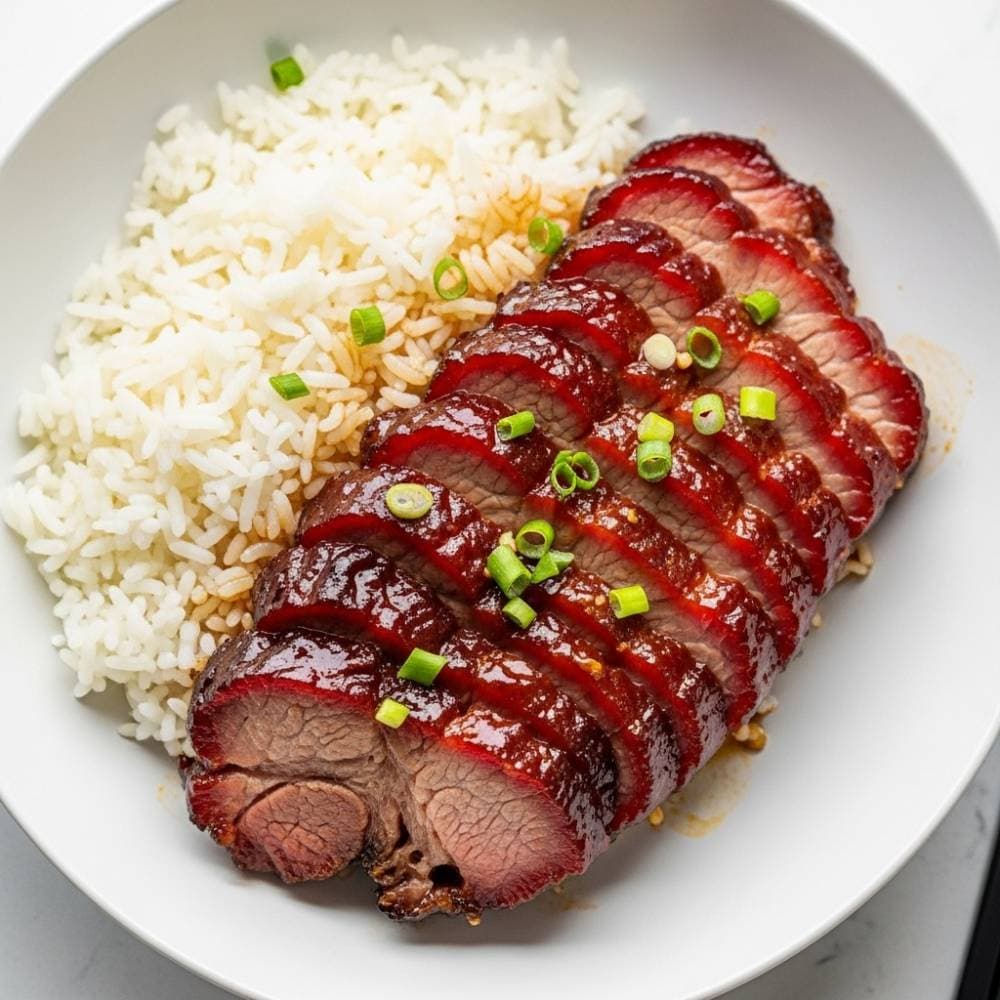
Char Siu BBQ Pork with Jasmine Rice
Sweet, savory, and sticky Chinese BBQ pork (Char Siu) with a beautiful glaze, served alongside fluffy jasmine rice. A classic and flavorful Asian meal for two.
The Quick Answer
The lacquered red crust and the moist interior of char siu pull in opposite directions, because the sugars that build the glaze burn at far lower temperatures than the meat needs to finish. Timing the marinade coats and understanding the cut's fat content is what keeps it sticky rather than scorched and dry.
Why does my char siu glaze blacken and taste bitter?
The marinade is loaded with honey and hoisin, both rich in fructose and glucose that begin caramelizing and then scorching at temperatures well below the 400 degree oven and long before the pork reaches a safe 63 degrees Celsius. Coat the meat in those sugars from the start and the surface carbonizes during the twenty-minute initial roast. That is why the pork goes on the rack bare first, then takes thin marinade coats only in the final fifteen minutes: the sugars get just enough time to brown into glossy lacquer without crossing into acrid char. The red food coloring is purely cosmetic here; it does not protect against burning, so the timing of the coats is what matters.
Does it matter whether I use pork tenderloin or pork butt for char siu?
It changes how forgiving the cook is. Tenderloin is very lean, so once it passes 63 degrees Celsius its muscle proteins contract and wring out moisture quickly, and a few extra minutes leaves it dry and stringy. Pork butt carries far more intramuscular fat and connective tissue, which renders during roasting and bastes the meat from inside, buffering it against overcooking and giving the classic juicy, slightly fatty char siu bite. If you choose tenderloin, watch the internal temperature closely and pull it the instant it hits target, because carryover heat keeps cooking it. Butt is the safer pick when you want that traditional texture and a wider margin for error.
Not sure what to cook next? Let the generator pick your next dish in one click.
Random Recipe GeneratorAbout This Recipe
What is this dish?
Char siu (叉燒) is Cantonese BBQ pork — one of the most iconic preparations in Chinese cuisine and a cornerstone of Hong Kong and Cantonese cooking. The name literally means 'fork roasted' from the traditional method of skewering pork on long forks and roasting it over open flame. Char siu's defining characteristic is its lacquered, burnished exterior — a deep red-mahogany glaze of honey, hoisin, soy, and five-spice that caramelizes in the oven's high heat to a sticky, intensely flavored crust.
Why you'll love it
Char siu delivers a remarkable combination of sweet, savory, and slightly smoky flavors in a glossy, caramelized package that is arguably the most versatile preparation in Chinese cooking. Eat it over rice, stuff it in steamed buns, use it in fried rice, or simply slice and eat with chopsticks. The deeply flavored pork with its lacquered crust is something that once you make at home, the takeout version never quite satisfies again.
When to serve
Serve over steamed jasmine rice for a complete dinner, slice thinly and serve as an appetizer with hoisin and Chinese mustard, or use as an ingredient in fried rice, lo mein, and congee.
Quick tips
Marinate overnight for the deepest flavor penetration. Roast on a rack over a foil-lined pan for even heat circulation and easy cleanup. Brush with glaze every 10-15 minutes during the last half of cooking. Finish under the broiler for the signature lacquered char.
Ingredient Highlights
Pork Shoulder or Country-Style Ribs
The ideal cut for char siu — fatty enough to stay moist during roasting, with enough surface area to develop the caramelized crust. Pork tenderloin is leaner and faster to cook but requires careful attention to avoid drying out. Country-style boneless ribs are the most convenient and produce excellent results.
Hoisin Sauce
The backbone of the char siu marinade. Hoisin is a thick, fermented soybean sauce with a complex sweet-savory-spicy-umami character. It provides the sauce's dark color, deep fermented depth, and characteristic stickiness when roasted. Every brand varies — Lee Kum Kee and Koon Chun are two reliable options.
Five-Spice Powder
The signature spice of Cantonese cuisine: a blend of star anise, cloves, cinnamon, Sichuan pepper, and fennel seeds. In char siu, five-spice provides a warm, complex, slightly sweet-spicy aromatic note that is immediately recognizable as Chinese BBQ. A little goes a long way — don't increase beyond the recipe.
Honey
Two roles: in the marinade, it provides sweetness and helps the glaze adhere. Brushed onto the surface during cooking, it caramelizes rapidly at high heat to create the iconic sticky lacquered exterior. Dark honey (buckwheat, chestnut) adds more complex flavor; neutral honey (acacia) lets the other flavors dominate.
Substitution Options
Pork shoulder can be replaced with chicken thighs for a faster char siu version (marinate 2 hours, roast 25-30 minutes). Hoisin can be approximated with equal parts plum sauce and soy sauce plus a pinch of five-spice. Red fermented bean curd (nan ru) is the traditional coloring agent and can replace part of the hoisin for a more authentic result. Honey can be replaced with maltose (Chinese malt sugar) for a more traditional, less sweet glaze.
You'll likely need to buy
Likely in your pantry
Step-by-Step Instructions
Marinate the pork
In a large bowl or a resealable plastic bag, combine 1/4 cup hoisin sauce (a sweet and savory Chinese sauce), 1/4 cup honey, 2 tablespoons soy sauce (use tamari for gluten-free), 1 tablespoon Shaoxing wine (Chinese cooking wine) or dry sherry, 1 teaspoon Chinese five-spice powder (a blend of star anise, cloves, cinnamon, Sichuan peppercorns, and fennel seeds), and 1/2 teaspoon red food coloring. Whisk until the marinade is smooth. Add the 1 pound pork tenderloin or pork butt strips to the marinade, making sure they are fully coated. Cover and refrigerate for at least 4 hours, or preferably overnight. Marinating allows the pork to soak up all the flavors and tenderize.
Chef's Tips
- ›Marinating longer yields deeper flavor.
- ›Shaoxing wine adds depth to Chinese dishes.
Cook the jasmine rice
In a medium saucepan with a tight-fitting lid, combine 1 cup rinsed jasmine rice, 1 1/2 cups water, and 1/4 teaspoon salt. Bring the water to a rolling boil over medium-high heat. Once boiling, reduce the heat to low, cover the pot tightly, and simmer (cook gently just below boiling, with small bubbles) for 15 minutes. After 15 minutes, remove the pot from the heat and let it rest, covered, for 10 minutes. Do not lift the lid during this time. Fluff the rice with a fork before serving. Simmer means to cook gently just below boiling, with small bubbles.
Chef's Tips
- ›Letting the rice rest after cooking makes it fluffy.
- ›Do not lift the lid while rice is resting to keep steam trapped.
Bake the Char Siu pork
Preheat your oven to 400°F (200°C). Line a baking sheet with aluminum foil and place an oven-safe wire rack on top. Lightly brush the wire rack with 1 tablespoon vegetable oil to prevent sticking. Remove the marinated pork from the bowl, reserving the remaining marinade. Place the pork strips on the prepared wire rack. Bake for 20 minutes. After 20 minutes, brush the pork generously with some of the reserved marinade. Continue baking for another 15-20 minutes, brushing every 5-7 minutes with more marinade, until the pork is cooked through and has a sticky, caramelized (turned slightly sticky and browned) glaze. The internal temperature of the pork should reach 145°F (63°C). For extra char, you can broil (cook under a top heating element) for the last 1-2 minutes, watching closely.
Chef's Tips
- ›Basting frequently builds layers of glaze.
- ›Caramelized means turned slightly sticky and browned from cooking sugar.
- ›Broil means to cook food directly under a high heat source.
Serve
Remove the Char Siu pork from the oven and let it rest for 5 minutes before slicing against the grain (across the muscle fibers) into thin pieces. Serve the sliced Char Siu pork immediately alongside the fluffy jasmine rice. Garnish with 2 tablespoons thinly sliced green onions and 1 teaspoon toasted sesame seeds.
Chef's Tips
- ›Resting the pork keeps it juicy.
- ›Slicing against the grain makes meat more tender.
- ›Garnishes add freshness and texture.
Chef's Tips
Techniques that separate good from great
Marinate overnight in the refrigerator for dramatically deeper flavor
A 4-hour marinade produces good results; overnight produces extraordinary ones. The sugars and soy in the marinade penetrate the pork fibers through osmosis over time, creating depth that cannot be achieved with a short marinade. The pork also benefits from the acid in the Chinese wine or vinegar which very gently tenderizes the exterior.
Use the reserved marinade as a basting glaze during the last 20 minutes of cooking
The marinade that the pork soaked in should be boiled briefly (to kill any bacteria from the raw pork) then used as a basting glaze applied every 10-15 minutes in the final stage of roasting. Each application builds up a thicker, stickier lacquer. Three or four applications create the signature char siu glaze depth.
Roast on a wire rack over a foil-lined baking pan for proper air circulation
Roasting directly on a pan causes the bottom of the pork to steam in its own juices rather than roasting, preventing the caramelized crust from forming on all sides. A wire rack elevates the pork, allowing hot air to circulate completely around it and develop the characteristic crust on all surfaces.
Finish under the broiler for 2-3 minutes for the true lacquered char
The high direct heat of the broiler does in 2-3 minutes what would take much longer at regular roasting temperature — it aggressively caramelizes the sugars in the glaze to create the dark, charred spots that give char siu its distinctive flavor and name. Watch closely — the difference between perfectly charred and burnt is about 1 minute.
Nutrition Facts
Per serving · Estimated values
* Estimated per serving based on a 2,000 calorie diet.
Equipment Needed
- Large bowl or resealable plastic bag (for marinating)
- Whisk
- Baking sheet
- Aluminum foil
- Oven-safe wire rack
- Pastry brush
- Meat thermometer (recommended)
- Medium saucepan (for rice)
- Knife and cutting board
- Measuring cups
- Measuring spoons
As an Amazon Associate we earn from qualifying purchases — at no extra cost to you.
Quick Tips
- For a gluten-free version, use tamari instead of regular soy sauce, and ensure your hoisin sauce is also gluten-free.
- Pork butt (Boston butt) will yield juicier results due to higher fat content, but tenderloin is leaner and cooks quicker.
- Store any leftover Char Siu in an airtight container in the refrigerator for up to 3 days. Reheat gently in the oven or microwave.
Recipe Variations
Different ways to make this dish your own
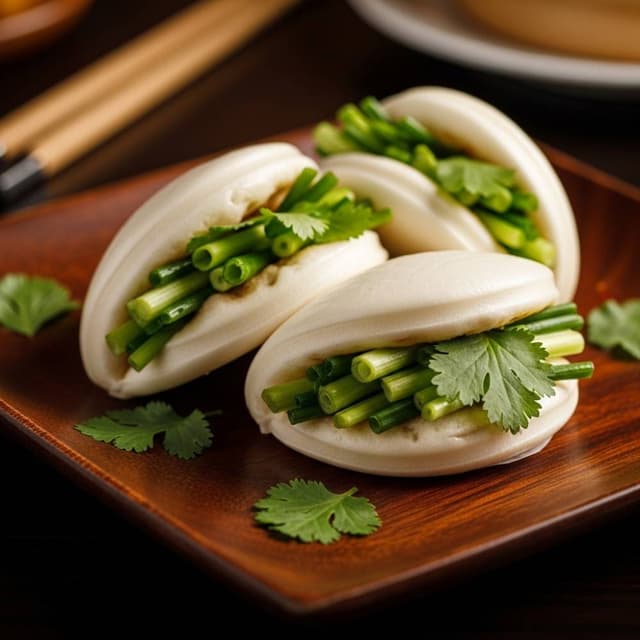
Char Siu Bao (BBQ Pork Steamed Buns)
Dice leftover char siu into small pieces, mix with hoisin, oyster sauce, and a cornstarch slurry, then use as filling for steamed or baked bao (Chinese buns). This is one of the most beloved dim sum items.
Char Siu Fried Rice
Dice leftover char siu and add to wok-fried rice with eggs, peas, and soy sauce. The glazed pork pieces add sweet-savory flavor pockets throughout the fried rice that make it exceptional.
Char Siu Noodles
Slice char siu thinly and arrange over wonton noodles in a light broth with bok choy for a classic Hong Kong wonton noodle soup variation.
Vegan Char Siu (Jackfruit or Seitan)
Use canned young jackfruit or seitan with the same char siu marinade. The jackfruit absorbs the marinade well and develops a similar sticky exterior when roasted. A convincing vegan alternative.
What to Serve With
Perfect pairings to complete the meal
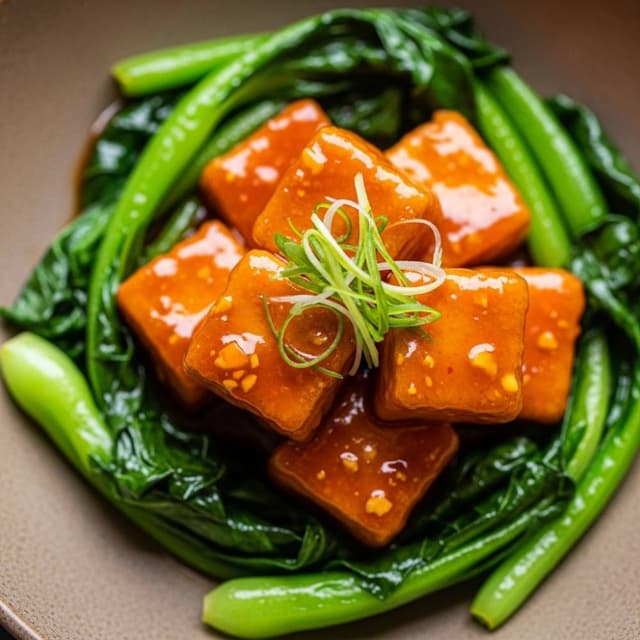
Over Steamed Jasmine Rice with Bok Choy
The classic and most satisfying presentation. Slice char siu at an angle (showing the lacquered exterior) and fan over steamed rice alongside blanched bok choy. Drizzle any remaining juices from the roasting pan over the rice.
In a Hong Kong-Style Plate Lunch (Siu Mei)
Slice thinly and arrange on a plate with steamed rice, a drizzle of char siu sauce, and a side of blanched Chinese broccoli (gai lan) with oyster sauce. This is the quintessential Hong Kong barbecue restaurant presentation.
Sliced as Part of a Chinese Appetizer Spread
Thin slices of char siu arranged on a platter alongside sliced poached chicken, jellyfish salad, cold sesame noodles, and Chinese mustard greens make a stunning Cantonese-style appetizer spread.
In Congee (Rice Porridge)
Slice or dice leftover char siu and add to a bowl of plain congee (jook) with sliced ginger, scallions, and sesame oil for an exceptional breakfast or restorative meal.
Storage & Reheating
Keep it fresh and plan ahead
Refrigerator
Char siu keeps refrigerated for up to 5 days, tightly wrapped. The glazed exterior remains good and the pork can be eaten cold, at room temperature, or reheated.
Freezer
Slice and freeze in portions for up to 2 months. Thaw overnight in the refrigerator. The texture and flavor remain excellent after freezing — char siu is an ideal freezer-friendly protein.
Make-Ahead
Marinate the pork up to 24 hours ahead in the refrigerator. Roast 1-2 days before serving — char siu is excellent at room temperature or reheated.
Reheating
Reheat sliced char siu in a hot skillet with a splash of water for 1-2 minutes, or in a 350°F (175°C) oven for 10 minutes covered with foil. Briefly broiling for 1 minute restores the lacquered glaze.
Cooking tonight?
Get a month of dinners like this — done for you
30 chef-tested dinners mapped to the month, plus 5 ready-to-shop grocery lists. One-time $8.99 — 30 dinners planned for you, zero nightly decisions.
See the 30-Day Plan →Got Leftovers?
Turn what you already have in your fridge into delicious meals. Our AI-powered generator creates personalized recipes from your ingredients.
Go Deeper
Master the Culinary Science
Every recipe is a doorway. Our 7 Mastery Guides give you the science, technique, and framework to understand why food works — not just how to follow steps.
AI-Powered
Have Ingredients? Generate a Recipe.
Tell our AI what's in your fridge and get a custom recipe with image in seconds. No waste, no boredom.
Try the AI Recipe Generator →Browse more like this:
You Might Also Like
Discover more delicious recipes similar to what you're cooking