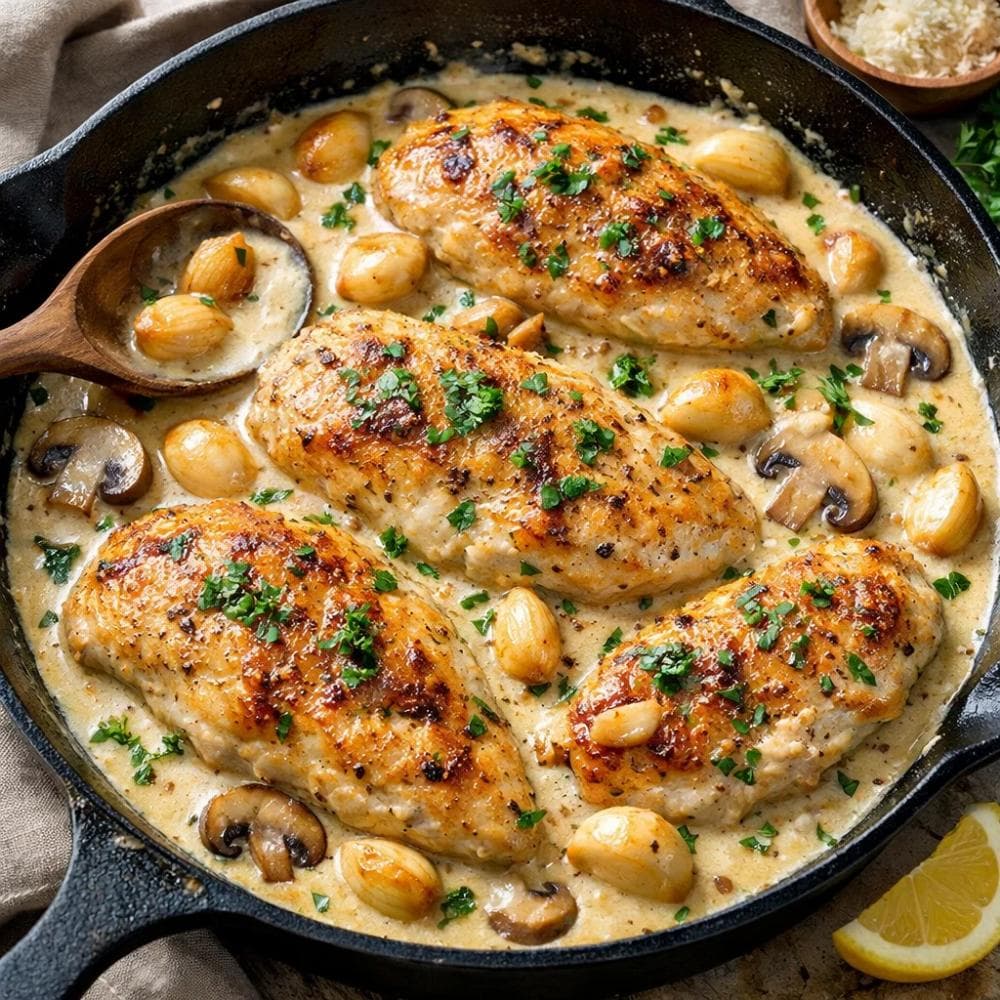
Creamy Garlic Chicken (One-Pan Skillet Recipe)
Tender pan-seared chicken breasts smothered in a rich, garlicky cream sauce made in the same pan — a complete, satisfying dinner that comes together in 30 minutes with minimal washing up. The sauce is built on slowly cooked whole garlic cloves that become sweet and almost melting, deglazed with white wine and finished with cream and Parmesan. It is the kind of one-pan weeknight dinner that tastes deeply impressive while requiring very little effort.
The Quick Answer
The two failures here are a cream sauce that splits into oily curds and chicken breasts that turn dry and stringy. The sauce breaks when cream is boiled hard, especially against the acidity of the wine, while dryness comes from cooking the lean breast past the point its proteins seize and squeeze out moisture.
Why did my creamy garlic sauce split or curdle?
Cream is an emulsion of butterfat suspended in water, stabilised by milk proteins. Push it to a hard boil and those proteins clump together, releasing the fat as visible oily droplets - the sauce looks broken and greasy. Acid makes it worse, and this sauce is built on white wine reduced in the pan plus a little Dijon, so the milk proteins are already destabilised. The defence is heat control: reduce the wine first so its sharpness mellows, then drop to medium-low before the cream goes in and hold it at a bare simmer, never a boil. The Parmesan's own fat and proteins thicken it gently; let it melt in slowly rather than blasting the pan to speed things up.
Why is my chicken breast dry in this dish?
Skinless breast is very lean, and its muscle fibres contract sharply once they pass about 74C internal, wringing out water like a twisted cloth - a few degrees too far and juicy becomes chalky. The recipe sidesteps this by searing the breast only to colour, not to cook through, then finishing it gently submerged in the warm sauce. Poaching in the simmering cream cooks the centre at a temperature far below scorching, so the surface never overshoots while you wait for the middle to reach safe doneness. Pulling the chicken out to build the sauce and returning it briefly limits its total time on high heat, which is why an even-thickness breast cooked covered for just 5-7 minutes stays tender.
Not sure what to cook next? Let the generator pick your next dish in one click.
Random Recipe GeneratorAbout This Recipe
What is this dish?
Creamy garlic chicken is one-pan French bistro cooking at its simplest — a technique of searing chicken in a hot pan, building a sauce in the residual fat, and finishing the chicken in the sauce. The garlic is cooked long enough to become sweet and mild rather than sharp, which is the difference between a harsh, raw-garlic sauce and the mellow, complex sauce this recipe produces. It is elegant without being complicated.
Why you'll love it
One pan, 30 minutes, minimal washing up, and a sauce that tastes like it took an hour. The cream and garlic combination is reliably beloved — sweet, rich, and deeply savoury. It produces restaurant-quality food from genuinely basic ingredients and straightforward technique.
When to serve
An impressive weeknight dinner or a casual dinner party main. Serves 4.
Quick tips
Dry the chicken. Don't move it while searing. Scrape the pan well when deglazing. Gentle heat for the cream sauce.
Ingredient Highlights
Garlic Cloves
Sliced and cooked slowly in the pan until golden and sweet, the garlic transforms from sharp and pungent to mellow, slightly nutty, and aromatic. This slow cooking is the key to the sauce — raw garlic added at the end would be harsh; garlic cooked until golden is complex and sweet. Six cloves sounds like a lot, but by the time they have been cooked and absorbed into the cream sauce, they become a gentle background presence.
Double Cream
The base of the sauce. Double cream (heavy cream) has sufficient fat to reduce and coat without breaking when simmered gently — it produces a glossy, luxurious sauce that clings to the chicken. Single cream or half-and-half can be substituted but produces a thinner, less luxurious result. The cream's richness is balanced by the Dijon mustard and white wine, which provide acidity.
Parmesan
Added to the cream sauce to provide depth, savouriness (umami), and a gentle thickening. Parmesan dissolves smoothly into warm cream and produces a sauce that is richer and more complex than cream alone. Use freshly grated Parmesan rather than pre-grated, which can be grainy.
Substitution Options
Use chicken thighs instead of breasts. Replace white wine with chicken stock. Swap double cream for single cream or coconut cream. Replace Parmesan with Pecorino or Gruyère. Use garlic paste instead of fresh garlic in a pinch. Add sun-dried tomatoes or spinach for extra substance.
You'll likely need to buy
Likely in your pantry
Step-by-Step Instructions
Prepare and sear the chicken
Pat the chicken breasts dry with kitchen paper — dry surfaces sear properly, wet ones steam. Season generously on both sides with salt, pepper, and garlic powder. Heat the olive oil in a large, heavy-bottomed skillet or frying pan over a medium-high heat until shimmering. Add the chicken and cook without moving for 5–6 minutes until a deep golden crust forms. Flip and cook for a further 4–5 minutes. The chicken does not need to be cooked through at this stage. Remove to a plate and set aside.
Chef's Tips
- ›Dry chicken is essential for a proper golden sear — wet chicken steams and produces a pale, soft surface
- ›Do not move the chicken while it sears — leave it undisturbed and it will release naturally when the crust has formed
Build the garlic sauce
Reduce the heat to medium. In the same pan, add the sliced garlic to the residual oil and cook for 2–3 minutes, stirring, until softened and starting to turn golden at the edges — do not let it burn. Pour in the white wine or stock and scrape up any browned bits from the base of the pan with a wooden spoon — these add enormous flavour to the sauce. Let it bubble and reduce by half, about 2 minutes.
Chef's Tips
- ›The browned bits on the base of the pan (the fond) are the most flavourful part of the dish — scraping them up and incorporating them into the sauce is essential
- ›Golden garlic is the goal — brown garlic becomes bitter and ruins the sauce; keep the heat moderate
Finish the cream sauce
Reduce the heat to medium-low and pour in the double cream. Add the Dijon mustard, thyme, and a generous pinch of salt. Stir to combine and bring to a gentle simmer. Add the Parmesan and stir until melted and the sauce has thickened slightly, about 2 minutes.
Chef's Tips
- ›A gentle simmer is all that is needed — boiling cream sauces can break or become grainy
- ›The Dijon mustard adds depth and a gentle tang without making the sauce taste of mustard — do not omit it
Return the chicken and finish
Return the seared chicken breasts to the pan, nestling them into the sauce. Spoon the sauce over the top. Reduce the heat to low, cover with a lid, and cook for 5–7 minutes until the chicken is cooked through — an internal temperature of 74°C (165°F). Scatter over the fresh parsley and serve directly from the pan.
Chef's Tips
- ›Finishing the chicken in the sauce rather than in the oven keeps it moist and allows it to absorb the garlic cream flavour
- ›Check the thickest part of the breast with a thermometer for certainty — overcooked chicken breast is the most common mistake in this recipe
Chef's Tips
Techniques that separate good from great
Pound the chicken breasts to an even thickness
Placing the chicken breasts between two sheets of cling film and pounding with a rolling pin to an even 2cm thickness ensures they cook evenly — thick-ended breasts are cooked through in the thin end well before the thick end reaches temperature, producing dry, overcooked edges. This step takes 2 minutes and significantly improves the result.
Use whole unpeeled garlic cloves
For a more dramatic, intense garlic flavour, add 8–10 whole unpeeled garlic cloves to the pan alongside the chicken when searing. The garlic roasts in the oil and becomes sweet and slightly caramelised. Squeeze the softened garlic out of its skin into the sauce when building it — the texture will be thick and rich rather than sliced pieces.
Add baby spinach at the end
Stirring a large handful of baby spinach into the sauce in the final minute of cooking wilts it beautifully and adds colour, nutrition, and a slight iron note that works very well with the cream sauce. Sun-dried tomatoes, quartered artichoke hearts, or a handful of frozen peas are equally good additions that transform the dish from sauce to stew.
Nutrition Facts
Per serving · Estimated values
* Estimated per serving based on a 2,000 calorie diet.
Equipment Needed
- Large heavy-bottomed skillet or frying pan with lid
- Tongs
- Wooden spoon
- Instant-read thermometer (optional)
As an Amazon Associate we earn from qualifying purchases — at no extra cost to you.
Quick Tips
- Dry the chicken thoroughly before seasoning and searing — wet chicken steams instead of searing
- Scrape up all the browned bits when deglazing — they are the most flavourful part of the dish
- Do not boil the cream sauce — a gentle simmer is all that is needed and prevents splitting
Recipe Variations
Different ways to make this dish your own
Creamy Garlic Mushroom Chicken
Add 200g of sliced mushrooms to the pan after removing the chicken and cook for 5 minutes until golden, then proceed with the garlic sauce as above. The mushrooms add an earthy depth and meaty texture that complements the cream sauce beautifully.
Tuscan Garlic Chicken
Add a handful of halved cherry tomatoes and 2 tablespoons of drained sun-dried tomatoes with the cream. Stir in a large handful of baby spinach in the last minute of cooking. Finish with fresh basil. A vibrant, slightly more robust variation.
Lemon Garlic Chicken
Add the zest and juice of 1 lemon with the cream and reduce the wine to 2 tablespoons. The lemon lifts the richness of the cream sauce and produces a brighter, more summery dish. Finish with extra fresh parsley and capers.
Creamy Garlic Chicken with Pasta
Cook the sauce with slightly more cream and chicken stock, toss in 400g of cooked pasta (linguine or pappardelle work well), and serve from the pan with extra Parmesan and parsley. Transforms the dish from a main with sides to a one-pan pasta.
What to Serve With
Perfect pairings to complete the meal
Mashed Potato
The ideal companion for a rich, creamy sauce — fluffy mashed potato with plenty of butter absorbs the garlic cream and provides a satisfying contrast to the tender chicken.
Egg Noodles or Pasta
Wide egg noodles or tagliatelle tossed through the sauce make this a complete, satisfying one-bowl meal. The pasta soaks up the sauce in a way that rice or potato cannot quite match.
Crusty Bread
A thick slice of crusty white bread or a baguette to mop up every last drop of the garlic cream sauce is arguably the best accompaniment. The sauce is the most memorable part of this dish and deserves something to carry it.
Steamed Tenderstem Broccoli
A handful of steamed tenderstem broccoli alongside adds colour, freshness, and a slight bitterness that cuts through the richness of the cream. Equally good dragged through the garlic sauce.
Storage & Reheating
Keep it fresh and plan ahead
Refrigerator
Keeps well in the fridge for up to 3 days in a sealed container. The sauce may thicken considerably when cold.
Freezer
The cream sauce does not freeze well — it can split and become grainy when reheated. Best eaten fresh or within 3 days from the fridge.
Make-Ahead
The sauce base (garlic cooked with wine) can be made ahead and refrigerated. Sear and finish the chicken fresh when ready to serve.
Reheating
Reheat gently in a covered pan over a low heat with a splash of chicken stock or milk to loosen the sauce. Do not boil. Microwave on medium power in 1-minute bursts, stirring between each.
Cooking tonight?
Get a month of dinners like this — done for you
30 chef-tested dinners mapped to the month, plus 5 ready-to-shop grocery lists. One-time $8.99 — 30 dinners planned for you, zero nightly decisions.
See the 30-Day Plan →Be the first to review this recipe!
Got Leftovers?
Turn what you already have in your fridge into delicious meals. Our AI-powered generator creates personalized recipes from your ingredients.
Go Deeper
Master the Culinary Science
Every recipe is a doorway. Our 7 Mastery Guides give you the science, technique, and framework to understand why food works — not just how to follow steps.
AI-Powered
Have Ingredients? Generate a Recipe.
Tell our AI what's in your fridge and get a custom recipe with image in seconds. No waste, no boredom.
Try the AI Recipe Generator →Browse more like this:
You Might Also Like
Discover more delicious recipes similar to what you're cooking