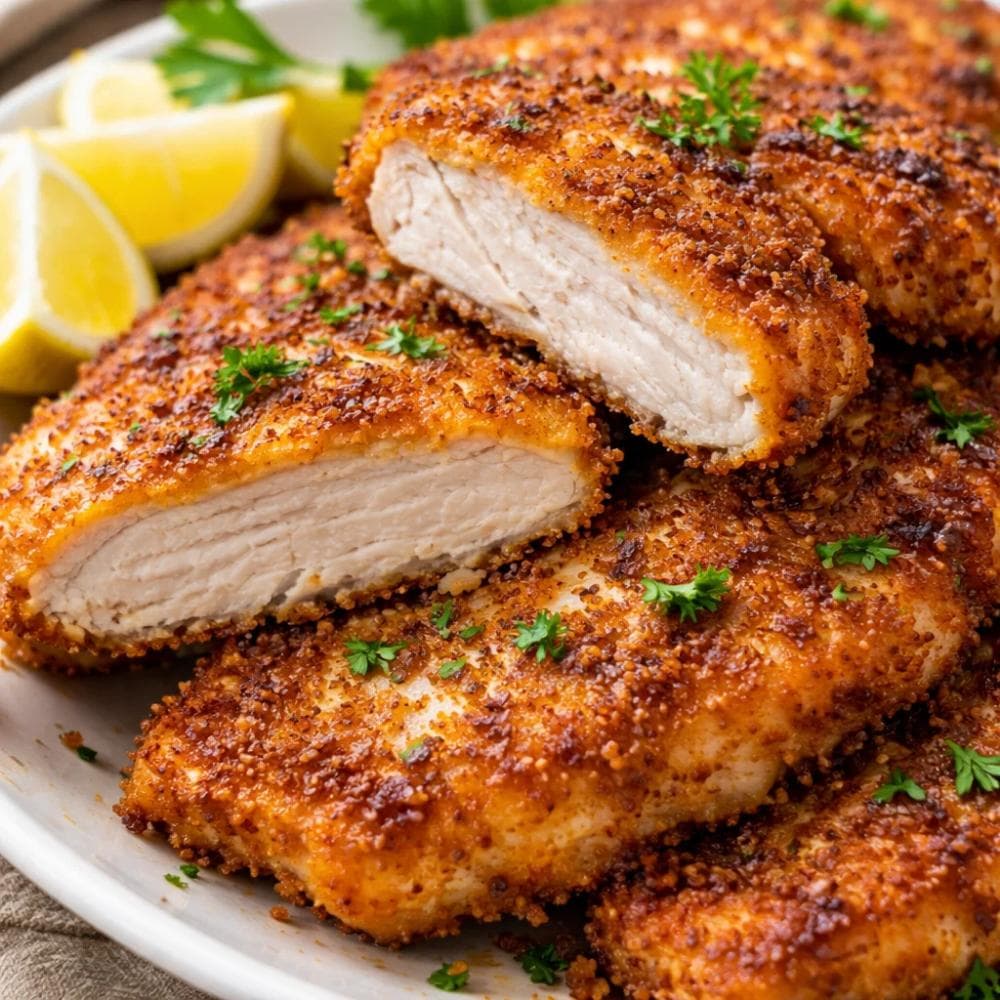
Crispy Chicken Cutlets (Pan-Fried or Oven-Baked)
Golden, ultra-crispy breaded chicken cutlets made with a three-stage coating of seasoned flour, egg, and panko breadcrumbs that produces a shatteringly crunchy crust over tender, juicy chicken. Pan-frying in a shallow layer of oil gives the best colour and crunch, but an oven-baked version with a spray of oil produces an excellent result with far less mess. Endlessly versatile — serve as schnitzel with lemon and potato salad, as a chicken sandwich, or alongside pasta. A fundamental, reliable recipe.
The Quick Answer
Breaded cutlets fail when the crust slides off in the pan or when it ends up soggy soon after frying. The coating peels because a wet or skipped flour layer gives the egg nothing to grip, and sogginess sets in when escaping steam is trapped against the crust on a plate or paper towel.
Why does the breading fall off my chicken cutlets?
The three stages each do a specific job, and the crust fails when one is skipped or rushed. The seasoned flour is the primer: it dries the chicken's damp surface and gives the wet egg something to cling to. The beaten egg is the glue, a protein layer that coagulates in the hot oil and welds the panko on. Skip the flour or leave the chicken's surface wet and the egg simply slides, taking the breadcrumbs with it. Pressing the panko in firmly, not just dipping, embeds the crumbs into that egg layer so they lock once set. Letting the breaded cutlet rest a few minutes before frying also lets the coating hydrate and adhere rather than flaking away on contact with the oil.
Why does my crispy crust go soggy?
Crispness is the dry, rigid structure of toasted panko, and it collapses the instant trapped steam softens it. A just-fried cutlet is still releasing moisture from the hot chicken inside; rest it flat on kitchen paper or a plate and that steam condenses against the underside, turning the crust limp within minutes. A wire rack over a tray lets the steam escape from all sides, keeping the base as crisp as the top. Oil temperature matters too - if the oil isn't hot enough that a crumb sizzles on contact, the coating absorbs oil instead of crisping, and panko's coarse, jagged flakes that normally trap less oil and stay shatteringly crunchy turn greasy and soft instead.
Not sure what to cook next? Let the generator pick your next dish in one click.
Random Recipe GeneratorAbout This Recipe
What is this dish?
Crispy chicken cutlets — known by different names in different traditions (schnitzel in Austria and Germany, Milanese in Italy, katsu in Japan) — represent one of the most universally beloved techniques in home cooking: a thin, pounded piece of meat coated in seasoned breadcrumbs and fried to a shattering golden crust. The technique is the same across cultures; only the seasoning and accompaniments change. Mastering this recipe gives you a template that works in dozens of different directions.
Why you'll love it
The contrast between the shatteringly crisp crust and the juicy chicken inside is one of the most satisfying textures in cooking. It is fast, reliable, and adaptable — the same cutlet can become a schnitzel, a sandwich, a salad topping, or the base of a chicken Parmesan. Once you understand the technique, the variations are endless.
When to serve
A quick weeknight dinner, a crowd-pleasing party food, or a packed lunch the next day. Serves 4.
Quick tips
Pound the chicken even. Dry before dredging. Press firmly into panko. Wire rack to rest. Do not overcrowd the pan.
Ingredient Highlights
Panko Breadcrumbs
The defining ingredient for the crust. Panko are larger, lighter, and drier than standard breadcrumbs, producing a crust that is noticeably crispier, crunchier, and more substantial. They absorb less oil during frying and maintain their crunch for longer after cooking. Regular breadcrumbs can be substituted but the result is finer-textured and less dramatically crispy.
A Three-Stage Breading
Flour, egg, then breadcrumbs — each stage plays a specific role. The flour dries the surface and provides a foundation for the egg to cling to. The egg acts as a binder between the flour and the crumbs. The crumbs provide the crust. Skipping any stage produces a worse result: no flour means patchy egg adhesion; no egg means the crumbs will not stick. The sequence must be followed.
Neutral Oil at the Right Temperature
The oil temperature is critical for a properly fried cutlet. Too cool and the crust absorbs oil and becomes greasy. Too hot and the crust burns before the chicken cooks through. Approximately 175°C (350°F) is ideal — a breadcrumb dropped in should sizzle immediately and vigorously. Sunflower, vegetable, or groundnut oil are the best choices for their high smoke points and neutral flavour.
Substitution Options
Use veal, pork, or turkey cutlets instead of chicken. Replace panko with regular breadcrumbs, crushed crackers, or cornflakes. Add Parmesan to the breadcrumbs for Italian-style Milanese. Use gluten-free flour and breadcrumbs for a coeliac-friendly version. Season the crumbs with Italian herbs for a different flavour profile.
You'll likely need to buy
Likely in your pantry
Step-by-Step Instructions
Prepare the chicken
Place each chicken breast between two sheets of cling film or in a zip-lock bag. Using a rolling pin, meat mallet, or the flat of a heavy pan, pound to an even thickness of approximately 1–1.5cm. This is the most important step: even thickness ensures the chicken cooks through by the time the crust is golden, and prevents dry edges while the centre is still raw. Season both sides with salt and pepper.
Chef's Tips
- ›Pounding the chicken to an even thickness is non-negotiable — uneven chicken produces overcooked thin parts and undercooked thick parts
- ›Work from the centre outward in firm, even strokes for the most uniform result
Set up the breading station
Arrange three shallow bowls in a row: the first with seasoned flour, the second with beaten eggs, the third with panko mixed with garlic powder, smoked paprika, oregano, salt, and pepper. Working one cutlet at a time, dredge in flour (shake off excess), dip in egg (let excess drip off), then press firmly into the panko, turning and pressing to ensure a thick, even coat on all sides.
Chef's Tips
- ›Pressing firmly into the panko is the key to a thick, adherent crust — a gentle dip produces a patchy coating that falls off during frying
- ›Season each component of the breading — flour, egg, and crumbs — not just the crumbs; flavour in layers produces a more seasoned result
Pan-fry until golden
Pour enough oil into a large frying pan to reach a depth of about 1cm. Heat over a medium-high heat until a breadcrumb dropped in sizzles immediately. Fry the cutlets for 3–4 minutes per side until deep golden brown and cooked through. Do not crowd the pan — cook in batches if necessary. Rest on a wire rack over a baking tray (not kitchen paper, which makes the base soggy) for 2 minutes before serving.
Chef's Tips
- ›A wire rack, not kitchen paper, preserves the crisp base — kitchen paper traps steam underneath the cutlet and softens the crust
- ›The correct oil temperature is 175°C (350°F) — too cool and the crust absorbs oil and becomes greasy; too hot and it burns before the chicken cooks through
Oven-baked alternative
For the oven method: preheat the oven to 220°C (425°F). Place the breaded cutlets on a wire rack set over a foil-lined baking tray. Spray or brush generously all over with oil. Bake for 18–20 minutes until golden and cooked through, flipping halfway. The crust will not be as deeply golden or as crunchy as pan-fried, but it is considerably less oily and very good.
Chef's Tips
- ›A wire rack in the oven allows hot air to circulate under the cutlet and crisp the base — a flat baking tray traps moisture and produces a soft underside
- ›Generously oiling the surface before baking is essential for colour — an under-oiled cutlet bakes pale and dry rather than golden and crisp
Chef's Tips
Techniques that separate good from great
Use panko rather than regular breadcrumbs
Panko (Japanese breadcrumbs) are larger, lighter, and drier than regular breadcrumbs, producing a significantly crispier and more substantial crust that maintains its crunch for longer. Regular breadcrumbs produce a finer, denser coating that absorbs more oil and softens faster. The difference is noticeable — once you use panko for cutlets, it is very hard to go back.
Add Parmesan to the breadcrumbs
Mixing 30g of finely grated Parmesan into the panko breadcrumbs adds a savoury, umami-rich depth to the crust and promotes a more even, deeper golden colour. The Parmesan browns in the oil and adds a subtle nuttiness that elevates a basic breaded cutlet considerably. This is a common Italian-American technique for chicken Milanese.
Let the breaded cutlets rest before frying
After breading, placing the cutlets on a wire rack for 10–15 minutes before frying allows the coating to adhere more firmly to the surface — the moisture in the egg dries slightly and forms a better seal between the chicken and the crumbs. This reduces the likelihood of the coating slipping off during frying and produces a more uniformly adherent crust.
Nutrition Facts
Per serving · Estimated values
* Estimated per serving based on a 2,000 calorie diet.
Equipment Needed
As an Amazon Associate we earn from qualifying purchases — at no extra cost to you.
Quick Tips
- Pound the chicken to an even 1–1.5cm thickness before breading — the single most important step for even cooking
- Press firmly into the panko rather than just dipping — a thick, well-adhered crust needs pressure
- Rest on a wire rack, not kitchen paper — wire rack keeps the base crispy by preventing steam build-up
Recipe Variations
Different ways to make this dish your own
Chicken Parmesan
Top the fried cutlets with a spoonful of tomato sauce and a thick layer of mozzarella, then bake at 200°C for 10 minutes until the cheese is bubbling and golden. Serve with spaghetti or alone as a main. The most famous variation on the basic cutlet.
Chicken Milanese
Mix 30g of finely grated Parmesan into the panko. Fry as described. Serve on a bed of rocket dressed with lemon juice, olive oil, and Parmesan shavings. A simple, elegant Italian presentation that turns the cutlet into a complete dish.
Chicken Katsu
Season the panko with nothing but salt (the Japanese version relies on the sauce for flavour). Serve sliced over steamed white rice with katsu curry sauce — a mild, sweet, deeply savoury Japanese curry sauce. The combination of crispy chicken, fluffy rice, and thick curry sauce is outstanding.
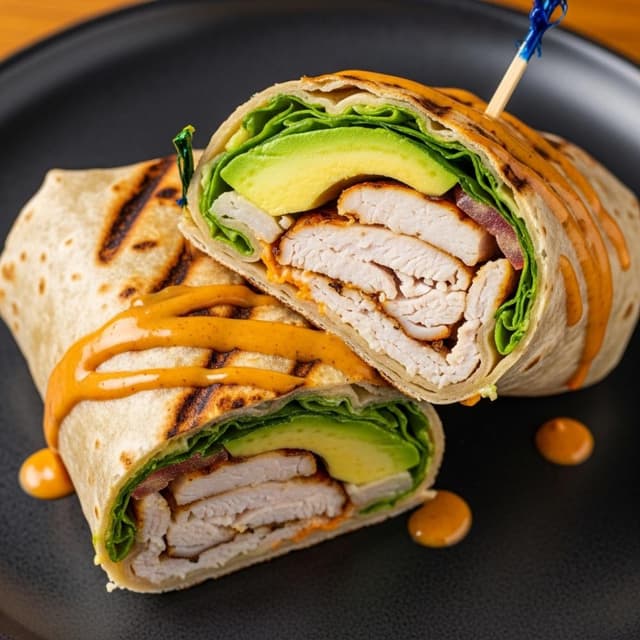
Crispy Chicken Sandwich
Serve the cutlet in a brioche bun with shredded iceberg lettuce, sliced pickles, and a sauce of mayonnaise, Dijon mustard, and a little hot sauce. One of the best sandwiches you can make at home.
What to Serve With
Perfect pairings to complete the meal
Lemon and Simple Green Salad
The classic schnitzel presentation — a wedge of lemon to squeeze over the hot cutlet and a simple green salad alongside. The lemon brightens the richness of the fried crust and the salad provides freshness. Nothing more is needed.
Potato Salad
A warm German-style potato salad with mustard, vinegar, and herbs, or a creamy mayonnaise potato salad, alongside crispy chicken cutlets is a deeply satisfying combination that is greater than the sum of its parts.
Coleslaw
A sharp, well-dressed coleslaw (not too mayonnaise-heavy) is an excellent accompaniment that provides crunch, freshness, and acidity to balance the richness of the fried chicken.
Pasta with Tomato Sauce
A simple tomato and basil pasta alongside a chicken cutlet is a Friday-night family classic — fast, satisfying, and universally popular. The cutlet can be laid directly on the pasta for a more integrated presentation.
Storage & Reheating
Keep it fresh and plan ahead
Refrigerator
Keeps in the fridge for up to 3 days in an airtight container. The crust softens significantly in the fridge.
Freezer
Freeze cooked cutlets on a lined tray until solid, then transfer to a bag. Reheat from frozen in the oven at 200°C for 15–18 minutes. Alternatively, freeze raw breaded cutlets for up to 2 months — cook directly from frozen with 5 extra minutes.
Make-Ahead
Bread the cutlets up to 4 hours ahead and refrigerate on a wire rack (uncovered). The resting time actually improves the crumb adhesion and crispiness.
Reheating
Reheat in a 200°C (400°F) oven on a wire rack for 8–10 minutes to restore some of the crust crispiness. A microwave reheats quickly but softens the crust completely — only use if the texture does not matter.
Cooking tonight?
Get a month of dinners like this — done for you
30 chef-tested dinners mapped to the month, plus 5 ready-to-shop grocery lists. One-time $8.99 — 30 dinners planned for you, zero nightly decisions.
See the 30-Day Plan →Be the first to review this recipe!
Got Leftovers?
Turn what you already have in your fridge into delicious meals. Our AI-powered generator creates personalized recipes from your ingredients.
Go Deeper
Master the Culinary Science
Every recipe is a doorway. Our 7 Mastery Guides give you the science, technique, and framework to understand why food works — not just how to follow steps.
AI-Powered
Have Ingredients? Generate a Recipe.
Tell our AI what's in your fridge and get a custom recipe with image in seconds. No waste, no boredom.
Try the AI Recipe Generator →Browse more like this:
You Might Also Like
Discover more delicious recipes similar to what you're cooking