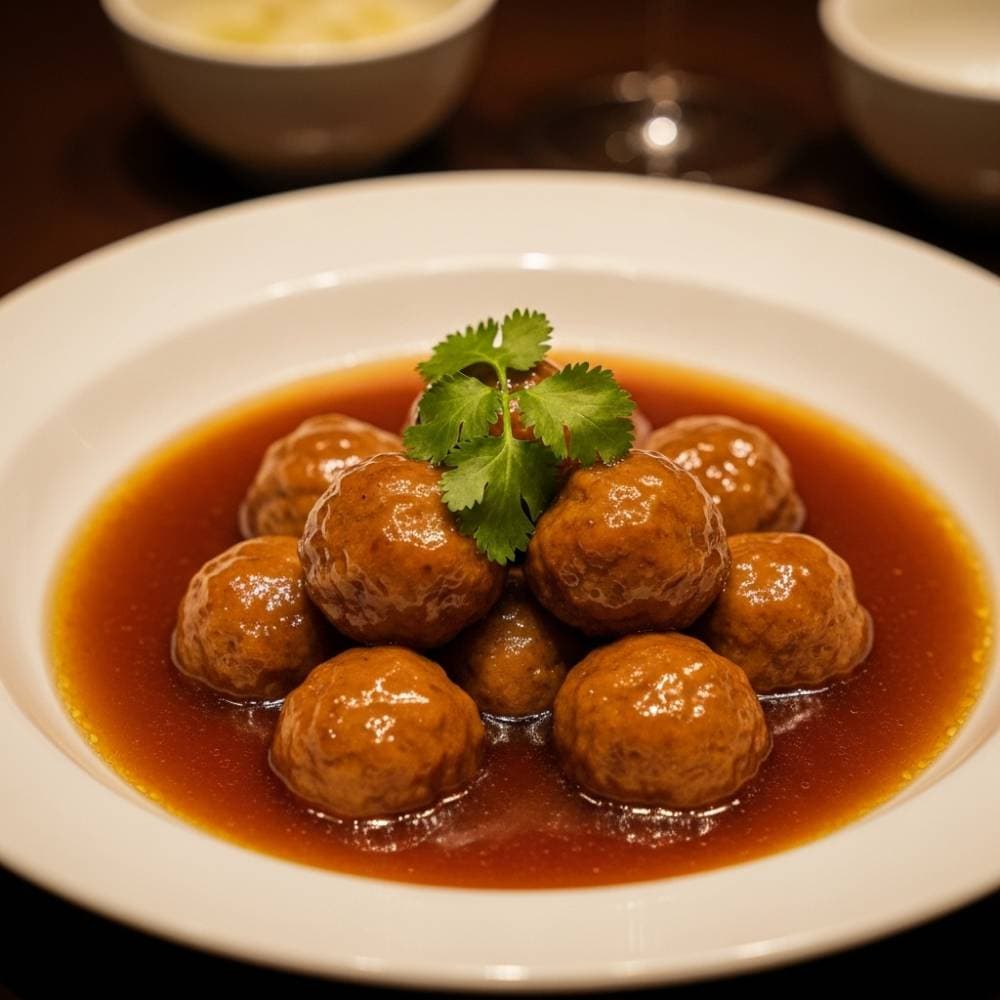
Lion’s Head Meatballs (Shanghai Style)
Large, tender pork meatballs (Lion's Head meatballs) braised in a savory sauce with napa cabbage, creating a hearty and comforting Chinese dish. A flavorful meal for two.
The Quick Answer
These oversized pork meatballs aim for a soft, almost custardy interior, which depends on managing the sticky myosin protein and the 80/20 fat that melts during the braise. How you handle the meat and how hard the liquid bubbles decide whether they stay silky or turn rubbery.
Why are my lion's head meatballs bouncy and rubbery instead of soft?
Ground pork is full of myosin, a sticky protein that cross-links when the meat is kneaded, squeezed, or packed tight, building the springy, sausage-like bounce you want in a hot dog but not here. The egg and cornstarch bind the mixture enough on their own, so working it hard only adds unwanted elasticity. Mix just until the seasonings disperse, then shape with a light hand into the two large balls. The lion's head texture should be loose and tender, almost falling apart, which only happens when the protein network stays slack rather than tightened into a dense, chewy matrix from overmixing.
Why does the napa cabbage go watery and bland under my meatballs?
Napa cabbage is over ninety percent water, and during the thirty-to-forty-minute braise it wilts and releases that liquid straight into the pan. This is not a flaw to fight; the cabbage's water dilutes and sweetens the chicken broth, soy, and sugar into the gentle sauce the dish is built around. Problems come when the cabbage sits in a layer the broth cannot reach, so it steams unevenly and tastes flat. Spread it so the meatballs nestle among the leaves and the simmering liquid circulates, letting the cabbage absorb the savory braise while giving back its own sweetness. The sesame oil goes on only at the end, since its aroma cooks off if added to the simmer.
Not sure what to cook next? Let the generator pick your next dish in one click.
Random Recipe GeneratorAbout This Recipe
What is this dish?
Lion head meatballs (shizi tou, 狮子头) are a celebrated Shanghai and Jiangnan cuisine classic — enormous, exceptionally tender braised pork meatballs that derive their name from their resemblance to a lion's head, with the surrounding napa cabbage representing the mane. Unlike Western meatballs, lion head meatballs are prized for their incredibly soft, almost pillowy texture achieved through finely ground pork, water chestnuts, and gentle braising.
Why you'll love it
These meatballs achieve a texture that is unlike anything in Western meatball preparations — they are almost impossibly tender and moist, nearly dissolving on the tongue, with a savory-sweet braising sauce that has reduced to a glossy, lightly sweet coating. The napa cabbage braised alongside becomes silky and absorbs all the pork's umami into its leaves.
When to serve
Serve as the centerpiece of a Shanghai home-cooking dinner with steamed rice and simple stir-fried vegetables. Also an impressive dish for Chinese New Year celebrations and family holiday gatherings.
Quick tips
Don't skip water chestnuts — they add lightness and a subtle crunch that defines the texture. Mix the meat mixture gently to avoid overworking. Brown the meatballs thoroughly before braising. The braising liquid should be barely simmering, not boiling.
Ingredient Highlights
Ground Pork (70/30 fat ratio)
Lion head meatballs require a higher fat content than typical meatballs — ideally 70% lean and 30% fat. The fat keeps the meatballs incredibly moist and tender during the long braise. Leaner ground pork produces drier, tougher meatballs. Ask your butcher for hand-ground fatty pork, or use pork belly ground in a food processor.
Water Chestnuts
Fresh or canned water chestnuts, finely minced, are the secret to lion head meatballs' distinctive tender-yet-slightly-crunchy texture. They don't melt during cooking but soften enough to blend seamlessly. They also add moisture without the heaviness of breadcrumbs. This is a non-negotiable ingredient.
Shaoxing Wine
Chinese rice wine with a complex, slightly sweet and nutty flavor that is fundamental to Shanghai braised dishes. It tenderizes the pork and adds depth. Dry sherry is the best substitute; sake is also acceptable. Avoid 'cooking wine' which contains added salt.
Napa Cabbage
Braised alongside the meatballs, napa cabbage (Chinese cabbage) becomes completely silky and absorbs all the pork's umami into its leaves. It is as essential to the dish as the meatballs — don't skip it or replace it with regular cabbage, which has a completely different texture when braised.
Substitution Options
Water chestnuts can be partially replaced with finely diced bamboo shoots, though they add a different flavor. Replace Shaoxing wine with dry sherry or sake in equal amounts. Napa cabbage can be replaced with Savoy cabbage or bok choy, though the texture differs. For a vegetarian version, use a mix of firm tofu and mushrooms ground together with the same aromatics and seasonings.
You'll likely need to buy
Likely in your pantry
Step-by-Step Instructions
Prepare the meatballs
In a large bowl, combine 1 pound ground pork, 2 tablespoons finely chopped green onions, 1 tablespoon grated fresh ginger, 1 large egg, 1 tablespoon Shaoxing wine (Chinese cooking wine) or dry sherry, 1 tablespoon soy sauce, 1 tablespoon cornstarch, 1/2 teaspoon salt, and 1/4 teaspoon white pepper. Mix gently with your hands until all ingredients are just combined. Do not overmix. Divide the mixture into two large, round meatballs (Lion's Head meatballs), about 3-4 inches in diameter.
Chef's Tips
- ›Lion's Head meatballs are large pork meatballs, often served with cabbage resembling a lion's mane.
- ›Overmixing can make meatballs tough; mix just until combined.
Brown the meatballs
Heat 2 tablespoons vegetable oil in a large, deep skillet or Dutch oven over medium-high heat. Carefully place the meatballs in the hot oil. Cook for 5-7 minutes, turning occasionally, until they are golden brown on all sides. You do not need to cook them through completely at this stage. Remove the browned meatballs from the skillet and set them aside. Carefully drain any excess fat from the skillet, leaving about 1 tablespoon.
Chef's Tips
- ›Browning adds flavor and helps the meatballs hold their shape during braising.
- ›Do not overcrowd the skillet; cook one at a time if needed.
Braise the meatballs
Add the 4 cups napa cabbage (Chinese cabbage) to the skillet with the remaining fat. Cook for 3-5 minutes, stirring, until the cabbage begins to wilt (become soft and droopy). Return the browned meatballs to the skillet, nestling them among the cabbage. Pour in 2 cups chicken broth, 1 tablespoon soy sauce, and 1 teaspoon sugar. Bring the liquid to a gentle simmer (cook gently just below boiling, with small bubbles). Cover the skillet, reduce the heat to low, and braise (cook slowly in liquid with a lid on) for 30-40 minutes, or until the meatballs are cooked through and tender.
Chef's Tips
- ›Braising cooks food slowly in liquid with a lid on, making it very tender.
- ›Simmer means to cook gently just below boiling, with small bubbles.
Serve
Remove the skillet from the heat. Carefully transfer each Lion's Head meatball and a generous portion of the braised cabbage to serving bowls. Drizzle with 1/2 teaspoon sesame oil over each serving. Serve immediately, often with steamed white rice.
Chef's Tips
- ›Serving immediately ensures the meatballs are warm and tender.
- ›Sesame oil adds a nutty, aromatic finish.
Chef's Tips
Techniques that separate good from great
Mix the meat mixture gently — overworking makes the meatballs tough
Use your hands or chopsticks to mix the ground pork, water chestnuts, and seasonings until just combined — stop the moment everything is evenly distributed. Overworking develops the meat's proteins into a dense matrix that produces a rubbery, tough meatball instead of the characteristic tender texture.
Add cold water or ice water to the meat mixture for extra tenderness
While mixing the meat, splash in 2-3 tablespoons of ice-cold water or broth in small additions. The cold water gets incorporated into the protein matrix, keeping the meatballs moist during braising and contributing to their characteristic lightness. This technique is used in many Chinese meatball and dumpling preparations.
Brown the meatballs carefully before braising — don't rush this step
A proper golden-brown crust on the outside of each meatball locks in juices during braising and adds a layer of caramelized flavor that the braising sauce alone cannot create. Fry in batches in enough oil to come 1/3 up the side of each meatball, turning gently. Handle them carefully — they are fragile before braising sets their structure.
Braise at the gentlest possible simmer — visible boiling breaks the meatballs
Once the meatballs and napa cabbage are in the braising liquid, maintain the absolute lowest heat that maintains a gentle simmer — barely a bubble every few seconds. Vigorous boiling physically agitates the meatballs and causes them to break apart. The gentle, low heat allows the pork's collagen to slowly dissolve into gelatin, making the meatballs tender and the broth naturally thick.
Nutrition Facts
Per serving · Estimated values
* Estimated per serving based on a 2,000 calorie diet.
Equipment Needed
- Large bowl (for meatballs)
- Large, deep skillet or Dutch oven
- Spatula or tongs
- Measuring cups
- Measuring spoons
- Knife and cutting board
As an Amazon Associate we earn from qualifying purchases — at no extra cost to you.
Quick Tips
- For a gluten-free version, ensure your soy sauce is tamari and verify any chicken broth is gluten-free.
- The tenderness of the meatballs depends on not overmixing the pork and slow braising.
- You can add other vegetables like mushrooms or bamboo shoots to the braising liquid for more texture and flavor.
Recipe Variations
Different ways to make this dish your own
Red-Braised Lion Head (Hong Shao Style)
Add 2 tablespoons of soy sauce and 1 tablespoon of brown sugar to the braising liquid along with star anise for a deeper, richer, more intensely flavored red-braised (hong shao) version popular in Shanghai.
Clear-Braised Lion Head (Qing Dun Style)
Use only light soy sauce, Shaoxing wine, and chicken broth in the braising liquid for a purer, more delicate white-braised version. The clear broth style shows off the natural sweetness of the pork.
Seafood Lion Head Meatballs
Combine half pork with half finely minced shrimp for a lighter, seafood-flavored version. The shrimp adds sweetness and keeps the meatballs even lighter and more delicate.
Steamed Lion Head Meatballs
Instead of braising, place the browned meatballs on a bed of napa cabbage in a steamer and steam for 30-40 minutes. This produces an even more delicate texture and preserves the natural pork flavor without the braising sauce.
What to Serve With
Perfect pairings to complete the meal
Over Steamed Jasmine or Short-Grain Rice
The braising sauce is the star — ladle it generously over steamed rice alongside the meatballs and silky braised napa cabbage. The sauce soaks into the rice to create one of the most satisfying rice experiences in Chinese home cooking.
In Individual Clay Pots
For a traditional Shanghai presentation, serve each portion of meatballs and cabbage in a small clay pot (砂锅) placed directly on the table. The clay pot retains heat and adds a subtle earthiness. This is the classic restaurant presentation.
As Part of a Shanghainese Family Dinner
Serve alongside red-braised pork belly, garlic stir-fried water spinach, and steamed rice for a classic Shanghainese home-cooking dinner. The braising sauce from the lion head meatballs is poured over the rice.
With Silken Tofu Accompaniment
Place sliced silken tofu alongside the braised meatballs in the serving bowl. The tofu absorbs the braising sauce and provides a textural contrast — silky soft against the tender meatballs.
Storage & Reheating
Keep it fresh and plan ahead
Refrigerator
Lion head meatballs keep refrigerated for up to 4 days in the braising sauce. The sauce gels as it cools — reheat gently and it will return to a liquid state with even richer flavor.
Freezer
Freeze cooked meatballs in the braising sauce for up to 2 months. Thaw overnight in the refrigerator and reheat gently on the stovetop.
Make-Ahead
This dish improves after a day as the flavors meld. Make up to 2 days ahead and refrigerate. Reheat gently just before serving.
Reheating
Reheat gently on the stovetop over low heat, covered, adding a splash of water or broth if the sauce has reduced too much. The meatballs are fragile — never stir vigorously.
Cooking tonight?
Get a month of dinners like this — done for you
30 chef-tested dinners mapped to the month, plus 5 ready-to-shop grocery lists. One-time $8.99 — 30 dinners planned for you, zero nightly decisions.
See the 30-Day Plan →Got Leftovers?
Turn what you already have in your fridge into delicious meals. Our AI-powered generator creates personalized recipes from your ingredients.
Go Deeper
Master the Culinary Science
Every recipe is a doorway. Our 7 Mastery Guides give you the science, technique, and framework to understand why food works — not just how to follow steps.
AI-Powered
Have Ingredients? Generate a Recipe.
Tell our AI what's in your fridge and get a custom recipe with image in seconds. No waste, no boredom.
Try the AI Recipe Generator →Browse more like this:
You Might Also Like
Discover more delicious recipes similar to what you're cooking