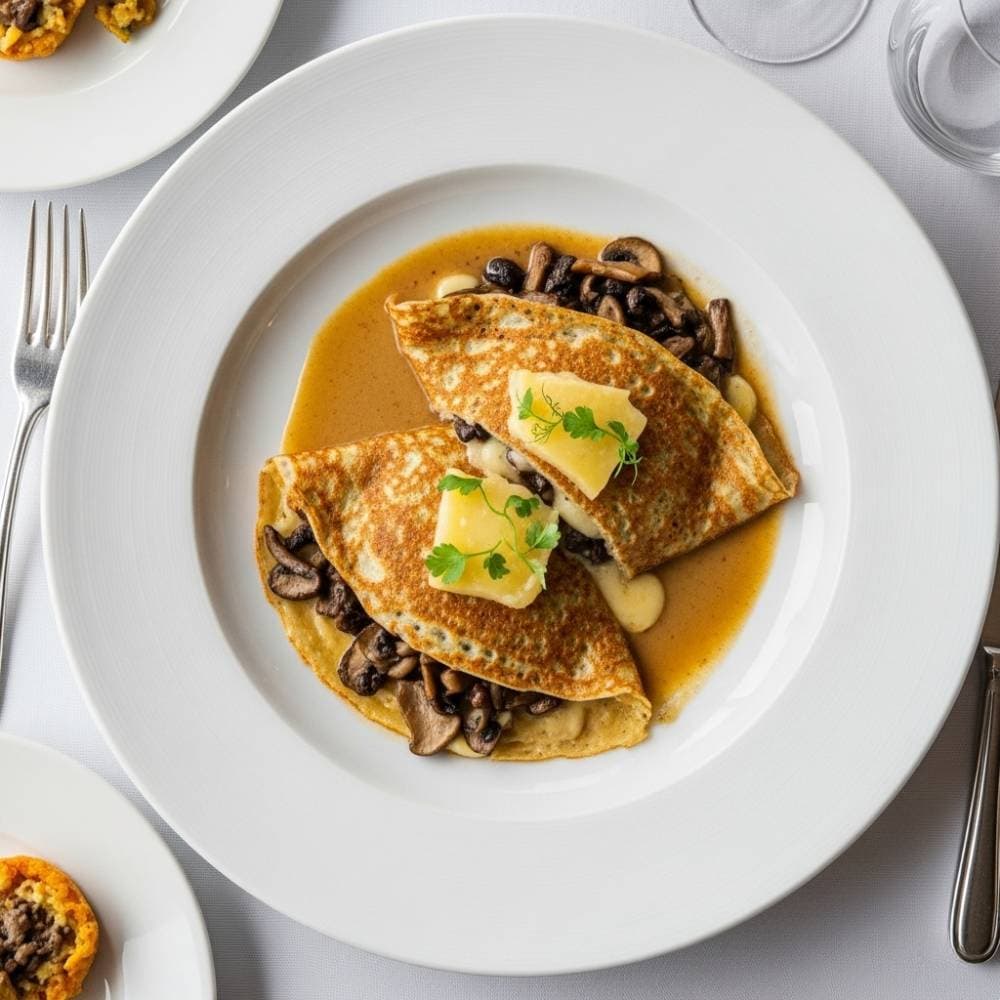
Savory Mushroom and Gruyère Crêpes
Delicate French crêpes filled with a rich, earthy mixture of sautéed mushrooms and melted nutty Gruyère cheese. A sophisticated and comforting meal for two.
The Quick Answer
These crepes hinge on batter chemistry and on the specific melting behavior of Gruyere. The egg-and-starch film and the cheese's protein structure explain how to get a flexible crepe and a filling that holds together.
Why does resting the crepe batter actually make a difference?
Whisking the 1/2 cup of flour into the wet ingredients hydrates the flour and develops some gluten, the elastic protein that would make a fresh-mixed crepe tight and tearable. The 30-minute rest in the fridge does two things: gluten strands relax so the cooked sheet is tender and flexible, and the starch granules continue absorbing the milk and water, thickening the batter slightly for a more even, less holey crepe. A rested batter also pours and swirls more smoothly. Resting cold rather than at room temperature matters because it slows any further gluten activity while hydration finishes, which is why the recipe specifies the refrigerator for at least half an hour.
Why does my Gruyere turn oily or stringy in the crepe instead of smooth?
Gruyere is an aged, relatively firm cheese, so its proteins are more crosslinked than a young melter, and overheating makes them seize and squeeze out fat as a greasy slick rather than flowing. The method's gentle finish, warming the folded crepe one to two minutes per side, is deliberate: just enough to soften the 1/2 cup of shredded Gruyere into a cohesive, nutty layer without breaking it. The dry, deglazed mushroom filling helps too, because a watery filling would steam the cheese and thin it. Shredding rather than slicing the Gruyere also lets it melt quickly and evenly at low heat, before the proteins have time to tighten and separate.
Not sure what to cook next? Let the generator pick your next dish in one click.
Random Recipe GeneratorAbout This Recipe
What is this dish?
Savory crêpes are a French classic from Brittany — thin, delicate unleavened pancakes made from a flour, egg, and milk batter, rested to relax the gluten, then cooked in a dry pan until lightly golden. Filled with sautéed mushrooms and melted Gruyère, these become a sophisticated, bistro-quality meal that's surprisingly simple to make at home once you understand the technique.
Why you'll love it
Savory crêpes are one of the most elegant quick meals in French home cooking. The crêpes themselves are delicate and thin with lightly crispy edges; the filling is earthy, buttery, and rich from the mushrooms and nutty Gruyère. The contrast of textures — thin, slightly crispy crêpe exterior and creamy filling — is remarkable, and they feel celebratory.
When to serve
Savory crêpes are perfect for a romantic brunch, a light dinner, or an elegant lunch. They're popular throughout France at street markets and crêperies but translate beautifully to home cooking. Serve them as a light main course with a simple green salad, or as part of a brunch spread with fruit and sparkling wine.
Quick tips
Rest the batter for at least 30 minutes — this relaxes the gluten for tender crêpes. The first crêpe almost always fails — consider it a pan calibration test. Use medium heat only. Swirl the batter immediately and decisively when it hits the pan for even coverage.
Ingredient Highlights
All-Purpose Flour
The structural base of the crêpe batter. The gluten must be allowed to relax after mixing — this is why resting the batter for 30 minutes is non-negotiable for tender, flexible crêpes. Inadequate resting produces rubbery, difficult-to-cook crêpes.
Gruyère Cheese
The classic French melting cheese for savory crêpes. Its nutty, slightly sweet, complex flavor pairs perfectly with mushrooms. It melts beautifully into a smooth, stringy layer and browns attractively if the crêpes are briefly returned to the pan after filling.
Cremini Mushrooms
Sautéed in butter until deeply browned and reduced to about half their volume. The browning concentrates the flavor and creates the savory, earthy depth that makes the filling so satisfying. The mushrooms must be properly browned, not just softened.
Whole Milk
Combined with water in the batter for optimal texture — milk provides richness and tenderness while water gives delicacy and keeps the crêpes thin and easy to handle. Using all milk makes the batter slightly thicker and richer.
Substitution Options
Replace Gruyère with Swiss, Emmental, Comté, or fontina for a similar flavor profile. Any mushroom variety works — oyster, shiitake, porcini, or a wild mix all give different but equally delicious results. A splash of cream or crème fraîche added to the mushrooms creates a richer, saucier filling. Buckwheat flour replacing half the all-purpose flour makes traditional Breton galettes with a nuttier, earthier flavor. For dairy-free crêpes, use oat milk or almond milk and replace butter with a neutral oil.
You'll likely need to buy
Likely in your pantry
Step-by-Step Instructions
Make the crêpe batter
In a medium bowl, whisk together 1/2 cup all-purpose flour and 1 pinch salt. In a separate bowl, whisk 1 large egg, 1/2 cup milk, 1/4 cup water, and 1 tablespoon melted unsalted butter. Gradually pour the wet ingredients into the dry ingredients, whisking constantly until the batter is smooth and lump-free. Cover the bowl and let the batter rest in the refrigerator for at least 30 minutes. Resting helps the gluten relax for a more tender crêpe.
Chef's Tips
- ›Resting the batter makes the crêpes more tender and easier to cook.
- ›A smooth batter prevents lumps in the finished crêpes.
Prepare the mushroom filling
While the batter rests, prepare the filling. In a large skillet, melt 1 tablespoon unsalted butter with 1 tablespoon olive oil over medium-high heat. Add 2 cups sliced mushrooms and cook for 5-7 minutes, stirring occasionally, until they are browned and tender. Add 1/4 finely chopped onion or shallot and 1 clove minced garlic. Cook for 3-5 minutes, stirring, until the onion is soft and translucent (you can see through it) and the garlic smells pleasant (fragrant). Season with 1/4 teaspoon salt and 1/8 teaspoon black pepper.
Chef's Tips
- ›Translucent means you can see through it, indicating it is soft.
- ›Fragrant means it smells good and aromatic.
- ›Browning the mushrooms adds depth of flavor to the filling.
Finish filling and cook crêpes
Pour 1/4 cup dry white wine or vegetable broth into the skillet with the mushrooms, scraping the bottom of the pan to loosen any browned bits (this is called deglazing). Let the liquid simmer (cook gently just below boiling, with small bubbles) for 1-2 minutes until it has reduced (cooked down and become thicker). Remove from heat. Now, cook the crêpes. Heat a crêpe pan or non-stick skillet over medium heat. Lightly grease with butter. Pour about 1/4 cup of batter into the pan, swirling to coat the bottom evenly. Cook for 1-2 minutes until the edges are set and the bottom is lightly golden. Flip and cook for another 30-60 seconds. Stack cooked crêpes on a plate. Repeat with remaining batter, making about 4-6 crêpes.
Chef's Tips
- ›Deglazing adds rich flavor to the sauce.
- ›Simmer means to cook gently just below boiling, with small bubbles.
- ›Reduced means cooked down to be thicker and more flavorful.
- ›The first crêpe often doesn't turn out perfect; consider it a test run!
Assemble and serve
Lay a cooked crêpe flat. Spoon an equal amount of mushroom filling onto one half of the crêpe. Sprinkle with 1/2 cup shredded Gruyère cheese. Fold the crêpe in half, then in half again to form a triangle. Repeat with remaining crêpes and filling. You can return the assembled crêpes to the warm skillet for 1-2 minutes per side to melt the cheese further, or briefly bake them. Serve immediately, garnished with fresh thyme or parsley.
Chef's Tips
- ›Assembling just before serving ensures the crêpes are warm and the cheese is melted.
- ›Serving immediately ensures the best taste and texture.
Chef's Tips
Techniques that separate good from great
Rest the batter for at least 30 minutes — this single step prevents rubbery crêpes
When you mix crêpe batter, the gluten strands in the flour become tense and elastic. Without resting, the crêpes spring back when you swirl the batter and cook up thick and rubbery. After 30-60 minutes of resting in the refrigerator, the gluten relaxes completely and the batter spreads effortlessly into a perfectly thin, even sheet.
The first crêpe is always a test — discard it without guilt
The first crêpe calibrates the pan temperature, butter amount, and amount of batter needed. It almost always comes out too thick, unevenly colored, or torn. Consider it a necessary sacrifice. By the second and third crêpe, you'll have the system dialed in — the right amount of batter (about 3 tablespoons for a 10-inch pan), the right heat, and the right wrist motion for swirling.
Swirl immediately and decisively when the batter hits the pan
Pour the batter into the center of the hot pan and immediately pick up the pan and tilt it in a circular motion so the batter flows evenly to the edges. This entire action should take about 3 seconds. Hesitation results in thick patches and an uneven crêpe. The batter starts cooking almost immediately, so you have a very short window to spread it before it sets.
Brown the mushrooms properly — cook until they've released their water and caramelized
Mushrooms are 90% water, and they must cook long enough to release all that water and then continue cooking until the water evaporates and the mushrooms start to brown. If you take them off the heat when they're just wilted and still wet, the filling will be bland and soggy. Keep cooking on medium-high heat, stirring occasionally, until the pan is dry and the mushrooms are deeply golden.
Nutrition Facts
Per serving · Estimated values
* Estimated per serving based on a 2,000 calorie diet.
Equipment Needed
- Medium bowls (for batter and filling)
- Whisk
- Crêpe pan or non-stick skillet
- Spatula or wooden spoon
- Measuring cups
- Measuring spoons
- Knife and cutting board
As an Amazon Associate we earn from qualifying purchases — at no extra cost to you.
Quick Tips
- For a perfectly smooth batter, you can blend it in a blender after mixing, then rest.
- Ensure your pan is hot enough for cooking crêpes quickly, but not so hot that they burn.
- These crêpes can be prepared ahead of time. Store cooked crêpes layered with parchment paper in the refrigerator. Reheat gently in a pan or microwave. Make the filling fresh.
Recipe Variations
Different ways to make this dish your own
Ham and Gruyère Crêpes (Galette Complète)
Add a thin slice of good-quality ham to each crêpe alongside the mushrooms and Gruyère, then crack an egg in the center and fold the crêpe edges into a square package. Cook until the egg white sets. A classic French galette complète.
Ratatouille Crêpes
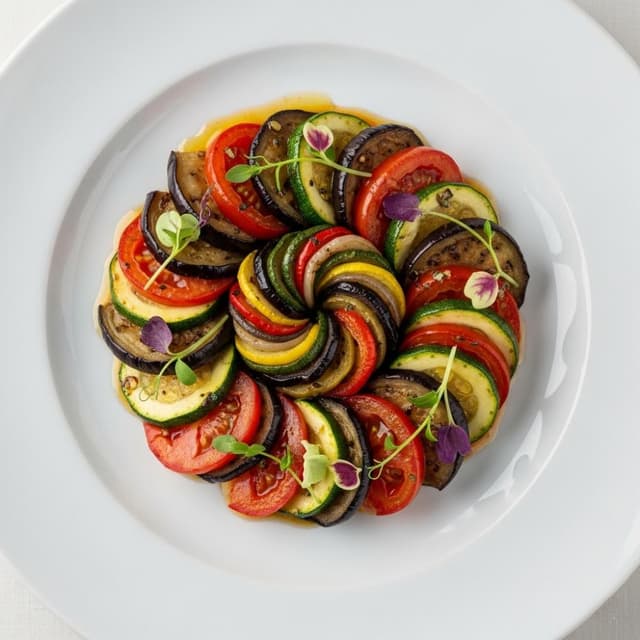
Fill with a classic ratatouille (eggplant, zucchini, tomatoes, peppers, and herbs) and crumbled goat cheese for a colorful, vegetable-forward summer version of the savory crêpe.
Smoked Salmon and Cream Cheese Crêpes
No cooking required for the filling — spread crêpes with cream cheese, top with smoked salmon, capers, thinly sliced red onion, and fresh dill. Roll or fold and serve immediately. A spectacular brunch option.
Sweet Dessert Crêpes
Use the same batter for dessert crêpes with butter, sugar, and a squeeze of lemon, or go full Crêpes Suzette with orange butter and a small amount of Grand Marnier. The batter is identical for both savory and sweet.
What to Serve With
Perfect pairings to complete the meal
As a Romantic Brunch with Fresh Fruit
Serve two filled and folded crêpes per person alongside a bowl of fresh berries, sliced fruit, and a pot of good coffee or tea. The contrast between the savory, cheesy crêpes and the sweet, fresh fruit is a perfect brunch combination that feels both indulgent and light.
As a Light Dinner with a Green Salad
Serve three mushroom crêpes per person as a light dinner alongside a simple butter lettuce or arugula salad with a sharp vinaigrette. The salad's acidity cuts through the richness of the Gruyère and butter beautifully.
As a French-Themed Dinner Party First Course
Serve one or two small, neatly folded crêpes per person as a starter before a French main course. Garnish with a few leaves of fresh thyme or chervil and a light drizzle of truffle oil for an impressive, elegant presentation.
With a Glass of White Burgundy or Beaujolais Blanc
The nutty Gruyère and earthy mushrooms pair beautifully with a crisp, mineral white Burgundy (Mâcon-Villages or Saint-Véran) or a chilled Beaujolais Blanc. Both wines have the acidity to cut the richness and the body to stand up to the Gruyère.
Storage & Reheating
Keep it fresh and plan ahead
Refrigerator
Store cooked, unfilled crêpes layered with parchment paper in an airtight container for up to 3 days. Store the mushroom filling separately for up to 3 days. Assemble fresh when ready to serve.
Freezer
Freeze cooked crêpes stacked with parchment between each layer in a zip-lock bag for up to 2 months. Thaw in the refrigerator overnight or at room temperature for 30 minutes before filling.
Make-Ahead
The crêpe batter can be made up to 24 hours ahead and refrigerated. Cooked crêpes can be made a day ahead. The mushroom filling is best made fresh but can be prepared up to 4 hours ahead and reheated gently before filling.
Reheating
Warm crêpes in a dry skillet over low heat for 30 seconds per side, or wrapped in a damp paper towel in the microwave for 20 seconds. Reheat the mushroom filling in a skillet with a splash of wine or broth. Assemble and serve immediately after reheating.
Cooking tonight?
Get a month of dinners like this — done for you
30 chef-tested dinners mapped to the month, plus 5 ready-to-shop grocery lists. One-time $8.99 — 30 dinners planned for you, zero nightly decisions.
See the 30-Day Plan →Got Leftovers?
Turn what you already have in your fridge into delicious meals. Our AI-powered generator creates personalized recipes from your ingredients.
Go Deeper
Master the Culinary Science
Every recipe is a doorway. Our 7 Mastery Guides give you the science, technique, and framework to understand why food works — not just how to follow steps.
AI-Powered
Have Ingredients? Generate a Recipe.
Tell our AI what's in your fridge and get a custom recipe with image in seconds. No waste, no boredom.
Try the AI Recipe Generator →Browse more like this:
You Might Also Like
Discover more delicious recipes similar to what you're cooking