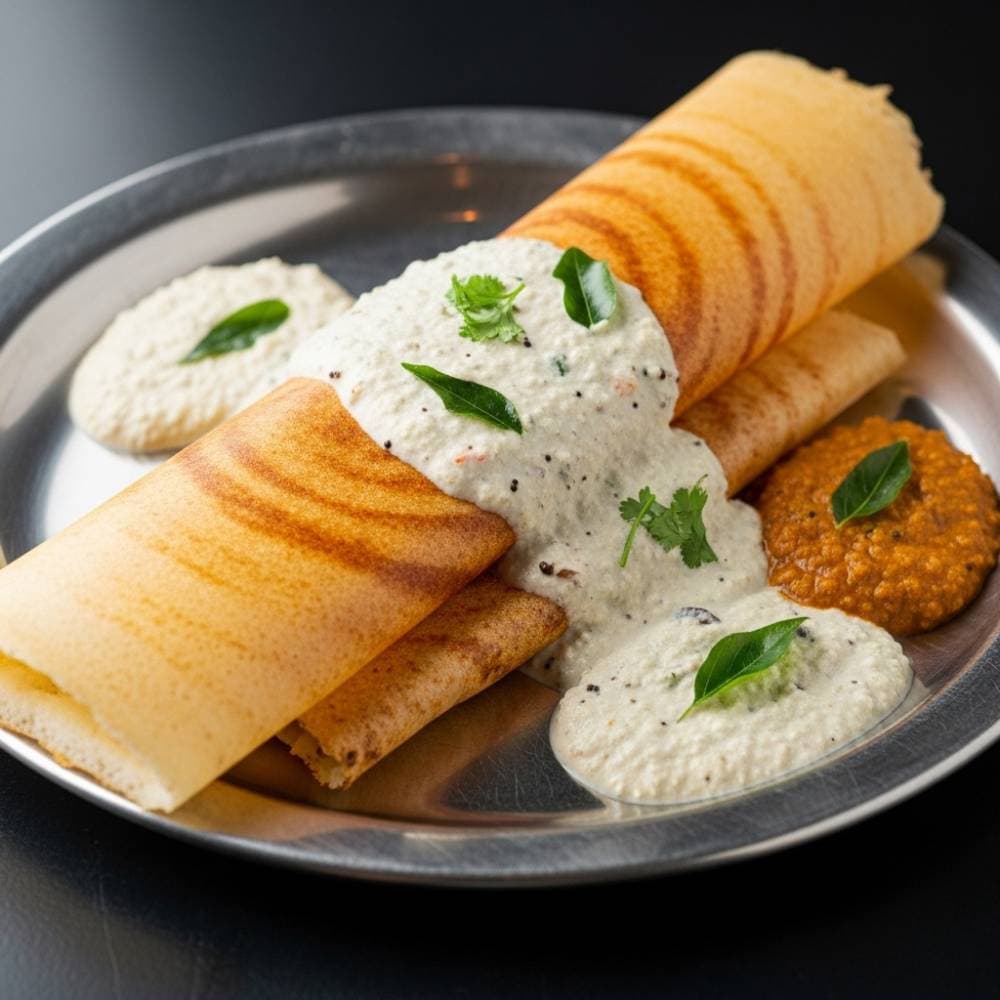
Spicy Masala Dosa with Coconut Chutney
Crispy, thin South Indian crepes (dosa) filled with a flavorful spiced potato mixture (masala), served with a fresh and tangy coconut chutney. A satisfying and authentic meal for two.
The Quick Answer
Dosas fail most often when the batter has not fermented properly, giving pale, dense crepes instead of crisp lacy ones, or when the batter sticks and tears on the tawa. Let the rice-and-urad-dal batter ferment fully until bubbly, and manage the griddle temperature carefully so the dosa releases and crisps rather than gluing itself down.
Why won't my dosa get crispy and lacy?
Crispness starts with fermentation, not the griddle. Wild yeast and bacteria feed on the rice and urad dal sugars over eight to twelve hours, producing carbon dioxide that aerates the batter and acids that lower its pH. Those bubbles create the lacy holes, and the slightly sour, fermented batter browns and crisps far better than a flat, unfermented one. The urad dal matters because its proteins and natural mucilage give the batter the stretch to spread thin without breaking. A batter that is too thick steams into a soft pancake instead of crisping, so it should be thick but pourable, spread fast and thin, with oil drizzled at the edges to fry and crisp the rim.
Why does my dosa stick and tear on the tawa?
Sticking is a temperature problem at the metal surface. If the tawa is too cool, the batter's starch bonds directly to the pan before a crust can form, so the dosa shreds when you lift it; if it is smoking hot, the first ladle seizes and seizes unevenly. The classic fix is to get the tawa hot, then wipe it with a cut onion or a damp cloth to drop the surface temperature slightly and leave a thin non-stick film just before pouring. A properly seasoned cast-iron tawa carries a layer of polymerized oil that releases the dosa cleanly, which is why resting the griddle briefly between dosas to even out its heat makes each one easier to spread and lift.
Not sure what to cook next? Let the generator pick your next dish in one click.
Random Recipe GeneratorAbout This Recipe
What is this dish?
Masala dosa is South India's most iconic dish — a paper-thin, lacquer-crisp crepe made from fermented rice and lentil batter, filled with spiced potato masala and served with coconut chutney and sambar. Originating in Karnataka and Tamil Nadu, it has become a beloved breakfast staple across all of India and in Indian communities worldwide. The fermentation process gives the batter its signature tang and makes it exceptionally nutritious.
Why you'll love it
Masala dosa achieves a textural combination that is nearly impossible to replicate with any other dish: crackling-crispy exterior that shatters when you break it, with a warm, lightly spiced potato filling inside. The coconut chutney provides cool creaminess and the sambar (if served) adds a tangy, lentil-based contrast. It is also naturally vegan, gluten-free, and dairy-free.
When to serve
Dosa is traditionally eaten for breakfast in South India, but it makes an excellent brunch dish, light lunch, or snack at any time of day. It is best eaten immediately off the tawa (griddle) — it does not hold well and must be served the moment it's cooked.
Quick tips
The batter must ferment in a warm place for at least 8 hours — overnight is ideal. The tawa must be properly hot before adding batter, and the spreading technique (circular outward motion with the ladle back) is the key skill to practice. Make one test dosa to calibrate heat and batter consistency before the full batch.
Ingredient Highlights
Urad Dal (Split Black Gram)
The essential lentil that creates the dosa's structure, fermentation, and characteristic tang. When soaked and ground, urad dal becomes fluffy and light, which makes the batter aerate during fermentation. No other lentil produces the same result — this is a non-negotiable ingredient.
Fenugreek Seeds
Added in small amounts to the batter, fenugreek seeds accelerate fermentation and contribute a subtle bitterness that balances the rice's starchiness. They also give the dosa its golden color during cooking. Essential for authentic flavor and texture.
Kokum (or Tamarind)
The sour agent used in the potato masala and sometimes the chutney. Dried kokum petals provide a distinctly Keralan tartness — different from tamarind's molasses-like depth. If unavailable, tamarind paste or a squeeze of lemon can substitute, though the flavor changes.
Fresh Curry Leaves
Non-negotiable for authentic South Indian flavor in both the masala and the chutney tempering. Dried curry leaves have negligible flavor — only fresh ones, available at Indian grocery stores, deliver the characteristic floral-citrus aroma that defines South Indian cooking.
Substitution Options
Store-bought dosa batter (available at Indian grocery stores) saves 8+ hours and produces good results — use it confidently. If kokum is unavailable for the masala, use 1/2 teaspoon tamarind paste diluted in 1 tablespoon water. Frozen coconut works as well as fresh coconut in the chutney. If no urad dal is available, idli rava (semolina idli batter) produces acceptable dosas. A non-stick frying pan can replace a traditional dosa tawa.
You'll likely need to buy
Likely in your pantry
Step-by-Step Instructions
Prepare dosa batter (starting day before)
Rinse 1 cup raw rice, 1/4 cup Urad dal (split black gram lentils), and 1/2 teaspoon Fenugreek seeds (small, yellowish-brown seeds) together several times until the water runs clear. Soak them in separate bowls in enough water to cover them by at least 2 inches, for 4-6 hours. After soaking, drain the water. First, grind the Urad dal and Fenugreek seeds with a little fresh water in a wet grinder or high-speed blender until very smooth and fluffy. Then, add the rice and grind until smooth, adding water as needed. The batter should be thick but pourable. Transfer the batter to a large bowl, add 1/2 teaspoon salt, and mix well. Cover and let it ferment (allow to rise and sour slightly) in a warm place for 8-12 hours, or overnight. The batter will rise and become bubbly.
Chef's Tips
- ›Ferment means to allow to rise and sour slightly. A warm place helps fermentation.
- ›The consistency of the batter is crucial; it should be like pancake batter.
Make the masala (potato filling)
Boil 2 medium potatoes until tender, then peel and roughly mash them. Heat 1 tablespoon vegetable oil in a medium pan. Add 1/2 teaspoon mustard seeds and let them splutter (pop open). Add 1/2 thinly sliced onion, 1 minced green chili, 1 teaspoon grated fresh ginger, and 5-6 fresh curry leaves (if using). Cook for 5-7 minutes until the onion is soft and translucent (you can see through it). Add 1/4 teaspoon turmeric powder and 1/4 teaspoon salt. Cook for 30 seconds. Stir in the mashed potatoes and 2 tablespoons water. Mix well and cook for 2-3 minutes. Remove from heat and stir in 2 tablespoons chopped fresh cilantro.
Chef's Tips
- ›Translucent means you can see through it, indicating it is soft.
- ›Spluttering mustard seeds shows they are cooked and releasing flavor.
Prepare the coconut chutney
In a blender, combine 1/2 cup grated fresh or frozen coconut, 1 green chili, 1/2 inch fresh ginger, 1 tablespoon roasted chana dal (split roasted chickpeas), 1/2 teaspoon tamarind paste, 1/4 teaspoon salt, and 1/4 cup water. Blend until completely smooth, adding more water if needed to reach a pouring consistency. For tempering (frying spices in oil to add flavor), heat 1 teaspoon vegetable oil in a small pan. Add 1/2 teaspoon mustard seeds and let them splutter. Add 5-6 fresh curry leaves and 1 small dried red chili. Cook for a few seconds. Pour this hot tempering over the blended chutney and mix.
Chef's Tips
- ›Tempering means frying spices in oil to add flavor.
- ›Roasted chana dal adds body and a nutty flavor to the chutney.
Cook the dosa
Heat a non-stick dosa tawa (a flat griddle) or a large non-stick skillet over medium-high heat. Test the heat by sprinkling a few drops of water; they should sizzle and evaporate quickly. Lightly grease the tawa with a little oil. Pour about 1/2 cup of the fermented dosa batter onto the center of the tawa. Immediately use the back of a ladle or the bottom of the cup to spread the batter in a circular motion, starting from the center and moving outwards, to form a thin, even crepe. Drizzle 1/2 teaspoon oil or ghee around the edges and over the dosa. Cook for 2-3 minutes until the bottom is golden brown and crispy, and the edges start to lift. Gently loosen the edges with a spatula. Spread 2-3 tablespoons of the potato masala filling over half of the dosa. Cook for another 30 seconds. Fold the dosa in half or roll it up. Remove from tawa. Repeat with remaining batter and filling. Serve immediately.
Chef's Tips
- ›The correct tawa temperature is crucial for crispy dosa.
- ›Spreading the batter quickly creates a thin dosa.
- ›Dosa means crepe in South Indian cuisine.
Serve
Serve the hot and crispy Masala Dosa immediately with the prepared Coconut Chutney and a side of Sambar (a lentil-based vegetable stew), if desired. The dosa is best eaten fresh.
Chef's Tips
- ›Dosa is best enjoyed fresh from the tawa.
- ›Coconut Chutney complements the dosa perfectly.
Chef's Tips
Techniques that separate good from great
Make a test dosa first to calibrate your tawa temperature and batter consistency
The first dosa almost always comes out imperfect — too thick, uneven, or sticking. Use it as a diagnostic tool. If batter isn't spreading easily, the tawa is too hot or the batter too thick (add a splash of water). If dosa sticks, re-season the tawa with oil. The second and subsequent dosas will be better.
The spreading technique is the critical skill — fast, outward, circular motion
Pour batter in the center of the tawa, then immediately use the back of a ladle or measuring cup to spread in a continuous outward spiral, applying gentle pressure. You have only about 3-4 seconds before the batter sets. Practice the motion before you pour. Thin, even spreading is everything.
Rest the tawa briefly between dosas to avoid overheating
After cooking each dosa, wipe the tawa with a damp cloth or paper towel. This removes any residue and briefly reduces the temperature, preventing the next dosa from cooking too quickly and burning before it can be spread thin.
Add ghee or oil around the edges of the dosa for the crispiest result
Once you've spread the dosa, drizzle a teaspoon of ghee or oil around the entire circumference where the dosa meets the tawa. This edges the dosa in fat that crisps and chars the border — the best part of a dosa.
Nutrition Facts
Per serving · Estimated values
* Estimated per serving based on a 2,000 calorie diet.
Equipment Needed
- Medium bowls (for soaking and batter fermentation)
- Wet grinder or high-speed blender
- Medium pan (for masala)
- Non-stick dosa tawa or large non-stick skillet
- Ladle (for spreading dosa batter)
- Spatula
- Small blender (for chutney)
- Small pan (for tempering)
- Measuring cups
- Measuring spoons
- Knife and cutting board
As an Amazon Associate we earn from qualifying purchases — at no extra cost to you.
Quick Tips
- The success of dosa heavily relies on proper batter fermentation. Ensure a warm, consistent temperature.
- The dosa batter can be stored in the refrigerator for up to 3 days. It may become more sour over time.
- For a truly authentic taste, use a dedicated cast iron dosa tawa, seasoned well.
- You can add other vegetables like carrots or beans to the potato masala for variety.
Recipe Variations
Different ways to make this dish your own
Plain Dosa (Without Filling)
Omit the potato masala entirely for a plain dosa (sada dosa). The crispy, tangy crepe is delicious on its own with only coconut chutney and sambar. Many South Indians prefer this simpler version.
Rava Dosa (Instant Semolina Dosa)
Mix semolina (rava), rice flour, and all-purpose flour with yogurt and spices for an instant no-ferment version. Rava dosas are thinner, lacier, and crispier than traditional dosas and require no overnight soaking or fermentation.
Egg Dosa
Crack a raw egg onto the dosa while it cooks, spread it over the surface, and cook until set before folding. The egg adds protein and richness to the dosa in a particularly satisfying combination.
Cheese Dosa (Fusion)
Spread a tablespoon of butter over the dosa surface, sprinkle with grated cheese, add the potato masala, and fold. Butter-cheese dosas are wildly popular at South Indian street stalls as a comfort-food twist on the classic.
What to Serve With
Perfect pairings to complete the meal
With Coconut Chutney and Sambar
The traditional and obligatory accompaniments. The coconut chutney provides creamy richness, while sambar (a tamarind lentil soup with vegetables) offers tangy, spiced contrast. Together with the dosa, they form a complete, balanced meal.
With Tomato Chutney
A cooked tomato chutney with onion, dried red chili, and mustard seed tempering is the second essential South Indian condiment for dosa. Its sharper, spicier profile contrasts the coconut chutney's mildness.
As Part of a South Indian Breakfast Spread
Serve alongside idli (steamed rice cakes), vada (savory fried lentil donuts), and multiple chutneys for an authentic South Indian breakfast feast. This spread is the traditional weekend breakfast in Tamil Nadu and Karnataka.
With Filter Coffee
South Indian filter coffee — strong, slightly sweet, served in a stainless steel tumbler and davara — is the traditional drink companion to a dosa breakfast. The coffee's bitterness cuts through the richness of the ghee-drizzled dosa perfectly.
Storage & Reheating
Keep it fresh and plan ahead
Refrigerator
Dosa batter keeps in the refrigerator for 3-4 days after fermenting. It continues to ferment slowly in the fridge and may become more sour over time. Potato masala keeps for 2 days refrigerated. Cooked dosas do not store well.
Freezer
Dosa batter can be frozen in airtight containers after fermentation for up to 1 month. Thaw overnight in the refrigerator. The masala filling can also be frozen for up to 1 month.
Make-Ahead
The dosa batter can be prepared 1-3 days ahead and refrigerated — the flavor actually improves slightly with more fermentation. Potato masala can be made the day before. Cook dosas fresh to order as they lose their crispiness within minutes.
Reheating
There is no good way to reheat cooked dosas — they become soggy and lose their crispiness entirely. Always cook dosas fresh. Reheat the potato masala separately in a pan over medium heat.
Cooking tonight?
Get a month of dinners like this — done for you
30 chef-tested dinners mapped to the month, plus 5 ready-to-shop grocery lists. One-time $8.99 — 30 dinners planned for you, zero nightly decisions.
See the 30-Day Plan →Got Leftovers?
Turn what you already have in your fridge into delicious meals. Our AI-powered generator creates personalized recipes from your ingredients.
Go Deeper
Master the Culinary Science
Every recipe is a doorway. Our 7 Mastery Guides give you the science, technique, and framework to understand why food works — not just how to follow steps.
AI-Powered
Have Ingredients? Generate a Recipe.
Tell our AI what's in your fridge and get a custom recipe with image in seconds. No waste, no boredom.
Try the AI Recipe Generator →Browse more like this:
You Might Also Like
Discover more delicious recipes similar to what you're cooking