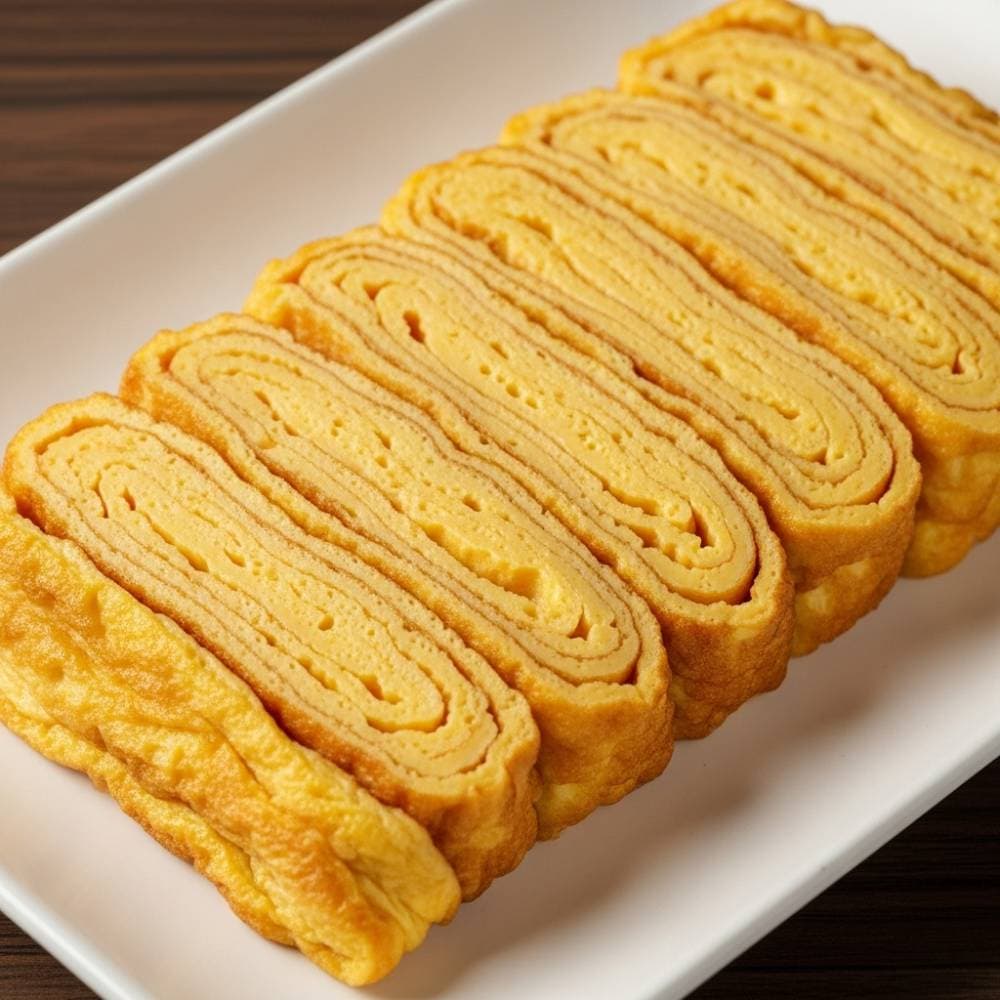
Tamagoyaki (Sweet Japanese Omelette)
A light and subtly sweet Japanese rolled omelette, featuring thin layers of seasoned egg cooked and folded into a compact block. Perfect for breakfast, lunch, or as a sushi topping for two.
The Quick Answer
Tamagoyaki turns greasy at the seams or pale and bland when the pan is over-oiled or the dashi and mirin are skipped. Straining the egg and oiling only with a thin wipe between layers are what give the rolled omelette its smooth, even cross-section and savory-sweet depth.
Why is my tamagoyaki greasy or oily between the layers?
Each new layer needs only a wiped film of oil, applied with a folded paper towel, because the oil's real job is release, not frying. Pour fresh oil into the pan and it pools in the corners of the rectangular tamagoyaki pan, then gets rolled into the spiral where it can't evaporate, leaving slick, separating seams and a heavy mouthfeel. A bare wipe leaves just enough non-stick film for the sheet to lift cleanly while the egg proteins on the wet top surface still meet the new liquid and fuse. Too much oil also lowers the contact temperature unevenly, so some layers brown while others stay raw.
What does the dashi do in tamagoyaki, and can I leave it out?
The two tablespoons of dashi are the difference between a plain sweet omelette and tamagoyaki. Dashi carries glutamate and inosinate, two compounds whose savory effect multiplies when combined, so a small amount reads as deep umami rather than just salt. Its water also dilutes the egg proteins so they set into a softer, more custardy block, and its presence lets the mirin's sweetness register as balanced rather than cloying. Replace it with plain water and you keep the tenderness but lose that backbone of flavor; the omelette tastes flat and one-dimensionally sweet. If you must skip dashi, a pinch more soy and salt only partly compensates, since neither supplies the same synergistic umami.
Not sure what to cook next? Let the generator pick your next dish in one click.
Random Recipe GeneratorAbout This Recipe
What is this dish?
Tamagoyaki (玉子焼き) is Japan's elegant rolled omelette — layers of seasoned egg mixture cooked in a rectangular pan and rolled into a rectangular log using the uniquely Japanese technique of rolling each cooked layer over itself to create visible, delicate internal layers. Tamagoyaki appears daily in Japanese breakfast, bento boxes, and sushi bars. The word means 'grilled egg' and the dish showcases the Japanese culinary value of simple technique executed to perfection.
Why you'll love it
Tamagoyaki is deceptively simple and endlessly rewarding to make. Once mastered, the technique produces a visually stunning, perfectly tender, multi-layered omelette that is simultaneously sweet, savory, and silky. The slightly sweet version (with dashi) is one of the most comforting breakfast foods imaginable. The same technique produces an elegant sushi topping (tamago nigiri) for homemade sushi.
When to serve
Serve as part of a Japanese breakfast with rice and miso soup, as a key component in bento boxes, sliced and arranged alongside sushi as a starter, or as a protein-rich snack. Tamagoyaki is also served as a sushi topping at Japanese restaurants.
Quick tips
Beat the eggs very thoroughly — no streaks of white should remain. Cook each layer over medium-low heat — never high heat. Roll each layer while still slightly wet on top for the best adhesion between layers. A rectangular tamagoyaki pan makes this easier, but a round pan works too.
Ingredient Highlights
Dashi
The Japanese stock (from kombu and katsuobushi) that forms the flavor base of dashimaki tamago (the savory style of tamagoyaki). Dashi adds a subtle oceanic umami that makes the egg mixture taste deeply Japanese. Instant dashi powder dissolved in water works well. Without dashi, the omelette lacks its characteristic depth.
Mirin
Adds a subtle, complex sweetness and shine to the egg mixture that is different from plain sugar. The alcohol in mirin also helps the eggs set with a smooth, fine texture. Hon-mirin (real mirin) produces the best result; mirin-style seasoning is an acceptable substitute.
Soy Sauce
Used in small quantities to add color (a light golden-amber) and savory depth without making the omelette taste obviously of soy. Light soy sauce (usukuchi) keeps the color paler if visual appearance is important — dark soy sauce would make the egg brown.
Fresh Eggs
The quality of tamagoyaki depends entirely on fresh, high-quality eggs. Farm-fresh eggs with deep yellow or orange yolks produce the most beautiful, richly colored tamagoyaki. Room-temperature eggs beat more evenly than cold eggs from the refrigerator.
Substitution Options
Dashi can be replaced with chicken or vegetable broth for a similar (though less authentically Japanese) savory version. Mirin can be replaced with a mixture of sake and sugar (2:1 ratio). For a dairy-based version without dashi, use a small splash of whole milk and omit the dashi. A square or small round non-stick skillet can replace the rectangular tamagoyaki pan, producing a round rather than rectangular omelette.
You'll likely need to buy
Likely in your pantry
Step-by-Step Instructions
Prepare egg mixture
In a medium bowl, gently whisk 4 large eggs until the yolks and whites are just combined, without creating too many bubbles. Add 2 tablespoons dashi (Japanese broth, use vegetable broth or water for vegan), 1 tablespoon mirin (sweet Japanese cooking wine), 1 teaspoon soy sauce (use tamari for gluten-free), 1 teaspoon granulated sugar, and 1/4 teaspoon salt. Whisk gently until the sugar dissolves. Strain the egg mixture through a fine-mesh sieve into a clean bowl. This removes any bits of egg white or chalazae (the white stringy parts), ensuring a smooth omelette. Mirin is a sweet Japanese cooking wine. Dashi is a clear Japanese broth.
Chef's Tips
- ›Do not over-whisk the eggs; too much air creates bubbles that break the omelette.
- ›Straining the egg mixture makes the tamagoyaki smooth.
Heat pan and cook first layer
Heat a non-stick rectangular tamagoyaki pan (a special rectangular omelette pan) or a small round non-stick skillet over medium-low heat. Lightly brush the entire surface of the pan with 1 teaspoon vegetable oil. Pour about one-quarter of the strained egg mixture into the pan, tilting the pan to coat the bottom evenly with a thin layer of egg. Cook for 1-2 minutes until the edges are set and the top is mostly set but still slightly wet.
Chef's Tips
- ›A rectangular tamagoyaki pan is ideal for shaping, but a small round non-stick pan can work.
- ›Medium-low heat is important to cook the egg gently without browning too quickly.
Roll the omelette layers
Using a spatula, carefully roll the cooked egg layer from one end of the pan to the other end. If using a rectangular pan, roll from the far end towards yourself. Once rolled, push the rolled egg to one end of the pan. Lightly brush the newly empty part of the pan with more oil. Pour another quarter of the egg mixture into the empty space and also slightly under the cooked roll. Lift the cooked roll slightly to allow the fresh egg to flow underneath. Cook until this new layer is mostly set but still slightly wet on top.
Chef's Tips
- ›Work quickly but gently to avoid tearing the egg.
- ›The slightly wet top layer helps the new layer stick.
Continue rolling and finish
Repeat the rolling process: roll the combined cooked layers from one end to the other, incorporating the new layer. Push the roll back to one end, oil the pan, and pour in the remaining egg mixture, repeating the process until all the egg mixture is used and you have one thick, rolled omelette (tamagoyaki). Cook for 1-2 minutes on all sides to ensure it is cooked through. Tamagoyaki means rolled omelette in Japanese.
Chef's Tips
- ›The final omelette should be a neat, golden-yellow block.
- ›Practice improves the rolling technique.
Serve
Remove the tamagoyaki from the pan and place it on a cutting board. Let it rest for 1-2 minutes. Slice into 1-inch thick pieces. Serve warm or at room temperature. It is delicious on its own, with rice, or as part of a bento box.
Chef's Tips
- ›Resting allows the omelette to firm up slightly before slicing.
- ›Slicing makes it easier to eat and presents nicely.
Chef's Tips
Techniques that separate good from great
Strain the beaten egg mixture through a fine-mesh sieve before cooking
Straining removes chalaza (the white stringy parts attached to the yolk) and any incompletely mixed whites, producing a smooth, uniform egg mixture that cooks into a silky omelette without any rubbery or white spots. This is a step professional Japanese chefs always take and home cooks often skip.
Keep the heat at medium-low throughout — high heat creates bubbles and tough texture
Tamagoyaki requires gentle, patient cooking. High heat causes the egg proteins to seize quickly, creating a porous, bubbly texture with tough layers. Medium-low heat allows the eggs to set gradually, creating the characteristic smooth, silky, even texture. Be patient — each layer takes 2-3 minutes properly.
Roll each layer while the top is still slightly wet — this creates the tightest spiral
The rolling technique requires timing: the bottom of each layer should be just set while the top is still slightly wet and liquid. If you wait until the top is fully set, the layer doesn't roll as tightly and the seams show. Work quickly once the layer is ready — the egg continues cooking from the residual heat of the pan.
Wrap the finished tamagoyaki in plastic wrap and shape while warm for a perfect rectangle
Immediately after cooking, roll the tamagoyaki tightly in plastic wrap, pressing it into a perfect rectangle or cylinder shape, and let it cool for 5 minutes. The egg sets in this shape as it cools. This gives a restaurant-quality appearance when sliced — clean edges, perfect layers visible in cross-section.
Nutrition Facts
Per serving · Estimated values
* Estimated per serving based on a 2,000 calorie diet.
Equipment Needed
- Medium bowl
- Whisk
- Fine-mesh sieve
- Tamagoyaki pan or small non-stick skillet
- Pastry brush or paper towel (for oiling pan)
- Spatula
- Measuring cups
- Measuring spoons
- Knife and cutting board
As an Amazon Associate we earn from qualifying purchases — at no extra cost to you.
Quick Tips
- For a truly dairy-free version, ensure your dashi is made without dairy or use plain water.
- You can adjust the sweetness of the tamagoyaki to your preference by adding more or less sugar.
- The key to beautiful layers is consistent heat and quick rolling; practice helps improve the technique.
Recipe Variations
Different ways to make this dish your own
Atsuyaki Tamago (Sweeter Version)
Increase the sugar to 2 tablespoons and reduce or eliminate the soy sauce for a sweeter tamagoyaki with a more pronounced golden color. This is the classic sweet version served at sushi bars.
Dashimaki Tamago (Full Savory Version)
Increase the dashi quantity to 4 tablespoons and add only a few drops of soy sauce for the purest savory version. This style is traditional in Kyoto and western Japan.
Tamagoyaki with Nori and Scallion
Place a strip of nori and some sliced scallions on the first layer before rolling for a spiral of green inside the omelette when sliced. A beautiful and flavorful variation.
Mentaiko Tamagoyaki
Add a strip of spicy pollock roe (mentaiko) along the center of the first layer before rolling for an intensely flavored, salty, slightly spicy variation popular in Japanese izakayas.
What to Serve With
Perfect pairings to complete the meal
In a Traditional Japanese Breakfast Set
Serve sliced tamagoyaki alongside steamed white rice, miso soup, tsukemono (pickled vegetables), and grilled fish or tofu for a complete traditional Japanese breakfast (ichiju sansai — one soup, three sides).
In a Bento Box
Thick slices of tamagoyaki are a bento box staple. Pack alongside onigiri, edamame, pickled ginger, and a side salad. The slightly sweet flavor makes it universally popular with both children and adults.
As Tamago Nigiri Sushi
Slice the tamagoyaki into pieces 3/4-inch thick, slightly larger than a mound of seasoned sushi rice. Place atop the rice and secure with a strip of nori for homemade tamago nigiri — one of the simplest and most authentic sushi preparations.
With a Dipping Sauce of Dashi and Soy
Serve warm sliced tamagoyaki with a small dipping sauce of 2 tablespoons dashi, 1 tablespoon soy sauce, and a touch of mirin for a restaurant-style presentation. Grate fresh ginger alongside for a traditional accompaniment.
Storage & Reheating
Keep it fresh and plan ahead
Refrigerator
Tamagoyaki keeps refrigerated for up to 3 days wrapped tightly in plastic wrap. It is excellent served cold or at room temperature, making it ideal for bento boxes.
Make-Ahead
Tamagoyaki can be made up to 1 day ahead and refrigerated. Slice just before serving. The flavors actually develop nicely overnight as the dashi and soy permeate the egg layers more fully.
Reheating
Tamagoyaki can be eaten cold or at room temperature — most bento preparations use it this way. If you prefer warm, briefly heat in a covered pan over low heat for 1-2 minutes. Avoid the microwave which makes eggs rubbery.
Cooking tonight?
Get a month of dinners like this — done for you
30 chef-tested dinners mapped to the month, plus 5 ready-to-shop grocery lists. One-time $8.99 — 30 dinners planned for you, zero nightly decisions.
See the 30-Day Plan →Got Leftovers?
Turn what you already have in your fridge into delicious meals. Our AI-powered generator creates personalized recipes from your ingredients.
Go Deeper
Master the Culinary Science
Every recipe is a doorway. Our 7 Mastery Guides give you the science, technique, and framework to understand why food works — not just how to follow steps.
AI-Powered
Have Ingredients? Generate a Recipe.
Tell our AI what's in your fridge and get a custom recipe with image in seconds. No waste, no boredom.
Try the AI Recipe Generator →Browse more like this:
You Might Also Like
Discover more delicious recipes similar to what you're cooking