Warm Goat Cheese Salad
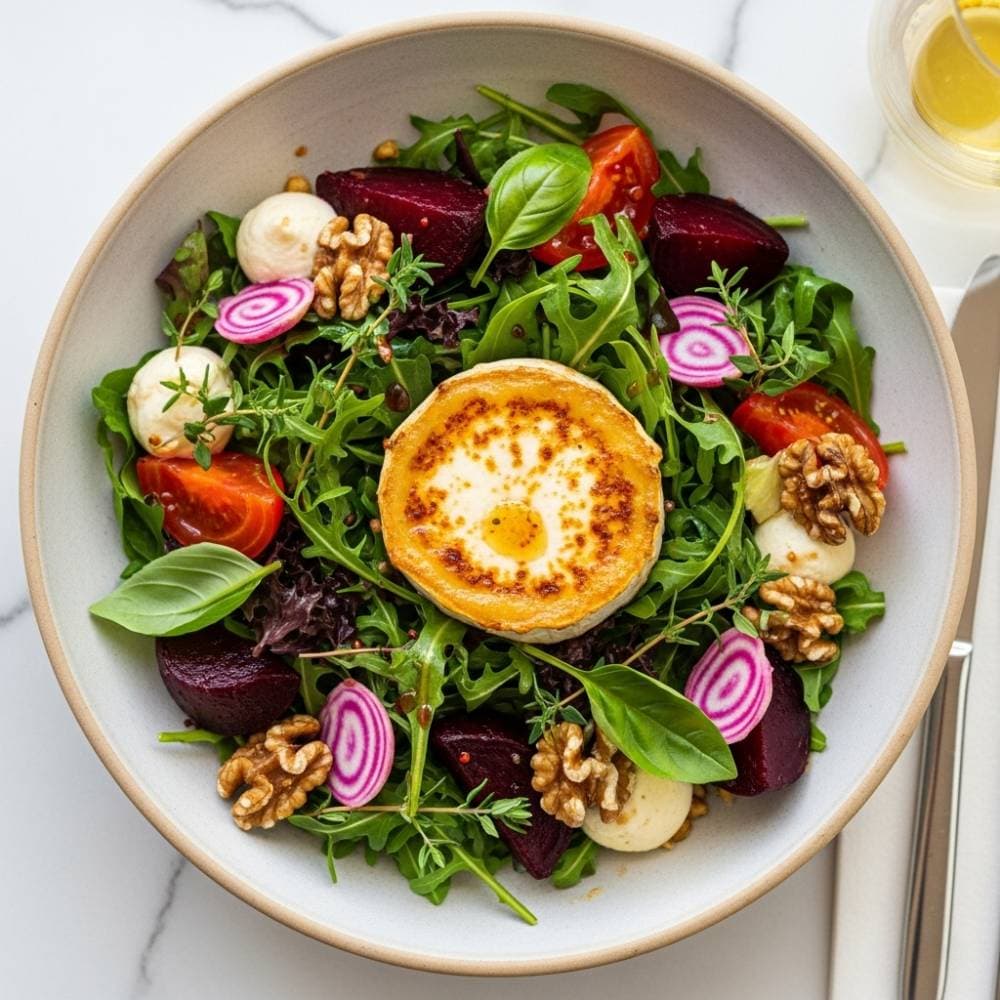
A delightful salad featuring crisp mixed greens, tangy warm goat cheese medallions, and crunchy nuts, all dressed in a sweet and tangy balsamic vinaigrette. A perfect light meal for two.
The Quick Answer
Warm goat cheese salads fail when the medallions slump into a melted puddle in the oven or when the dressed greens wilt before they reach the table. Bake the nut-crusted rounds just until softened rather than fully molten, and toss the greens with only enough balsamic vinaigrette to coat so the acid and oil do not collapse the leaves.
Why does my baked goat cheese melt into a puddle?
Fresh goat cheese is a soft, high-moisture cheese with very little of the stretchy casein network that holds a firm cheese together, so heat quickly loosens it into a flowing mass. The pecan or walnut crust pressed onto both medallions is structural, not just decorative: the nuts form a toasted shell that physically dams the softening cheese and keeps each round holding its shape. Baking at 375°F for only eight to ten minutes warms the interior to gooey without driving it past the point where it spreads. Chilling or briefly freezing the log before slicing helps too, because cold cheese cuts into clean, even medallions that heat uniformly instead of one thin edge collapsing first.
Why does balsamic vinaigrette make my salad greens wilt?
Tender leaves like spring mix and arugula stay crisp because water inside their cells presses outward against the cell walls. The vinaigrette works against that in two ways: salt draws water out by osmosis, and the olive oil coats the leaf surface and breaks down its waxy protection, so cells deflate and the salad goes limp. The balsamic vinegar's acid accelerates the softening. This is why you dress these greens at the last possible moment and use only enough to barely coat, and why the warm cheese goes on top of already-plated leaves rather than being tossed through. Less dressing and less standing time means the leaves keep their structure and crunch.
Not sure what to cook next? Let the generator pick your next dish in one click.
Random Recipe GeneratorAbout This Recipe
What is this dish?
Warm goat cheese salad is a French bistro classic that has graced the menus of Parisian cafés for decades. Crispy rounds of goat cheese — breaded or simply baked — are placed atop a bed of peppery greens and dressed with a sharp balsamic vinaigrette. The contrast of warm, creamy cheese against cool, crisp lettuce is one of the most elegant flavor pairings in simple French cooking.
Why you'll love it
This salad achieves something rare: it functions simultaneously as an elegant starter, a light main course, or a sophisticated side. The warm goat cheese is richly satisfying in a way that cold cheese is not, and it transforms a simple salad into something genuinely special. The entire dish comes together in under 20 minutes with minimal equipment.
When to serve
Serve as a first course for a French dinner party, a light lunch paired with a glass of Sauvignon Blanc, or as part of a weekend brunch spread. It pairs particularly well with roasted chicken or a vegetable quiche as a complete French-inspired meal.
Quick tips
Refrigerate the goat cheese log for at least 30 minutes (or 15 minutes in the freezer) before slicing — cold cheese cuts cleanly without crumbling. The nut coating prevents the cheese from melting into a puddle and adds essential texture. Dress the greens lightly and assemble immediately before serving.
Ingredient Highlights
Goat Cheese
The star of the salad. Its tangy, creamy character contrasts beautifully with both the sharp vinaigrette and the peppery greens. Log-style goat cheese is easiest to slice into uniform medallions. A fresh chèvre works perfectly; aged goat cheese will be drier and more crumbly.
Balsamic Vinegar
The backbone of the vinaigrette. Aged balsamic has natural sweetness and viscosity that balances the goat cheese's tang. Even a basic supermarket balsamic works well here because the Dijon mustard and honey round out any sharpness.
Mixed Greens or Arugula
The peppery bitterness of arugula is the ideal foil for rich, warm goat cheese. A mesclun mix also works well. Avoid iceberg or romaine, which lack the flavor character to stand up to the bold dressing and cheese.
Pecans or Walnuts
The nut coating serves two purposes: it prevents the cheese from melting and spreading during baking, and it adds an essential textural crunch. Press them firmly onto all surfaces of each medallion. Toast them lightly first for deeper flavor.
Substitution Options
Swap goat cheese for brie or camembert for a richer, milder result (remove the rind first). Pecans and walnuts are interchangeable — hazelnuts also work well. Replace dried cranberries with fresh pomegranate seeds, dried cherries, or sliced fresh strawberries. For a vegan version, use breaded and baked firm tofu and maple syrup instead of honey. Apple cider vinegar can substitute for balsamic vinegar for a sharper, lighter dressing.
You'll likely need to buy
Likely in your pantry
Step-by-Step Instructions
Prepare goat cheese medallions
Preheat your oven or toaster oven to 375°F (190°C). Slice the 4 ounce goat cheese log into 4 equal medallions (round slices). Gently press about 1 tablespoon finely chopped pecans or walnuts onto both sides of each goat cheese medallion. This coating will provide a nice crunch.
Chef's Tips
- ›Chilling the goat cheese slightly beforehand can make it easier to slice cleanly.
- ›Pressing the nuts firmly helps them stick during baking.
Bake the goat cheese
Place the coated goat cheese medallions on a small baking sheet lined with parchment paper. Bake for 8-10 minutes, or until the cheese is softened and the nuts are lightly toasted. The cheese should be warm and slightly gooey but still hold its shape.
Chef's Tips
- ›Watch the cheese closely to prevent it from melting too much or burning.
- ›Parchment paper prevents sticking and makes cleanup easy.
Make the vinaigrette
While the cheese bakes, make the vinaigrette. In a small bowl, whisk together 2 tablespoons olive oil, 1 tablespoon balsamic vinegar, 1 teaspoon Dijon mustard, 1 teaspoon honey or maple syrup, 1/4 teaspoon salt, and 1/8 teaspoon black pepper. Whisk until the dressing is well combined and emulsified (smooth and well-mixed).
Chef's Tips
- ›Emulsified means smooth and well-mixed, like mayonnaise.
- ›Adjust the sweetness of the honey/maple syrup to your taste.
Assemble and serve
In a medium bowl, gently toss 2 cups mixed greens with 1/4 cup thinly sliced red onion and 1/4 cup dried cranberries. Divide the salad greens evenly between two plates. Top each salad with two warm goat cheese medallions. Drizzle the balsamic vinaigrette evenly over both salads. Serve immediately with 2 slices crusty baguette or bread on the side. The bread makes the dish not gluten-free.
Chef's Tips
- ›Assemble the salad just before serving to keep the greens crisp.
- ›Serving immediately ensures the cheese is warm and gooey.
Chef's Tips
Techniques that separate good from great
Freeze the goat cheese for 15 minutes before slicing for perfectly clean cuts
Room-temperature goat cheese crumbles and sticks to the knife. A brief freeze firms up the cheese dramatically, allowing you to cut clean, uniform medallions without the cheese tearing apart. Use a sharp knife in one clean downward motion — don't saw.
The nut coating does more than add texture — it keeps the cheese from spreading
The nut coating acts as an insulating layer that slows the melting of the cheese during baking. Without it, the cheese rounds collapse and spread. Press the nuts firmly onto all surfaces of each medallion before baking.
Dress the greens with just enough vinaigrette to barely coat the leaves
Over-dressed salad greens become limp and heavy. Use just enough to make the leaves glisten — not wet. Taste a leaf after dressing. If you can taste sharp vinegar with every bite, you've used too much. The warm goat cheese will add plenty of richness.
Place the warm goat cheese on the plated greens at the very last second
The warm cheese should hit the dressed, plated greens immediately before serving. If the cheese sits on the greens for even a few minutes, it starts wilting them. Have everything ready, plate the greens, add the cheese, and serve immediately.
Nutrition Facts
Per serving · Estimated values
* Estimated per serving based on a 2,000 calorie diet.
Equipment Needed
- Small bowl (for goat cheese coating)
- Small baking sheet
- Parchment paper
- Small bowl (for vinaigrette)
- Whisk
- Medium bowl (for salad greens)
- Knife and cutting board
- Measuring cups
- Measuring spoons
As an Amazon Associate we earn from qualifying purchases — at no extra cost to you.
Quick Tips
- For a gluten-free option, omit the bread or serve with gluten-free crackers or bread.
- You can toast the baguette slices lightly for extra crunch.
- Add slices of fresh apple or pear to the salad for an extra layer of flavor and texture.
- Walnuts can be used instead of pecans for the goat cheese coating.
Recipe Variations
Different ways to make this dish your own
With Fresh Pear or Apple
Add thinly sliced ripe pear or crisp apple to the salad for a sweet, crunchy element that complements the goat cheese even better than dried cranberries. Anjou pear or Fuji apple work particularly well.
With Prosciutto and Fig
Add 2-3 slices of paper-thin prosciutto and 2-3 fresh or dried figs to the salad for a more substantial, Italian-French fusion version. The salty prosciutto and sweet fig create an extraordinary combination with warm goat cheese.
Pan-Fried Version
Bread cold goat cheese rounds in flour, egg, then breadcrumbs and pan-fry in a thin layer of oil for 1-2 minutes per side until golden. This gives a crispier exterior than baking and mirrors the classic French frisée aux lardons preparation.
Honey Drizzle Instead of Vinaigrette
Skip the vinaigrette and simply drizzle warm honey and a few drops of good olive oil over the baked goat cheese and greens. This simpler preparation lets the quality of the cheese and greens speak for itself.
What to Serve With
Perfect pairings to complete the meal
Classic French Bistro Style with Baguette
Serve with sliced baguette or toasted crostini alongside the salad. In French bistros, the bread is used to scoop up the melted cheese and dressing from the plate — don't skip it.
As a First Course Before Roasted Chicken
This salad pairs perfectly as a light, elegant starter before roasted chicken. The acidity of the balsamic vinaigrette prepares the palate for a richer main course.
As a Light Lunch with Soup
Pair with a simple French onion soup or leek and potato soup for a satisfying and complete French-inspired lunch. The contrast of warm soup and warm-cheese salad is particularly satisfying in cooler weather.
With a Glass of Sauvignon Blanc
Goat cheese and balsamic vinaigrette are classic pairings for a crisp, mineral Sauvignon Blanc or dry Sancerre. The wine's citrus and herb notes echo the acidity in the dressing and the tang of the cheese.
Storage & Reheating
Keep it fresh and plan ahead
Refrigerator
Store the vinaigrette in an airtight jar for up to 1 week. Baked goat cheese medallions can be refrigerated for up to 2 days. Do not dress and assemble the salad in advance — the greens will wilt immediately.
Make-Ahead
Prepare the vinaigrette and slice and coat the goat cheese medallions up to 1 day ahead. Keep the cheese refrigerated. Bake the cheese fresh when ready to serve. This makes assembly very quick.
Reheating
Reheat refrigerated baked goat cheese medallions in a 350°F (175°C) oven for 5 minutes or in a toaster oven until warmed through. Avoid the microwave, which makes the cheese rubbery and melts it unevenly.
Cooking tonight?
Get a month of dinners like this — done for you
30 chef-tested dinners mapped to the month, plus 5 ready-to-shop grocery lists. One-time $8.99 — 30 dinners planned for you, zero nightly decisions.
See the 30-Day Plan →Got Leftovers?
Turn what you already have in your fridge into delicious meals. Our AI-powered generator creates personalized recipes from your ingredients.
Go Deeper
Master the Culinary Science
Every recipe is a doorway. Our 7 Mastery Guides give you the science, technique, and framework to understand why food works — not just how to follow steps.
AI-Powered
Have Ingredients? Generate a Recipe.
Tell our AI what's in your fridge and get a custom recipe with image in seconds. No waste, no boredom.
Try the AI Recipe Generator →You Might Also Like
Discover more delicious recipes similar to what you're cooking